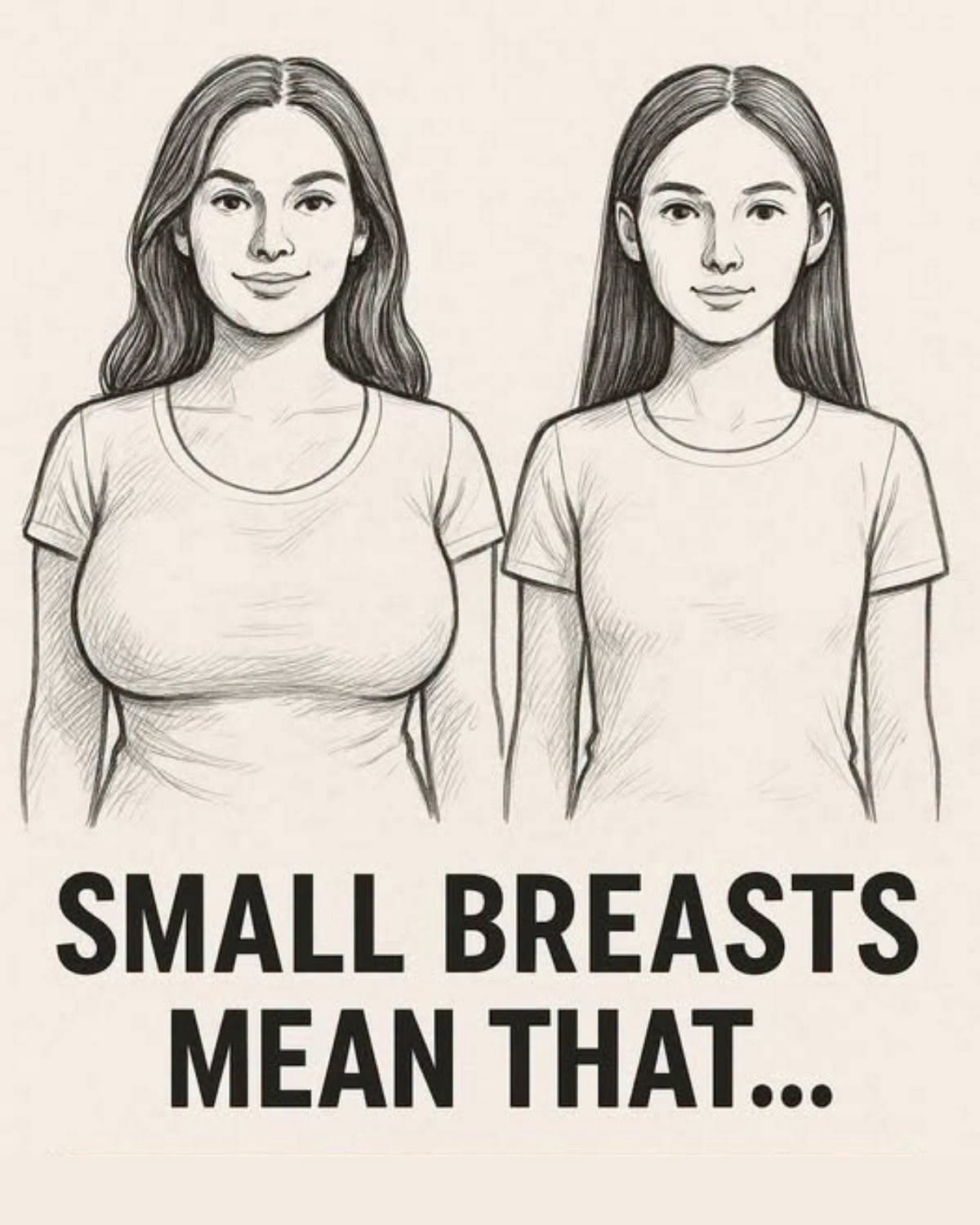
For generations, women have been surrounded by myths about their bodies.
Some are passed down through families.
Others spread through magazines, television, social media, or casual conversations between friends.
Many sound convincing because they have been repeated so often that they begin to feel like facts.
One of the most common myths claims that a woman’s breast size reveals everything about her hormones.
According to this belief, larger breasts supposedly indicate higher estrogen levels, while smaller breasts are often assumed to signal hormonal deficiencies or reduced fertility.
It is an idea that has circulated for decades.
It is also one that continues to influence how many women see themselves.
But modern medicine tells a very different story.
The truth is that breast size reveals remarkably little about a woman’s hormone levels.
Despite the confidence with which this myth is often repeated, doctors and researchers have long known that the relationship between breast size and hormones is far more complicated than popular culture suggests.
In reality, breasts are shaped by many different factors working together over an entire lifetime.
Genetics play perhaps the biggest role.
Just as genes influence height, eye color, facial features, and body shape, they also largely determine breast size and structure.
A daughter often inherits physical characteristics that resemble those of women in her family.
Hormones certainly contribute to breast development, especially during puberty, but they do not dictate the final result on their own.
Two sisters raised in the same household may have dramatically different body types despite sharing similar hormone levels.
Likewise, two women with nearly identical breast sizes may have completely different hormone profiles.
Body fat also plays a significant role.
Breasts contain both glandular tissue and fatty tissue.
The proportion of each varies from woman to woman.
Some naturally carry more fatty tissue, resulting in larger breasts even though their hormone levels remain perfectly average.
Others have denser glandular tissue with less fat, creating a smaller appearance despite equally healthy hormonal function.
This explains why breast size often changes throughout life.
Weight gain can increase breast volume.
Weight loss may reduce it.
Neither automatically reflects a major hormonal shift.
Pregnancy provides another example.
During pregnancy, hormonal changes prepare the breasts for breastfeeding.
Milk-producing glands enlarge, blood flow increases, and breast tissue expands.
After pregnancy and breastfeeding end, the breasts frequently change again.
Some women notice very little difference.
Others experience permanent changes in size or shape.
These variations are entirely normal.
Age brings additional changes.
As women grow older, estrogen levels naturally decline, especially after menopause.
Breast tissue gradually becomes less dense, while fatty tissue often increases.
The result may be breasts that feel softer, appear differently shaped, or change in volume.
Again, these are expected biological processes rather than indicators of illness.
Unfortunately, myths surrounding breast size often create unnecessary anxiety.
Many young women worry that smaller breasts mean they have hormonal problems.
Others fear larger breasts indicate unusually high estrogen levels.
Some even question their fertility or long-term health based entirely on appearance.
These concerns can become emotionally exhausting.
The reality is far more reassuring.
Doctors do not diagnose hormone disorders by looking at breast size.
Instead, they evaluate symptoms, medical history, physical examinations, and laboratory testing.
Hormone levels fluctuate naturally throughout the menstrual cycle.
A single physical characteristic cannot accurately represent this complex system.
The endocrine system regulates countless processes simultaneously.
Estrogen, progesterone, testosterone, thyroid hormones, cortisol, insulin, and many others interact constantly.
Understanding hormonal health requires much more than visual observation.
So what actually signals that hormones may deserve medical attention?
Persistent symptoms.
Irregular menstrual cycles are among the most important clues.
Periods that disappear unexpectedly, occur extremely infrequently, or become dramatically heavier or lighter than usual may indicate hormonal changes worth evaluating.
Similarly, unusually painful periods or bleeding between cycles should not simply be ignored.
Unexpected nipple discharge outside pregnancy or breastfeeding can also require medical assessment.
While many causes are harmless, evaluation helps determine whether further investigation is needed.
Excess facial hair in women, particularly when accompanied by acne or irregular periods, may suggest conditions affecting androgen levels.
Severe acne that suddenly develops in adulthood can also reflect hormonal changes.
Hot flashes occurring well before the expected age of menopause deserve attention as well.
Persistent fatigue.
Difficulty sleeping.
Rapid weight changes without explanation.
Mood shifts.
Trouble becoming pregnant despite regular attempts.
All of these may indicate underlying medical conditions affecting hormonal balance.
Importantly, none of these symptoms can be diagnosed by breast size alone.
Healthcare professionals rely on careful evaluation rather than assumptions.
Blood tests measure hormone concentrations directly.
Ultrasound imaging may examine reproductive organs.
Additional testing depends on each individual’s symptoms and medical history.
This evidence-based approach replaces guesswork with reliable information.
Another misconception involves fertility.
Many people mistakenly assume larger breasts somehow predict greater reproductive potential.
Science does not support this belief.
Fertility depends upon healthy ovulation, reproductive anatomy, sperm quality, overall health, age, and numerous additional factors.
Breast size simply does not appear on that list.
Women with every body type successfully become mothers.
Others experience fertility challenges regardless of physical appearance.
Appearance cannot predict reproductive success.
Beyond medicine, these myths also affect confidence.
Countless women spend years comparing themselves with unrealistic beauty standards or worrying that their bodies somehow reveal hidden medical problems.
Social media often amplifies these insecurities by promoting simplified explanations for extremely complex biological processes.
Quick answers attract attention.
Accurate explanations usually require more patience.
Perhaps the healthiest approach is learning what feels normal for your own body.
Become familiar with how your breasts naturally look and feel.
Many women notice small changes during different stages of the menstrual cycle.
Hormonal fluctuations can temporarily increase tenderness, fullness, or sensitivity before menstruation.
These changes typically resolve naturally.
Knowing your baseline makes it easier to recognize something genuinely new.
Regular breast self-awareness—not obsessive examination, but simple familiarity helps women notice persistent lumps, skin changes, nipple inversion, unusual discharge, or lasting discomfort that deserves medical evaluation.
When something changes significantly and remains different, speaking with a healthcare professional is always appropriate.
Early evaluation often provides reassurance.
When problems do exist, prompt assessment allows earlier treatment.
Listening to your body remains far more valuable than listening to internet myths.
Ultimately, breast size says very little about hormone levels.
It does not determine femininity.
It does not predict fertility.
It does not measure health.
It certainly does not define a woman’s worth.
Every body develops according to its own unique combination of genetics, environment, nutrition, age, and life experiences.
Those differences are entirely normal.
The next time someone confidently claims they can judge a woman’s hormones simply by looking at her body, remember how remarkably complex the human body truly is.
Hormones cannot be measured by appearance.
They cannot be guessed from cup size.
They require proper medical evaluation supported by science rather than assumptions.
The most important thing any woman can know is not whether her body resembles someone else’s.
It is understanding her own normal, paying attention to meaningful changes, and seeking professional advice whenever something feels different.
Knowledge, not myths, is what truly protects long-term health.
And when it comes to understanding the human body, facts will always be more powerful than assumptions.