The World Cup final had already delivered everything football fans could have hoped for: relentless intensity, unforgettable moments, and the emotional release that comes only after years of preparation. Spain stood at the summit of world football, celebrating a victory that would be remembered for generations, while Argentina reflected on a courageous campaign that had carried them all the way to the final.
The night was supposed to belong entirely to the players.
But as the medal ceremony unfolded, another moment unexpectedly captured public attention.
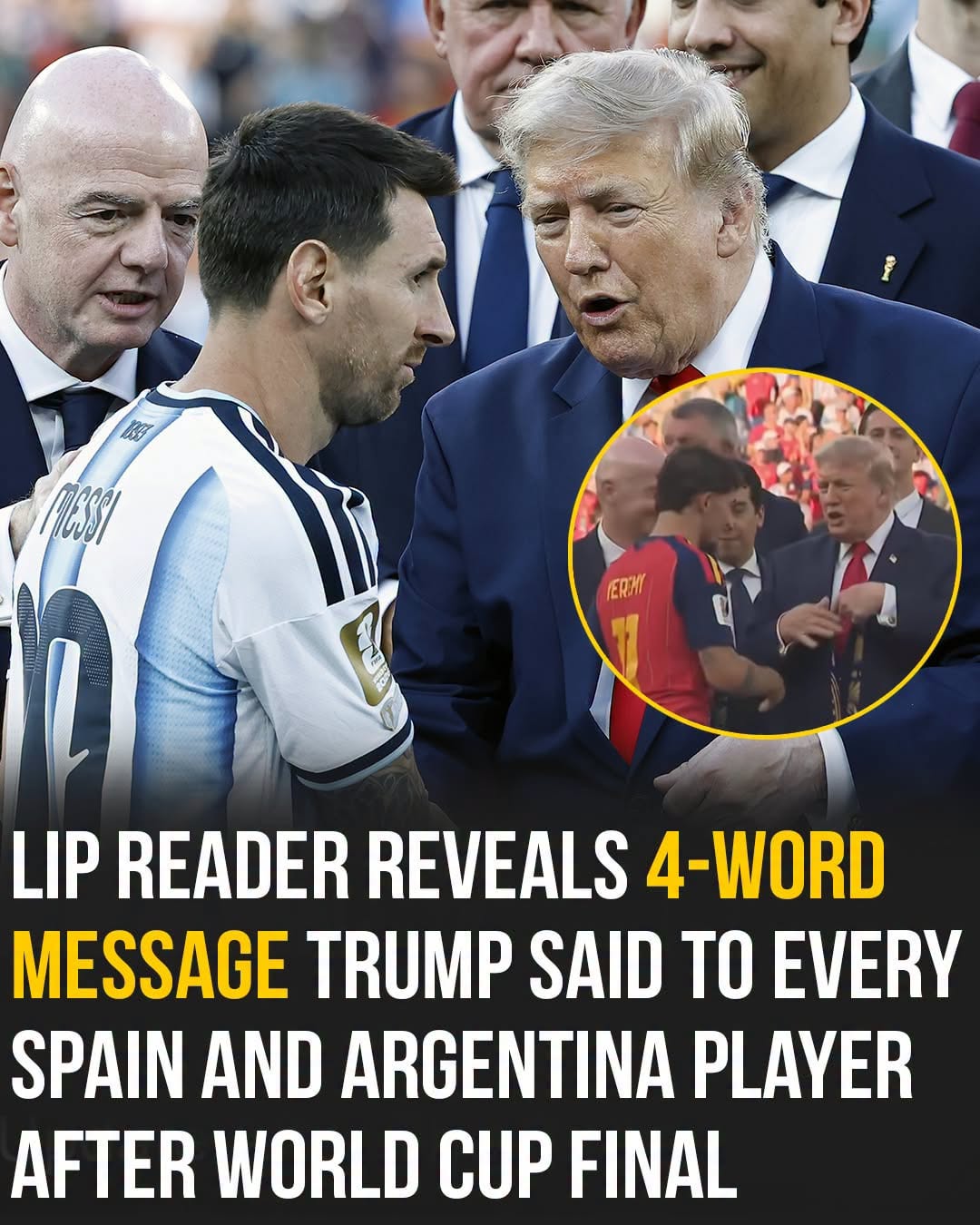
Standing alongside FIFA officials during the post-match presentation, Donald Trump became the focus of widespread online discussion after professional lip readers claimed they identified a phrase he repeated to nearly every player who stepped onto the podium.
According to those interpretations, Trump greeted each footballer with the same four simple words.
“You are a champ.”
Whether the player wore Spanish red or Argentine blue and white, the greeting reportedly remained the same.
The phrase itself was short, positive, and straightforward.
Yet because of who delivered it and the highly visible setting it quickly became one of the ceremony’s most talked-about moments.
As each athlete approached to receive a medal, television cameras captured brief interactions that lasted only seconds.
Players paused momentarily, accepted congratulations, shook hands with officials, collected their medals, and continued moving toward teammates waiting farther down the stage.
To most viewers, the exchanges appeared routine.
Only after close analysis of broadcast footage did attention shift toward the repeated greeting.
Lip readers reviewing the ceremony suggested that Trump consistently leaned toward players while saying exactly the same words.
The claim rapidly spread across social media, where millions of viewers began replaying short video clips in slow motion.
Some believed the interpretation fit naturally with what they observed.
Others questioned how accurately anyone could identify spoken words without audio confirmation.
As often happens online, certainty and skepticism quickly collided.
The discussion soon expanded beyond the four-word greeting itself.
Viewers began examining every facial expression, handshake, and reaction visible during the medal presentation.
Some players smiled politely while continuing through the line.
Others maintained neutral expressions focused on the celebration unfolding around them.
Because medal ceremonies move quickly, every interaction lasted only a brief moment.
Even so, those few seconds became the subject of countless online debates.
One exchange, in particular, attracted significant attention.
Many viewers claimed that Argentina defender Cristian Romero appeared to continue walking without fully acknowledging Trump’s extended hand.
Video clips circulated widely, with different observers reaching very different conclusions.
Some believed the moment represented an intentional snub.
Others argued that Romero simply remained focused on teammates and the ceremony itself, barely noticing the gesture amid the excitement and constant movement.
Without direct comment from those involved, interpretations remained largely speculative.
The incident nevertheless fueled hours of discussion across social media platforms.
Meanwhile, the atmosphere inside the stadium provided another layer to the evening’s conversation.
As Trump appeared on the field alongside FIFA officials, reactions from sections of the crowd became clearly audible during the television broadcast.
Some spectators applauded.
Others responded with loud boos.
The contrasting reactions briefly rose above the surrounding noise, creating one of the ceremony’s most noticeable audio moments.
Large international sporting events frequently attract political figures, celebrities, and dignitaries whose appearances generate strong reactions from audiences representing many different countries and viewpoints.
For some spectators, their presence is simply part of major global events.
For others, it inevitably introduces politics into celebrations meant to focus entirely on sport.
That tension became especially noticeable during the closing moments of the presentation.
As Spain prepared for the defining image every champion dreams about the lifting of the World Cup trophy television cameras showed numerous officials gathering near the victorious squad.
Fans watching from home paid close attention to who remained near the players as photographers assembled for the historic moment.
Several observers suggested that FIFA president Gianni Infantino appeared to encourage officials, including Trump, to step aside so the players could occupy the center of the stage.
Whether intentional or simply part of organizing dozens of people in a crowded ceremony, the movement restored the visual focus to Spain’s celebrating squad.
Within seconds, captain and teammates lifted the trophy high above their heads.
Confetti exploded.
Teammates embraced.
Years of sacrifice culminated in one unforgettable celebration.
For Spain, nothing could overshadow that achievement.
Winning the World Cup represents the highest honor in international football, earned only after navigating one of the most demanding tournaments in sport.
The players had spent years preparing for that opportunity.
Every training session, qualification match, injury setback, tactical adjustment, and emotional challenge had led to that single moment.
Argentina, despite falling short in the final, also left the tournament with enormous respect.
Reaching a World Cup final requires extraordinary consistency, resilience, and talent.
Although disappointment naturally followed defeat, players received recognition for an exceptional campaign that captivated supporters throughout the competition.
Yet modern sporting events rarely end when the final whistle blows.
Instead, conversations continue online long after medals have been awarded.
Tiny moments lasting only seconds frequently generate headlines alongside the athletic achievements themselves.
A handshake.
A smile.
A glance.
A brief exchange captured by television cameras can quickly become international news.
The reported four-word greeting attributed to Trump became exactly that kind of moment.
Some people viewed it as a simple gesture of congratulations toward elite athletes who had reached football’s biggest stage.
Others interpreted every interaction through broader political perspectives already shaping public opinion.
Still others questioned whether lip-reading interpretations should ever be treated as definitive without independent confirmation.
Ultimately, the evening belonged to football.
Spain celebrated one of the greatest accomplishments any national team can achieve.
Argentina earned admiration for an outstanding tournament.
Fans witnessed unforgettable scenes of triumph, disappointment, emotion, and sportsmanship.
The discussions surrounding the medal ceremony demonstrated how quickly public attention can shift from athletic competition to the smallest moments occurring around it.
Whether remembered for the championship itself, the medal presentations, or the conversations that followed, the ceremony illustrated the unique intersection of sport, public figures, media attention, and social media analysis.
For millions watching around the world, the trophy presentation delivered more than medals and celebrations.
It also produced a handful of brief interactions that continued generating debate long after the confetti had settled and the champions had lifted football’s greatest prize into the night sky.