The World Cup final was supposed to be remembered for football alone.
It was meant to be a night of history, emotion, and unforgettable sporting moments. One team would lift the greatest trophy in international football, while the other would be left carrying the heartbreak of coming so close.
But when the final whistle ended the match and the medal ceremony began, the conversation quickly moved beyond tactics, goals, and celebrations.
A brief moment on the podium captured global attention.
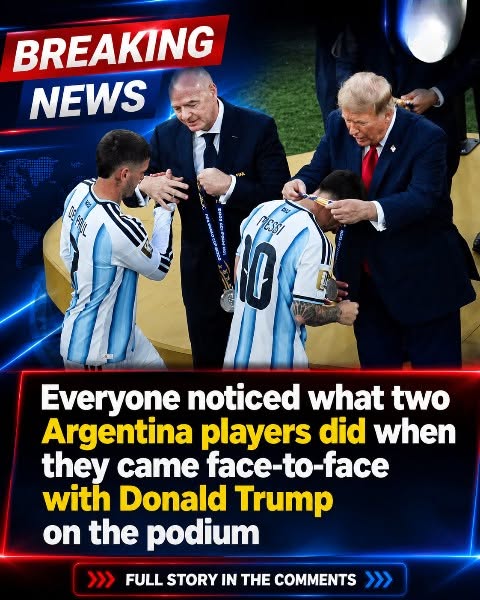
As Argentina’s players stepped forward to receive their silver medals, cameras followed every movement. In those few seconds, several interactions appeared to reveal the intense emotions surrounding a night that had already carried enormous pressure.
Among the moments that sparked discussion was the reaction of Argentina defenders Lisandro Martínez and Cristian Romero when they approached Donald Trump, who was standing among officials during the ceremony.
According to widely shared footage and online interpretations, both players appeared to avoid a direct handshake with the former U.S. president, instead acknowledging other figures nearby, including Mexican president Claudia Sheinbaum and Canadian prime minister Mark Carney.
The gesture lasted only a moment.
There were no public statements from the players explaining their actions.
But because it happened on one of the biggest stages in world sport, the brief exchange immediately became a topic of intense debate.
Some viewers interpreted the moment as a deliberate political statement.
Others argued it was simply a quick movement during a crowded ceremony where players were focused on receiving medals, moving through the line, and processing the disappointment of losing a World Cup final.
Regardless of the intention, the images spread rapidly.
Within minutes, social media users were analyzing every expression, every handshake, and every step taken on the podium.
The controversy became another layer added to an already emotional evening for Argentina.
For the players, the ceremony was not just a formal presentation.
It was the final chapter of a tournament filled with pressure, expectation, and the weight of representing an entire nation.
Argentina had entered the competition with hopes of achieving football immortality.
The possibility of lifting the trophy had carried special meaning for supporters and players alike, especially with Lionel Messi approaching what many believed could be his final World Cup appearance.
For much of the tournament, Argentina’s campaign had been built around resilience.
The team had overcome difficult moments, responded to criticism, and fought through intense matches to reach the final stage.
Every player understood what was at stake.
That made the defeat even harder to accept.
As the medal ceremony unfolded, the disappointment was visible.
The smiles expected from a traditional awards presentation were replaced by serious expressions, lowered heads, and emotional reactions from players who knew how close they had been to achieving their dream.
The frustration did not end when the match ended.
During the game, tensions had already reached a boiling point.
Several heated moments between players from both sides created a fierce atmosphere on the pitch.
Argentina players struggled to contain their emotions as the final result slipped away.
Leandro Paredes became involved in a tense confrontation after a challenge involving Spain’s Gavi, with the situation quickly escalating as teammates from both sides rushed toward the scene.
Later, another moment involving Nahuel Molina and a member of Spain’s celebrating group added to the feeling that emotions were running dangerously high.
For Argentina, the loss represented more than a single defeat.
It represented the end of a journey that many believed had been built around one final opportunity.
Lionel Messi, the player who had carried the hopes of millions for more than a decade, stood at the center of that emotional storm.
After the final whistle, cameras captured the legendary forward visibly affected by the result.
For years, Messi had faced questions about whether he could deliver the World Cup trophy that had escaped him throughout much of his career.
When he finally lifted the trophy in a previous triumph, it completed one of football’s greatest unfinished stories.
Now, another painful ending brought new emotions.
The image of Messi standing quietly, absorbing the atmosphere around him, became one of the defining pictures of the night.
Fans around the world understood the significance.
Few athletes have carried as much expectation as Messi.
Every tournament, every match, and every performance had been judged against the impossible standard of winning the World Cup.
For Argentina coach Lionel Scaloni, the defeat also brought uncertainty.
The manager, who had guided the national team through one of its most successful periods, struggled to hide his emotions after the match.
Reports of his visible distress fueled speculation about his future.
After years of pressure and responsibility, questions emerged about whether he would continue leading the team or step away from the role.
Scaloni had transformed Argentina into a disciplined, confident side capable of competing against the strongest teams in the world.
Under his leadership, the team developed a strong identity built on unity and determination.
But even the most successful eras eventually reach moments of reflection.
The aftermath of the final created a complicated picture of Argentina’s future.
There was heartbreak.
There was uncertainty.
There were questions about leadership, aging stars, and the next generation of players who would eventually inherit the responsibility of representing the country.
At the same time, the team’s achievements could not be ignored.
Reaching a World Cup final is an extraordinary accomplishment.
Only a handful of nations in every generation experience that opportunity.
Argentina’s players had fought through immense pressure and created memories that would remain part of football history.
Yet the podium incident involving Trump showed something larger about modern sport.
Major sporting events no longer exist in isolation.
They are watched through political, cultural, and social lenses.
A handshake or the absence of one can become a worldwide discussion.
A facial expression can become a headline.
A few seconds on camera can create conversations that continue long after the trophy has been lifted.
In the end, Argentina’s World Cup story became about more than the result.
It was about ambition, disappointment, emotion, and the complicated relationship between sport and the wider world.
The final may have produced a champion on the field, but the moments afterward revealed the human side of competition.
Behind every medal is a story.
Behind every celebration is a sacrifice.
And behind every defeat are players trying to process what they lost while the entire world watches.