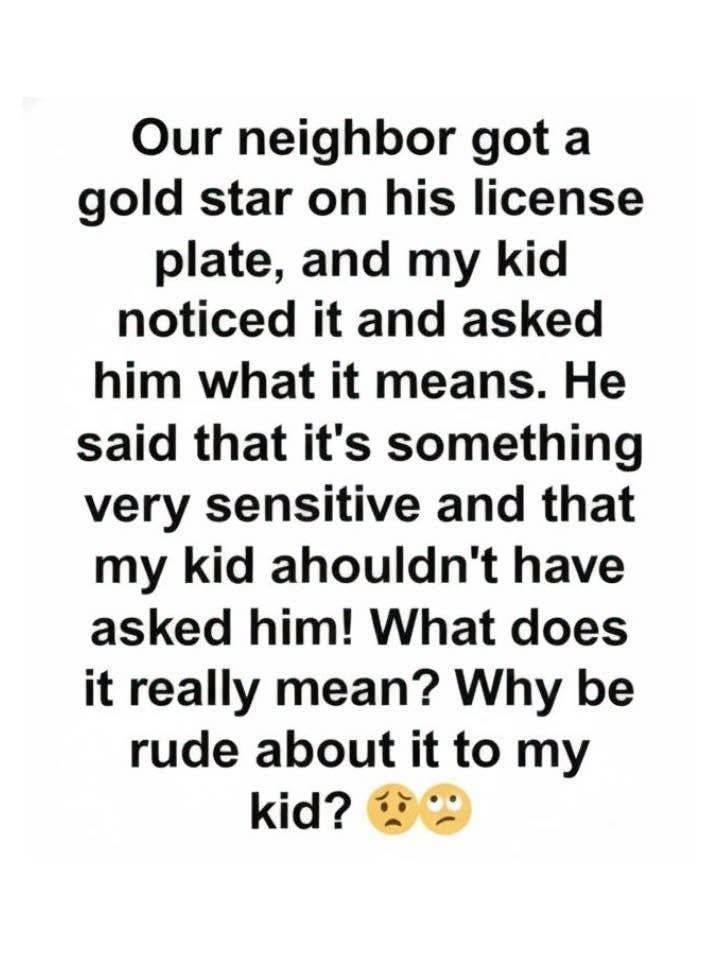
At first glance, a license plate may seem like nothing more than a simple piece of metal attached to the back of a vehicle.
It identifies a car.
It follows state regulations.
It helps authorities keep track of vehicles on the road.
But some license plates carry a meaning far greater than identification.
Gold Star license plates are among the most powerful examples.
To many drivers, they may appear to be just another special plate design. But behind the small symbol is a story of sacrifice, loss, courage, and remembrance that stretches back more than a century.
These plates are not simply decorations.
They are moving memorials.
They represent families whose lives were forever changed by the loss of a loved one who died while serving the United States military.
The story begins during one of the most difficult periods in American history.
During World War I, millions of Americans were sent overseas to serve in a conflict that affected families across the country. For those waiting at home, uncertainty became part of everyday life.
Parents worried about their sons and daughters.
Spouses waited for letters.
Children hoped their loved ones would return safely.
To show their connection to those serving, families began displaying Blue Star Service Banners in their windows.
The banners featured a blue star representing a family member actively serving in the military.
For many households, that blue star became a symbol of hope.
It told neighbors that someone from that home was away protecting the country.
It represented pride, courage, and the belief that their loved one would eventually walk back through the front door.
But for some families, that hope was shattered.
When a service member died, the blue star was replaced with a gold star.
The change was small, but the meaning was enormous.
The symbol transformed from one of anticipation into one of mourning.
A gold star announced a sacrifice that could never be undone.
It told the community that a family had paid the highest possible price.
The tradition became a way for grieving families to honor their loved ones while also showing the nation the human cost of war.
In 1917, President Woodrow Wilson formally recognized the significance of the gold star.
The symbol became connected with national remembrance, and bereaved mothers were permitted to wear black armbands featuring a gold star as a visible sign of their loss.
These mothers carried not only personal grief but also the weight of representing countless families who had experienced the same heartbreak.
The gold star became more than a symbol.
It became a promise that those who gave their lives would not be forgotten.
As years passed, families of fallen service members sought ways to support one another.
They understood a unique kind of grief that was difficult for others to fully comprehend.
Friends and neighbors could offer sympathy, but only those who experienced such loss themselves truly understood the emptiness left behind.
That need for connection led to the creation of organizations dedicated to supporting Gold Star families.
One of the most recognized groups, American Gold Star Mothers, Inc., was founded in 1928.
The organization provided comfort, community, and a place where mothers who had lost children in military service could stand together.
Their mission was not only to remember the fallen but also to serve communities and ensure that sacrifice was never overlooked.
Over time, the meaning of the Gold Star expanded.
It came to represent parents, spouses, children, siblings, and other relatives who lost someone in military service.
The grief belonged to entire families.
The sacrifice belonged to the entire nation.
Today, Gold Star license plates continue this tradition of remembrance.
Available in many states, these special plates allow eligible family members to publicly honor their fallen loved ones.
Unlike ordinary vehicle tags, they carry a message that cannot be seen simply through numbers and letters.
They quietly tell a story.
A driver passing a vehicle with a Gold Star plate may never know the name of the person being honored.
They may never know where that person served.
They may never know the dreams, personality, or life that ended too soon.
But the symbol offers a reminder.
Behind every military casualty statistic is a real person.
Someone with a family.
Someone with friends.
Someone whose absence continues to be felt.
For the families who display these plates, they are deeply personal.
Some see them as a tribute.
Some see them as a way to keep memories alive.
Some see them as a small gesture of respect toward someone who gave everything.
The plate does not erase the pain.
It does not replace the person who was lost.
But it allows their memory to remain visible.
In a world where many stories quickly disappear, the Gold Star symbol ensures that certain sacrifices remain present.
It reminds strangers on highways, in parking lots, and at traffic lights that freedom often comes with a cost carried by real families.
The power of these plates comes from their quiet nature.
They do not demand attention.
They do not tell a long story.
They simply exist.
A small symbol on a vehicle can communicate decades of history, love, and loss.
It represents a parent who never stopped missing a child.
A spouse who continued living with an empty space beside them.
A sibling who remembers a brother or sister who never came home.
A family that chose remembrance over silence.
In many ways, Gold Star license plates are modern versions of those early banners placed in windows during wartime.
The location has changed.
The symbol has evolved.
But the message remains the same.
We remember.
We honor.
We will not forget.
The next time you see a Gold Star license plate on the road, it is worth taking a moment to recognize what it represents.
It is not just a special plate.
It is a piece of history traveling through everyday life.
It carries the memory of someone who made the ultimate sacrifice and the story of the family that continues to carry their name, their love, and their legacy forward.
Some symbols are small because they do not need to be loud.
The gold star is one of them.
Its meaning speaks for itself.