Every so often, a phrase appears online that seems to stop people in their tracks.
Some react with curiosity.
Others respond with confusion.
Many immediately assume they know what it means before taking a closer look.
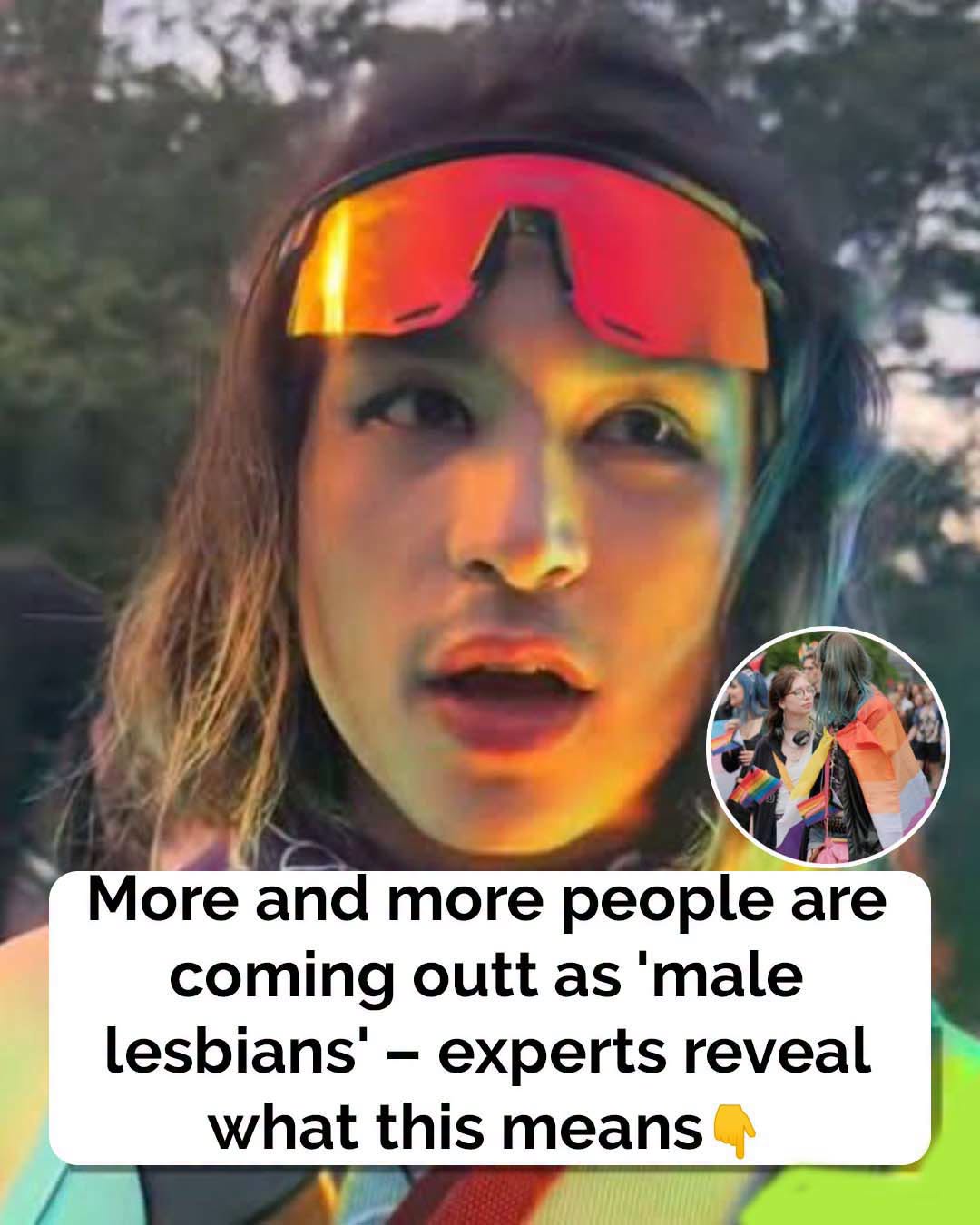
Recently, one expression has sparked exactly that kind of conversation across social media: “male lesbian.”
At first glance, the words seem contradictory.
For many people, the phrase appears impossible to reconcile with the traditional definitions of gender and sexual orientation they have always understood.
As a result, discussions quickly become heated.
Posts go viral.
Comment sections fill with arguments.
People take sides before anyone pauses to ask a simple question:
What does the term actually mean?
The answer is far more nuanced than many online debates suggest.
Rather than representing a brand-new sexual orientation, the phrase is most often used by a relatively small number of people whose personal histories, gender identities, and long-standing connections to lesbian communities cannot easily be captured by a single traditional label.
For some transgender men, transmasculine people, and certain non-binary individuals, the lesbian community was their home long before they publicly embraced or understood their gender identity.
Many spent years building friendships, relationships, support networks, and a sense of belonging within lesbian spaces.
Those experiences often shaped who they became.
When their understanding of their gender later evolved, their connection to those communities did not simply disappear overnight.
For these individuals, identity is not experienced as pressing a reset button.
Life continues.
Relationships remain.
History matters.
Some therefore continue using language connected to lesbian identity because it reflects an important part of their personal story rather than attempting to redefine everyone else’s.
This is why many people describe the phrase as deeply personal rather than universally applicable.
It is not a label that every transgender man uses.
In fact, many do not identify with it at all.
Likewise, many lesbians do not believe the term should be used outside of women or certain non-binary identities.
Within LGBTQ+ communities themselves, opinions vary considerably.
Some embrace the complexity.
Others disagree with the terminology.
The conversations are ongoing, thoughtful, and often rooted in decades of community history rather than the quick exchanges commonly seen online.
That history is important.
For generations, LGBTQ+ communities developed language not only to describe attraction but also to describe shared experiences, political movements, chosen families, and spaces where people found acceptance during times when society offered very little.
Words sometimes carried emotional meaning beyond dictionary definitions.
Someone’s identity often reflected where they had lived, whom they had loved, and which communities had supported them through difficult periods of life.
Because of this, changing gender identity did not always erase previous community connections.
For some individuals, continuing to use familiar language became a way of honoring that journey rather than rejecting who they had become.
Unfortunately, conversations on social media rarely leave room for that level of context.
Complex discussions are frequently reduced to short posts, headlines, and viral clips.
Nuance disappears.
People encounter a phrase without any background information and immediately interpret it through their own assumptions.
Algorithms often reward emotional reactions.
The more surprising or controversial something sounds, the more likely it is to spread.
As a result, discussions about identity often become less about understanding and more about winning arguments.
One side insists the phrase makes no sense.
Another accuses critics of refusing to understand lived experiences.
Meanwhile, the people whose personal identities inspired the discussion are often left trying to explain something that cannot easily fit into a few sentences.
Researchers who study gender and sexuality frequently point out that identity has always been more complicated than many people assume.
Language changes over time.
Communities develop new ways to describe experiences.
Older terms sometimes remain meaningful even after personal circumstances change.
That does not mean every new label will be universally accepted.
Nor does it mean everyone must adopt or personally identify with unfamiliar terminology.
It simply reflects the reality that human identity is often more layered than simple categories suggest.
Experts generally recommend approaching unfamiliar identity labels with curiosity rather than immediate judgment.
Instead of assuming a definition based solely on the words themselves, it can be more helpful to recognize that self-descriptions often carry personal histories that outsiders cannot immediately see.
For one individual, a particular label may represent years of friendships, relationships, activism, and emotional support.
For another person, that same label may feel entirely inappropriate.
Both experiences can exist simultaneously.
That is one reason why many specialists encourage treating phrases like “male lesbian” primarily as individual self-descriptions rather than broad categories meant to redefine established concepts for everyone.
In practice, the phrase is relatively uncommon.
Despite the enormous attention it has received online, only a small number of people actually identify this way.
Its visibility on social media can make it seem far more widespread than it truly is.
Viral discussions often magnify rare topics because unusual stories naturally attract attention.
The result is a cycle where millions of people debate a term used by relatively few individuals.
Yet the discussion itself highlights something larger than any single phrase.
It reveals how quickly conversations about identity become simplified in today’s digital world.
Real lives rarely fit neatly into headlines.
People carry memories, communities, relationships, and experiences that shape how they understand themselves.
Those stories cannot always be summarized by a single word.
Whether someone agrees with a particular label or finds it unfamiliar, understanding where it comes from often leads to a more productive conversation than reacting to the words alone.
Identity is rarely created in isolation.
It grows from family, friendships, culture, community, personal discovery, and years of lived experience.
Sometimes that journey follows a straightforward path.
Sometimes it does not.
In the end, the phrase “male lesbian” is less about changing the meaning of established identities than it is about illustrating how complicated human lives can be.
Behind every unfamiliar label is usually a personal story that stretches far beyond a viral headline.
And while social media often encourages immediate conclusions, the deeper lesson may be much simpler.
Not every identity can be reduced to a single definition.
Sometimes understanding begins not with certainty, but with the willingness to listen before deciding what someone else’s words are supposed to mean.