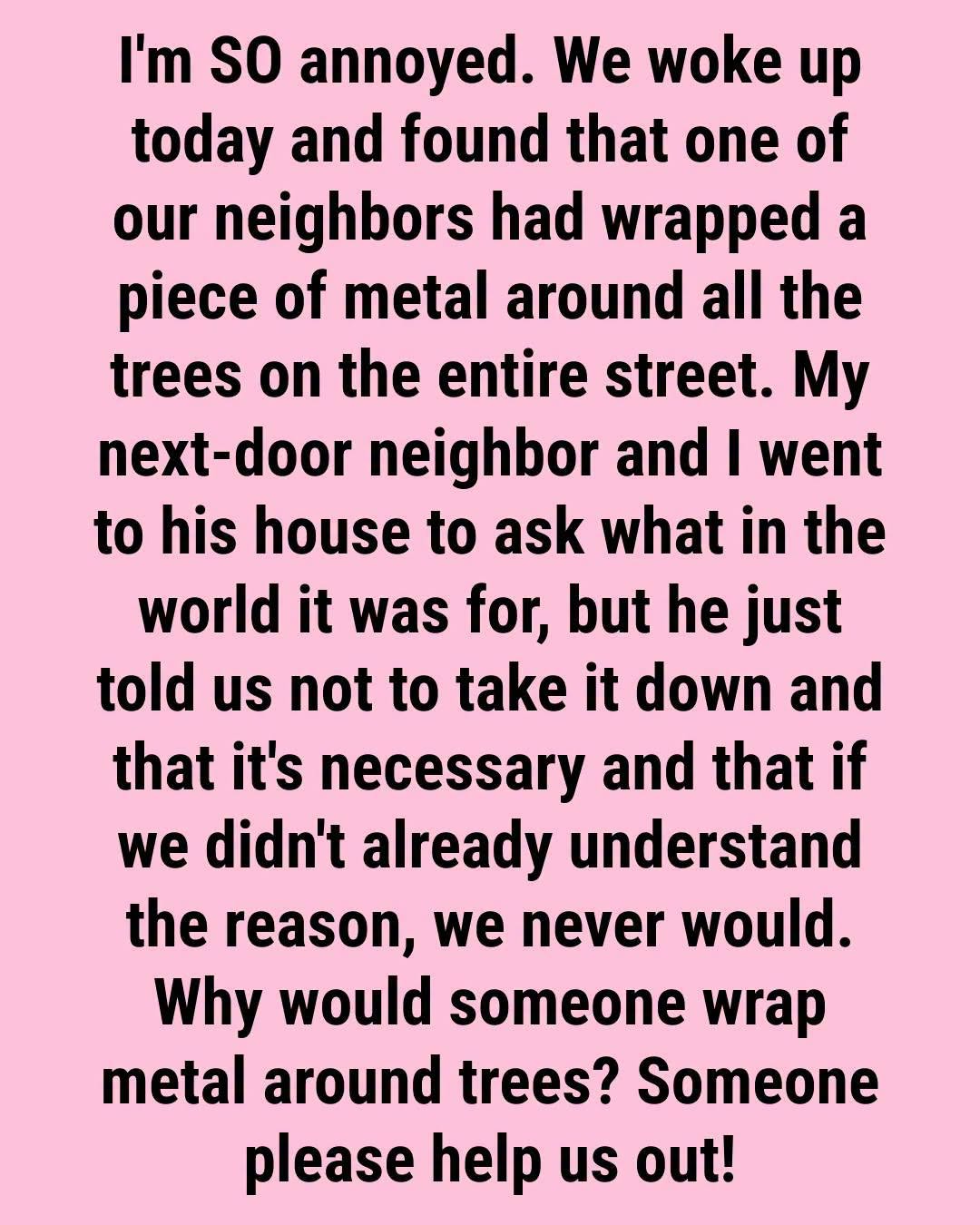
It catches your eye almost immediately.
You’re walking through a neighborhood, a city park, or even your own backyard when you notice something unusual wrapped around the trunk of a tree. Sometimes it’s a shiny sheet of metal. Other times it’s painted to blend into the bark. Occasionally it looks like a cone, while other versions resemble a simple silver band hugging the tree just above the ground.
At first glance, it can seem unsettling.
Is the tree injured?
Has lightning struck it?
Is it recovering from disease?
Has someone installed some kind of strange support brace?
Many people imagine the metal is protecting a damaged tree or covering a wound hidden beneath its surface.
The truth is far simpler—and surprisingly clever.
That strip of metal isn’t there for the tree itself.
It’s there to stop unwanted visitors from climbing it.
What appears to be an odd piece of hardware is actually one of the oldest and most effective ways to keep certain animals from reaching the branches above.
Think about how squirrels move.
They rely on rough bark to dig in their tiny claws and launch themselves upward with incredible speed. Raccoons, rats, possums, and other agile climbers use the same natural texture to scale tree trunks in search of food, nests, or an easy route onto rooftops.
Remove that grip, and everything changes.
The smooth metal creates a surface that most climbing animals simply cannot hold onto.
Their claws slide instead of digging in.
Their bodies lose traction.
Instead of racing upward, they slip back toward the ground.
It is not painful.
It is not dangerous.
It simply creates a barrier that says, “This path is closed.”
The idea is brilliantly simple.
Rather than trapping or harming wildlife, homeowners and property managers use basic physics to redirect it.
The animals look elsewhere.
The tree remains unharmed.
The surrounding property gains an extra layer of protection.
This matters more than many people realize.
Trees often serve as natural highways connecting wildlife to homes.
A squirrel may climb a trunk, leap onto a branch, and then jump directly onto a roof.
Once there, it may find loose shingles, vents, chimneys, or tiny openings leading into an attic.
Raccoons can be even more destructive.
Strong enough to tear apart vents or damaged roofing, they often create expensive repairs while searching for warm nesting places.
Rodents can chew through insulation, electrical wiring, and stored belongings.
Birds may also use nearby branches as convenient launching points.
By preventing easy access to the tree, people often eliminate the simplest route into their homes.
The barrier protects both the property and the animals.
Instead of ending up trapped inside an attic or chimney, wildlife simply moves elsewhere.
That is one reason these guards have become so popular.
You will often see them around fruit trees as well.
Growing apples, pears, peaches, or other fruit can attract hungry visitors long before people have a chance to harvest them.
Squirrels may strip branches.
Rats may feast at night.
Raccoons are famous for raiding orchards once fruit begins ripening.
Installing a smooth metal guard dramatically reduces how easily many of these animals can reach the harvest.
Gardeners appreciate the extra protection without relying on chemicals or more aggressive methods.
The metal itself comes in several designs.
Some are simple cylinders wrapped loosely around the trunk.
Others flare outward into cone-shaped guards that make climbing even more difficult.
Many are made from aluminum because it resists rust while remaining lightweight.
Galvanized steel is another popular option due to its durability.
Some homeowners paint the metal brown or green so it blends naturally into the landscape.
Others leave it shiny, where sunlight reflects brightly throughout the day.
Regardless of appearance, the purpose remains the same.
Create a surface that climbing animals cannot easily conquer.
Installing one correctly is important.
The guard should not squeeze tightly against the bark.
Trees continue growing year after year, gradually increasing in diameter.
A tight wrap could eventually damage the trunk.
Instead, installers leave enough space for future growth while making sure animals cannot slip behind the barrier.
The height matters too.
If the metal begins too low, animals may simply jump onto it.
If it is too short, agile climbers might leap over it after gaining momentum.
Proper placement makes the system far more effective.
Interestingly, these guards can protect trees as well.
Young trees are especially vulnerable to gnawing by rabbits, rodents, and other small animals that feed on bark during colder months.
Wrapping the lower trunk helps prevent this damage while still allowing the tree to breathe and grow naturally.
In that sense, the barrier protects both the tree and everything around it.
Many people only notice these metal wraps after learning what they are.
Once you understand their purpose, they suddenly seem to appear everywhere.
City parks.
Botanical gardens.
Neighborhood sidewalks.
Private backyards.
Commercial landscaping.
What once looked mysterious becomes completely understandable.
The same transformation happens with many everyday objects.
There are countless tools and designs hidden in plain sight that most people overlook because they blend into the background of daily life.
Until someone explains them.
Then they become impossible to ignore.
The metal around a tree is one of those quiet inventions.
It does not require electricity.
It has no moving parts.
It makes no noise.
Yet it solves a surprisingly common problem using nothing more than a smooth surface and a basic understanding of animal behavior.
Perhaps that is why it feels so satisfying to learn its purpose.
The explanation replaces mystery with appreciation.
Instead of imagining an injured tree wrapped in protective armor, you begin seeing thoughtful planning.
Someone noticed a problem.
Someone found a simple solution.
And that solution quietly continues working every day without demanding attention.
The next time you pass a tree wearing what looks like a silver belt or metal collar, you will probably smile.
What once seemed strange now tells a completely different story.
The tree is not sick.
It is not broken.
It is not being repaired.
It is simply protected.
That ordinary strip of metal is a silent guardian, keeping curious climbers on the ground while allowing the tree to continue growing peacefully toward the sky.
Sometimes the most fascinating discoveries are not hidden at all.
They have been standing right beside us the entire time, waiting for someone to explain what we were really looking at.