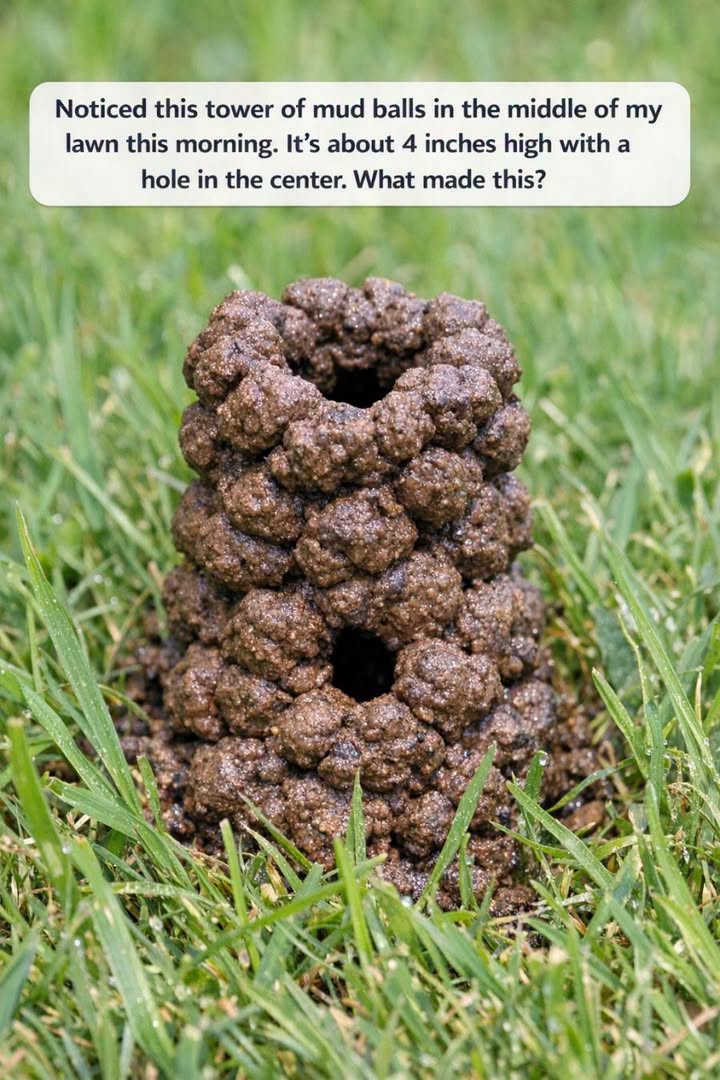
You step outside early in the morning, coffee in hand, expecting to see the same lawn you’ve walked across hundreds of times. Instead, something immediately catches your eye. Rising from the grass is a curious little tower made entirely of small balls of mud. It’s only a few inches tall, perhaps four inches at most, but it looks surprisingly deliberate. At the top sits a perfectly round hole, as though someone carefully sculpted it overnight.
Your first thought might be that insects built it.
Maybe worms.
Perhaps a mole pushed dirt upward.
Some people even wonder if snakes, frogs, or mysterious underground creatures are responsible. The structure looks almost too organized to have appeared naturally.
The truth, however, is far more fascinating than most people expect.
That unusual chimney is almost certainly the work of a terrestrial crayfish.
Although many people associate crayfish with streams, rivers, lakes, and crawfish boils, several species spend much of their lives underground. They rarely reveal themselves during the day, making them one of the least noticed residents of suburban neighborhoods, farms, parks, and rural properties.
Most homeowners never realize they are sharing their yard with these remarkable little engineers until one morning they discover a strange mud tower standing where there was nothing the day before.
The chimney is actually the entrance to an elaborate underground home.
Beneath that small opening lies a tunnel that may stretch several feet below the surface. Depending on the soil and groundwater level, some burrows descend even deeper until they reach consistently moist earth.
The crayfish builds this home one tiny scoop at a time.
Using its powerful claws, it digs through the soil, carrying damp mud to the surface. Rather than scattering the excavated material randomly around the entrance, it stacks small pellets into a cylindrical chimney that gradually grows taller with every trip.
The result looks almost like a miniature castle tower.
Scientists believe these chimneys serve several important purposes.
One function is drainage.
Heavy rain can flood underground burrows, but the raised entrance helps reduce the amount of surface water flowing directly into the tunnel.
The chimney may also improve airflow.
Fresh oxygen can move through the opening more efficiently, helping the crayfish breathe while it spends long periods underground.
Another advantage is protection.
The elevated entrance makes it more difficult for loose soil to collapse back into the tunnel, preserving the burrow’s structure after storms or foot traffic nearby.
For the crayfish, this isn’t simply a hole.
It’s a carefully engineered shelter.
Inside, conditions remain cool, humid, and relatively stable throughout changing weather. The underground chamber provides protection from birds, raccoons, foxes, snakes, and other predators that would quickly seize an exposed crayfish.
It also offers a safe place for molting.
As crayfish grow, they must periodically shed their hard outer shell. During this process they become extremely vulnerable because their new shell remains soft for several days.
Remaining hidden underground greatly increases their chances of survival.
Female crayfish may also use these burrows to protect their eggs and young.
While many aquatic crayfish live almost entirely in water, terrestrial species have adapted remarkably well to life beneath damp soil.
That is why they often appear in places people least expect.
You don’t necessarily need a pond.
You don’t need a creek.
You don’t even need visible standing water.
All they require is soil that remains moist enough to prevent their delicate gills from drying out.
Lawns with clay-rich soil, low-lying areas, drainage swales, woodland edges, and properties with naturally high groundwater are especially attractive.
A healthy layer of organic material also provides food.
Crayfish are opportunistic feeders.
They consume decaying leaves, small roots, fungi, insects, worms, and other organic matter they encounter underground.
Rather than harming healthy landscapes, they usually play a beneficial role in maintaining soil ecosystems.
Every tunnel they dig helps loosen compacted ground.
As the crayfish excavates deeper layers, air begins reaching soil that previously received little oxygen.
Rainwater can penetrate more effectively instead of running across the surface.
Roots often benefit from these improved pathways, while microorganisms flourish in better-aerated soil.
In many ways, crayfish perform functions similar to earthworms.
Both creatures naturally improve soil structure through their daily activities.
This is why discovering one or two mud chimneys often indicates that your lawn supports a healthy underground ecosystem.
Nature is quietly working beneath your feet.
Of course, not every homeowner welcomes these unexpected visitors.
The towers can appear suddenly after heavy rainfall, sometimes creating uneven patches across carefully maintained lawns.
Large numbers of burrows may become inconvenient in athletic fields, golf courses, or frequently walked areas where someone could twist an ankle on uneven ground.
Fortunately, serious infestations are relatively uncommon.
Most properties contain only a handful of active burrows.
If the chimneys bother you aesthetically, gently flattening them usually causes little harm to the crayfish below.
The animal often rebuilds the structure during the following night if it remains active.
If numerous chimneys appear repeatedly, improving drainage can make the area less attractive.
Redirecting standing water, correcting irrigation issues, or reducing constantly saturated soil often encourages crayfish to relocate naturally over time.
Chemical control is rarely necessary and generally discouraged because it may harm beneficial organisms while offering only temporary results.
The goal should usually be coexistence rather than elimination.
Many wildlife experts encourage homeowners to appreciate these unusual neighbors instead of viewing them as pests.
Their presence reminds us that even familiar suburban landscapes contain hidden worlds most people never notice.
Beneath every lawn lies an entire community of living organisms constantly shaping the environment.
Earthworms recycle nutrients.
Beetles break down organic matter.
Fungi connect plant roots.
Microbes support healthy soil.
And quietly, almost invisibly, crayfish continue constructing their underground fortresses one tiny mud pellet at a time.
Most of their work happens while everyone else sleeps.
As darkness settles over the neighborhood, the crayfish cautiously emerges from its burrow entrance. It gathers fresh mud, repairs damaged sections of the chimney, searches for food, and retreats underground before sunrise.
By morning, homeowners discover another mysterious tower seemingly built out of nowhere.
What looks strange at first is actually evidence of remarkable engineering.
Long before humans developed drainage systems, ventilation shafts, and underground shelters, these small crustaceans had already perfected many of the same ideas using nothing more than instinct, claws, and damp soil.
So the next time you notice a tiny mud chimney standing proudly in your yard, pause before knocking it over.
Beneath that small opening lives one of nature’s most overlooked architects.
Its quiet construction project may not win awards for landscaping, but it represents millions of years of evolution solving the challenges of survival beneath the surface.
Sometimes the most extraordinary discoveries aren’t found in distant forests or deep oceans.
Sometimes they’re waiting just a few inches below your own lawn, hidden beneath a small tower of mud that appeared while the world was asleep.