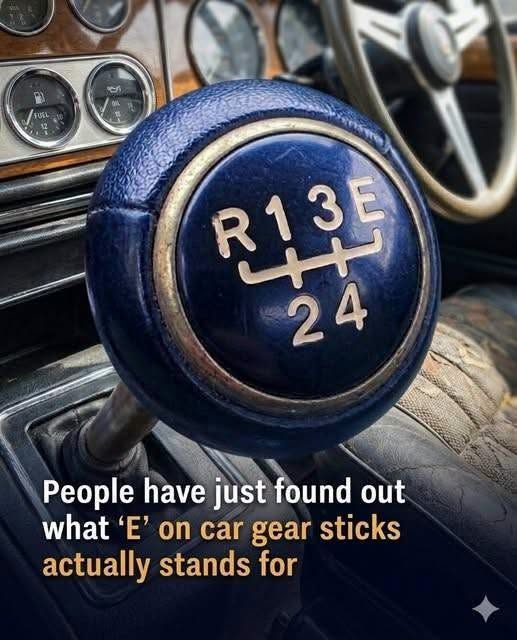
For many drivers who grew up with older vehicles, the gear shifter was a familiar part of everyday life. The letters and numbers lined up on the console seemed simple enough: Park, Reverse, Neutral, Drive, and sometimes something unexpected sitting quietly beside them.
An “E.”
To younger drivers, that small letter might look like a mystery from another era. Why would a car need an extra setting? What did it actually do? Was it for emergencies, special conditions, or something completely different?
The truth is that the “E” represented a major shift in automotive thinking. It was a small symbol that appeared during a time when drivers were beginning to care more about fuel economy, smoother driving, and getting more distance from every drop of gasoline.
The letter stood for a driving philosophy that feels surprisingly modern today: using less energy without sacrificing comfort.
When drivers moved the shifter into “E,” they were choosing economy mode. The car changed its behavior, not by adding power, but by becoming more intelligent about how it used the power it already had.
Instead of holding gears longer and allowing the engine to climb to higher revolutions per minute, the transmission would shift earlier. The goal was simple: keep the engine working efficiently and avoid unnecessary fuel consumption.
For many drivers, the difference was noticeable almost immediately.
The engine sounded calmer.
The acceleration felt smoother.
The vehicle seemed less eager to race forward and more focused on steady movement.
The car was essentially saying, “There is no need to work harder than necessary.”
During the decades when fuel prices became a major concern for millions of drivers, that small adjustment mattered. Every extra mile per gallon could save money over time, especially for families who depended on their vehicles for daily commuting, long trips, and work.
The “E” setting gave drivers a choice. They could enjoy the stronger acceleration and higher-revving performance of normal driving, or they could prioritize efficiency and make their fuel last longer.
It was not just a mechanical feature. It became a symbol of changing priorities.
For much of automotive history, cars were marketed around power.
Bigger engines.
Faster acceleration.
More horsepower.
A vehicle’s identity was often connected to how much strength it could produce.
But as fuel costs increased and environmental concerns became more important, manufacturers started exploring ways to make vehicles smarter rather than simply stronger.
The economy setting was one of those early steps.
Long before modern vehicles displayed fuel-saving statistics, automatically adjusted driving modes, or offered detailed efficiency reports, the “E” gave drivers direct control over a vehicle’s personality.
It was a simple solution in a complicated world.
The technology behind it was based on the automatic transmission’s ability to change when gears shifted. In regular driving modes, transmissions often allowed engines to build more power before shifting. This could create quicker acceleration but also used more fuel.
Economy mode changed those habits.
The transmission shifted earlier, reducing engine workload and keeping the vehicle operating at lower speeds whenever possible.
The tradeoff was that the car might feel less responsive when pressing the accelerator. Drivers looking for quick bursts of power would notice the difference. But for everyday commuting, highway driving, and relaxed trips, many people appreciated the smoother experience.
The “E” setting quietly encouraged a different relationship between driver and machine.
Instead of asking, “How much performance can I get?”
It asked:
“How efficiently can I get where I need to go?”
Over time, however, the letter began disappearing from dashboards.
As automotive technology advanced, manufacturers started replacing physical switches and labeled gear positions with electronic systems. The functions remained, but they moved behind computer controls.
Modern cars often use names like:
Eco Mode.
Smart Drive.
Efficiency Mode.
Fuel Saver.
Driving Assist.
The idea survived, even if the letter did not.
Today, drivers may press a button or select a menu option without realizing they are using the same concept that once appeared openly on older gear selectors.
The computer simply took over the decision-making process.
Sensors now monitor driving habits, road conditions, throttle input, and engine performance. Instead of relying on the driver to choose economy mode manually, newer vehicles can automatically adjust their behavior to maximize efficiency.
The disappearance of the “E” reflects a broader change in the automotive world.
Cars have become less mechanical and more digital.
Where older drivers interacted directly with transmissions, modern drivers often interact with software.
A physical lever has become a touchscreen option.
A simple letter has become a complex algorithm.
Yet the goal remains the same.
Use energy wisely.
The story of the “E” becomes even more interesting when looking at today’s electric vehicles.
In many electric cars, the letter has returned in a completely new context.
Instead of representing a traditional fuel-saving transmission mode, “E” often connects to ideas like electric power, energy management, and efficiency.
Electric vehicles have taken the original philosophy of economy driving and pushed it further.
Rather than simply using gasoline more efficiently, they focus on recovering energy, extending range, and reducing waste.
Features like regenerative braking capture energy that would normally disappear during slowing and send it back into the battery.
The same basic idea that once influenced older gasoline vehicles now shapes the future of transportation.
A tiny letter on a gear selector became part of a much bigger story.
It represented a moment when drivers began thinking differently about movement. A car was no longer only a machine built for speed and power. It became a tool that could be adjusted, optimized, and used more thoughtfully.
For people who remember those older vehicles, the “E” may bring back memories of simpler dashboards and mechanical controls. For younger generations, it serves as a reminder that many modern innovations did not appear overnight.
They evolved from ideas that began decades earlier.
That small letter carried a message that still matters today.
Driving is not only about going faster.
Sometimes it is about going farther.
Sometimes it is about using less.
And sometimes the smallest details reveal the biggest changes happening in the world around us.
The “E” may have disappeared from many gear shifters, but the idea behind it never left. It continues every time a driver chooses efficiency over excess and every time technology finds a smarter way forward.