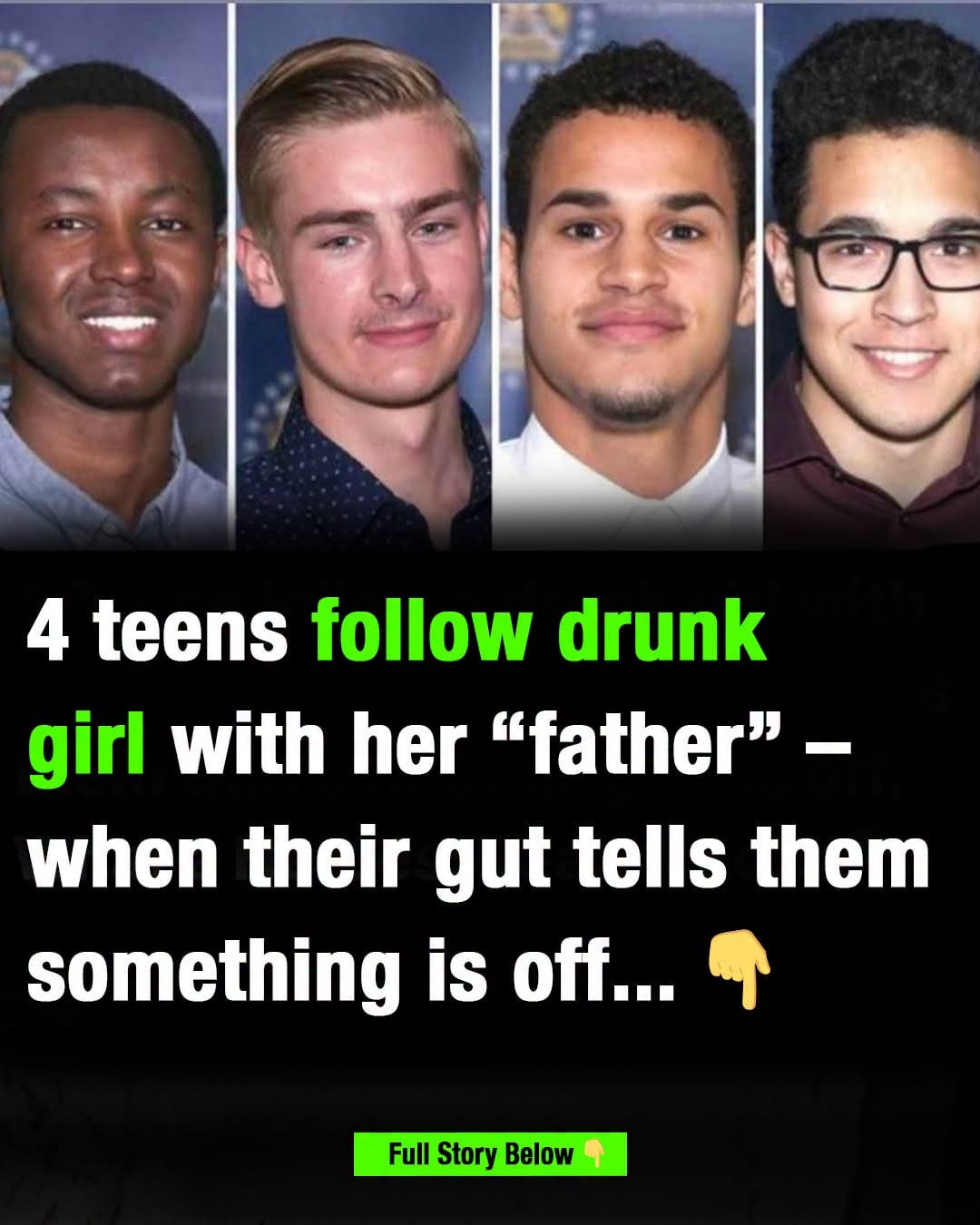
What began as an ordinary evening for four teenage skateboarders turned into a life-changing act of courage after they noticed a young woman who appeared to be in serious trouble.
They didn’t know who she was.
They had never met her before.
They had no idea how the night had started or what had led her to that moment.
What they did know was that something didn’t look right.
According to authorities, the teenagers were skating together when they saw a visibly intoxicated young woman being guided away by an older man. At first glance, it may have appeared to some passersby that the pair simply knew one another. But something about the interaction immediately made the teens uneasy.
The woman appeared disoriented.
She struggled to walk steadily.
More importantly, she didn’t seem to be participating willingly in where she was being taken.
Instead of continuing on their way or convincing themselves it was “none of their business,” the four teenagers trusted their instincts.
As they watched, the man allegedly attempted to lead the woman toward a darker, more isolated area away from the street.
That was all the confirmation they needed.
Without discussing it for long, they made a decision that would later earn them recognition from law enforcement—and quite possibly save a life.
Rather than keeping their distance, the four skateboarders rode directly toward the pair.
They intentionally placed themselves between the man and the young woman.
Using both their skateboards and their own bodies, they created a physical barrier that prevented him from continuing to move her toward the secluded location.
Witnesses later described the teenagers as calm but determined.
They did not attempt to escalate the confrontation.
They simply refused to move.
The unexpected intervention immediately disrupted whatever the man had intended to do.
Instead of finding an isolated victim, he suddenly found himself facing four alert teenagers who clearly weren’t intimidated.
Realizing his actions were now being watched, the man reportedly abandoned the encounter and fled the area.
Only after he disappeared did the teenagers fully shift their attention to the young woman.
Rather than leaving after scaring the man away, they stayed with her.
They quickly realized she was extremely vulnerable.
She was confused, frightened, and in no condition to safely care for herself.
The group remained by her side, speaking calmly and reassuring her that she was safe.
One of them contacted emergency services while the others stayed close, making sure she wasn’t left alone.
They waited patiently until police officers and emergency responders arrived.
Authorities later confirmed that their decision to remain with the woman was just as important as confronting the suspect.
Had they simply chased the man away and continued skating, the woman could still have been left alone in a dangerous condition.
Instead, they stayed.
They protected her until trained professionals could take over.
Investigators later praised the teenagers for recognizing warning signs that many adults might have ignored.
Situations involving intoxicated individuals can often appear ambiguous from a distance.
It is easy for witnesses to assume that someone is simply helping a friend or partner.
The teenagers resisted that assumption.
They paid attention to the woman’s body language, her apparent inability to make decisions for herself, and the man’s attempt to move her away from public view.
Those observations convinced them that intervention was necessary.
Their instincts proved to be correct.
As news of the rescue spread, many people expressed admiration for the young men’s courage.
Others pointed out something equally important.
The teenagers acted together.
Each likely found confidence knowing the others were willing to help.
Their teamwork transformed four ordinary teenagers into an effective protective presence that discouraged further violence without unnecessary force.
Police officials later acknowledged that their actions likely prevented a much more serious crime.
Although investigators did not publicly speculate about what might have happened had nobody intervened, they emphasized that vulnerable individuals often depend on observant bystanders willing to step forward.
Nearly a year after that night, the four skateboarders were invited to a formal ceremony.
Gone were the hoodies, backpacks, and skateboards.
Instead, they arrived dressed neatly alongside their families, surrounded by police officers, community leaders, and local residents.
During the ceremony, each teenager received the Chief’s Award for Bravery.
The distinction is not routinely presented.
It is generally reserved for individuals whose actions demonstrate exceptional courage while protecting others from immediate danger.
Police leaders praised the teenagers not only for their bravery but also for their maturity.
They noted that the boys managed to intervene without escalating violence, remained focused on the victim’s safety, and cooperated fully with responding officers.
The recognition served as a reminder that heroism is not limited to firefighters, police officers, or soldiers.
Sometimes it belongs to ordinary young people who simply refuse to ignore someone in need.
The story has continued inspiring conversations far beyond the local community.
Many parents have shared it with their own children as an example of responsible decision-making.
Teachers have used it to discuss bystander intervention and personal responsibility.
Law enforcement agencies have highlighted it as proof that paying attention to one’s surroundings can save lives.
Experts often explain that predators rely heavily on privacy, hesitation, and public indifference.
They count on people convincing themselves that someone else will intervene or that nothing is wrong.
The four teenagers broke that pattern.
They noticed.
They questioned.
They acted.
Most importantly, they stayed until help arrived.
Looking back, the teenagers have largely downplayed their actions, insisting they simply did what they hoped anyone else would have done.
Yet their story reminds us that courage is rarely about fearlessness.
More often, it is about recognizing fear and deciding that protecting another person matters more.
On one ordinary evening, four friends heading home with skateboards became something much greater.
Without planning it, seeking recognition, or expecting praise, they demonstrated that true bravery often arrives quietly.
It begins with paying attention.
It grows through compassion.
And sometimes, it changes the course of someone else’s life forever.