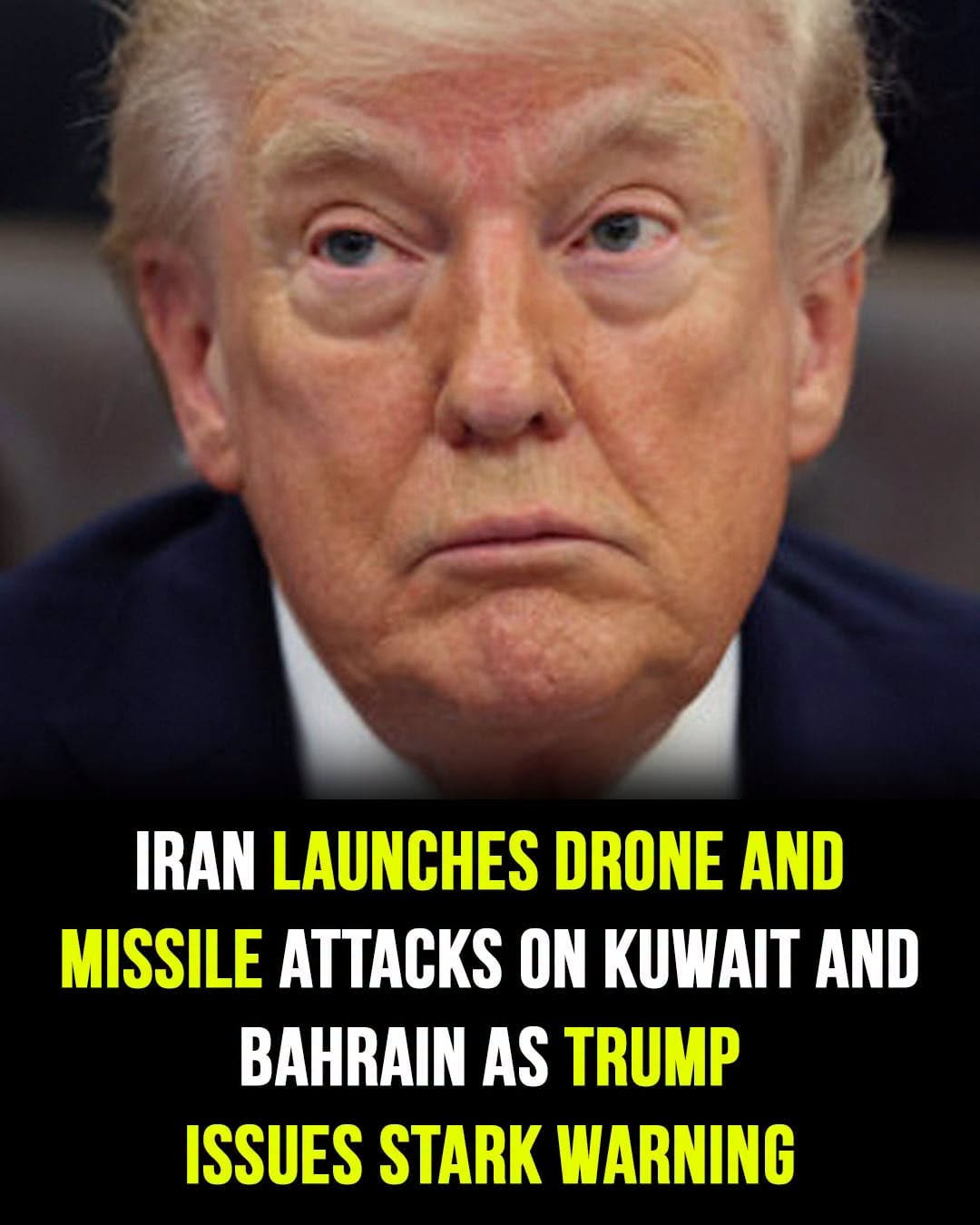
The fragile balance that had held across the Persian Gulf for months appeared to crack overnight.
Reports of Iranian drone and missile attacks targeting locations in Kuwait and Bahrain have sent shockwaves throughout the region, dramatically increasing fears that the confrontation between Iran, the United States, and their allies may be entering a far more dangerous phase. While officials continue to assess the full extent of the reported attacks, the developments have already intensified concerns that a conflict once viewed as containable could spread across multiple countries.
For years, diplomats, military analysts, and regional leaders warned that any direct confrontation between Iran and its opponents could quickly expand beyond a single battlefield. The Gulf states, with their strategic military facilities, energy infrastructure, and close relationships with Western powers, have long been viewed as potential flashpoints.
Now, those fears appear closer to reality.
Residents in parts of the Gulf reportedly awoke to air raid sirens, emergency alerts, and widespread uncertainty. Images circulating online showed smoke rising over several locations, while emergency crews and security forces moved rapidly to secure affected areas.
Although official assessments remain ongoing, the psychological impact was immediate.
Cities that had long considered themselves relatively insulated from direct conflict suddenly found themselves confronting the possibility of becoming active participants in a larger regional struggle.
For many civilians, the experience was deeply unsettling.
The sounds of sirens replaced morning routines.
Traffic slowed.
Schools and businesses reviewed emergency procedures.
Families checked news updates while contacting loved ones.
The realization that military confrontation could extend beyond traditional battle zones created a new atmosphere of anxiety throughout the Gulf.
At the center of international attention was the response from former President Donald Trump, who issued strong warnings regarding the growing crisis. His comments emphasized the dangers of further escalation and underscored concerns that continued attacks could trigger severe consequences throughout the region.
Trump’s remarks quickly generated international discussion, with supporters viewing his statements as a warning intended to deter additional violence, while critics argued that increasingly forceful rhetoric could contribute to already heightened tensions.
Regardless of political opinion, the underlying reality remains clear.
The situation has become increasingly dangerous.
Military analysts have long warned that modern conflicts in the Middle East rarely remain confined to a single location. Alliances, proxy groups, military partnerships, and strategic interests connect numerous countries, making even limited confrontations difficult to contain.
Each new strike carries risks far beyond the immediate target.
Each response creates additional pressure.
Each military action increases the possibility of miscalculation.
Perhaps no location better illustrates this danger than the Strait of Hormuz.
This narrow waterway serves as one of the world’s most important energy corridors. A significant percentage of global oil shipments pass through these waters every day, making the strait not only a regional concern but an international one.
For decades, control and access to the Strait of Hormuz have been central points of disagreement.
Iran has repeatedly emphasized its strategic position along the waterway and its ability to influence maritime traffic. The United States and allied nations have consistently maintained that international shipping lanes must remain open and protected.
These competing positions have transformed the strait into one of the world’s most sensitive geopolitical pressure points.
Today, warships patrol nearby waters.
Military aircraft monitor movement.
Commercial vessels carefully evaluate routes.
Every navigation decision carries political implications.
Every military maneuver is closely observed.
Shipping companies, insurance firms, and international markets follow developments almost hour by hour.
The consequences extend far beyond military calculations.
Energy markets react quickly to instability.
Investors monitor oil prices.
Governments assess supply risks.
Consumers around the world may ultimately feel the effects through energy costs and economic uncertainty.
Meanwhile, diplomatic efforts continue behind closed doors.
Representatives from multiple countries have reportedly engaged in discussions aimed at reducing tensions and preventing further escalation. Official statements often emphasize dialogue, restraint, and the importance of avoiding actions that could widen the conflict.
Yet diplomacy operates under immense pressure.
Negotiators speak of progress while military forces remain on alert.
Public statements emphasize caution while defensive systems remain active.
Officials call for calm while populations prepare for the possibility of further violence.
This contradiction reflects the complexity of the current situation.
Peace negotiations and military preparations often occur simultaneously.
Neither side wishes to appear weak.
Neither side wishes to surrender strategic advantages.
Yet both understand the enormous risks associated with further escalation.
The greatest concern among analysts may not be deliberate decisions but accidental ones.
Modern military systems operate at extraordinary speed.
Missiles travel quickly.
Radar systems interpret threats within seconds.
Commanders make decisions under intense pressure.
Miscommunication, technical errors, or mistaken identification can rapidly transform limited incidents into much larger confrontations.
History contains numerous examples of conflicts that expanded not through careful planning but through misunderstanding, fear, and rapid reactions.
This possibility worries many observers.
One incorrect radar signal.
One misunderstood movement.
One unintended strike.
Any of these scenarios could dramatically alter events.
For civilians living throughout the region, these geopolitical calculations feel deeply personal.
Families worry about safety.
Businesses worry about stability.
Communities worry about the future.
Many people who have already experienced years of political tension and economic uncertainty now face renewed fears about the possibility of broader conflict.
International leaders continue urging restraint.
Military officials continue monitoring developments.
Diplomats continue searching for solutions.
Yet uncertainty remains.
The coming days may prove critical.
Further attacks could increase pressure for retaliation.
Successful diplomatic efforts could help stabilize the situation.
Much depends on decisions made by leaders, military commanders, and negotiators across multiple countries.
For now, the world watches carefully.
The Gulf region stands at a crossroads.
One path leads toward greater confrontation.
The other toward diplomacy and de-escalation.
The stakes extend far beyond national borders.
Energy markets, global trade, international security, and millions of civilian lives are connected to the outcome.
Warships continue moving through narrow waters.
Air defense systems remain active.
Negotiators continue their discussions.
And the international community waits to see whether caution, diplomacy, and restraint can move faster than anger, retaliation, and fear.
Because in moments like these, history often turns not on grand speeches or official declarations, but on whether those holding power choose escalation or step back before a line is crossed that cannot easily be uncrossed.