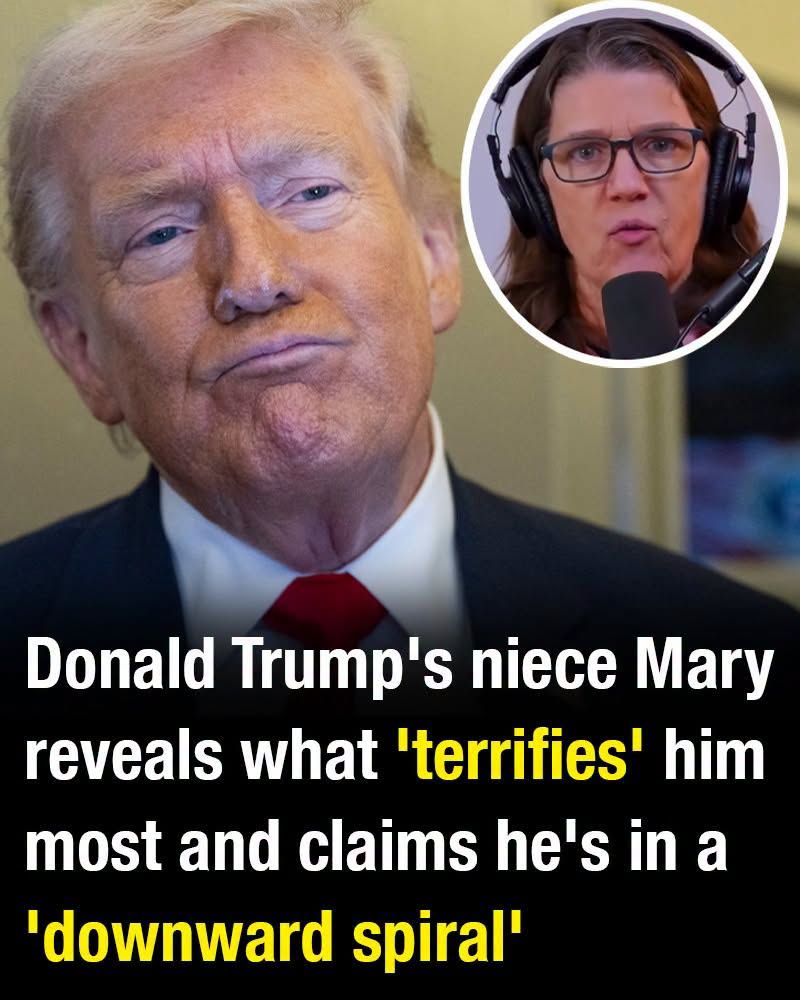
For years, few critics of Donald Trump have spoken with the same combination of familiarity and distance as his niece, Mary Trump. A psychologist, author, and longtime family observer, she has repeatedly offered a portrait of her uncle that differs sharply from the public image he has spent decades creating.
While supporters see a confident leader who thrives under pressure, Mary describes a man driven by deeper fears, insecurities, and an overwhelming need for validation.
Her latest comments have once again placed the Trump family under the spotlight, not because of politics alone, but because of a far more personal question: what truly frightens one of the most recognizable political figures in modern American history?
According to Mary Trump, the answer is surprisingly simple.
She believes Donald Trump’s greatest fear is humiliation.
Not political defeat.
Not criticism from opponents.
Not legal troubles.
But the possibility of appearing weak.
Speaking in recent interviews and public discussions, Mary argued that her uncle has spent his entire life constructing an image of strength, success, and dominance. In her view, every achievement, every public statement, and every confrontation has been shaped by an intense desire to avoid appearing vulnerable.
She claims that public embarrassment affects him more deeply than almost anything else.
For a man who built his reputation on winning, admitting mistakes or showing uncertainty may feel impossible.
Mary has long described her uncle as someone who depends heavily on praise and approval. She argues that criticism is not merely unpleasant for him but deeply threatening because it challenges the identity he has spent decades creating.
In her opinion, every political setback becomes personal.
Every loss becomes an injury.
Every public mistake becomes something that must be denied, explained away, or redirected toward someone else.
She describes these moments as “narcissistic injuries,” situations where a person’s carefully built self-image collides with reality.
Whether one agrees with her analysis or not, her comments have generated significant attention because they come from someone who spent years observing the Trump family from the inside.
Mary Trump has previously written extensively about her family history, describing an environment that she believes rewarded toughness while discouraging vulnerability. She has argued that emotional weakness was treated as failure and that success became the primary measure of personal worth.
In her view, those lessons shaped Donald Trump throughout his life.
She claims that his public persona functions almost like armor.
Confidence.
Certainty.
Strength.
Victory.
These themes appear repeatedly in his speeches, interviews, and public appearances.
According to Mary, this is not accidental.
She believes they represent protection against his deepest fears.
Her comments arrive during a period when Donald Trump continues to face intense public scrutiny. Every speech, interview, international meeting, and social media post receives enormous attention from both supporters and critics.
Some political observers have pointed to moments they consider signs of stress or fatigue. Others argue that such criticisms are politically motivated and no different from attacks directed at previous presidents.
Mary interprets these moments differently.
She believes that increasing pressure, criticism, and public scrutiny have placed her uncle in what she describes as a “downward spiral.”
In her view, each new controversy creates additional stress, which then leads to further mistakes and increased criticism.
She argues that this cycle becomes increasingly difficult to escape.
Her assessment, however, has been strongly rejected by those closest to Donald Trump.
The White House and Trump allies quickly dismissed her comments, characterizing them as politically motivated attacks from a family member who has long been critical of him.
Supporters argue that Mary Trump’s observations reflect personal disagreements rather than objective analysis.
They point to medical examinations, public appearances, and political accomplishments as evidence that the president remains capable and effective.
Some have accused her of seeking attention by criticizing a famous relative.
Others argue that psychological evaluations should not be conducted publicly by family members who have not personally treated the individual involved.
The disagreement highlights a larger debate that has surrounded Donald Trump for years.
Who is the real Donald Trump?
The confident businessman and political fighter his supporters admire?
Or the deeply insecure figure described by his critics?
For many Americans, the answer depends largely on political beliefs.
Supporters often see resilience.
Critics see fragility.
Supporters see confidence.
Critics see ego.
Supporters see determination.
Critics see fear.
Mary Trump insists that her concerns are not primarily political.
She argues that understanding her uncle’s emotional makeup is important because personality influences leadership.
If public humiliation truly represents his greatest fear, she suggests, it may affect how he responds to criticism, setbacks, negotiations, and challenges.
She believes that avoiding embarrassment can sometimes become more important than acknowledging mistakes or changing course.
Whether accurate or not, this idea has fueled substantial debate among political analysts.
Some believe leaders must project confidence regardless of circumstances.
Others argue that the ability to admit mistakes demonstrates strength rather than weakness.
The discussion extends beyond one political figure.
It touches on broader questions about leadership itself.
Should leaders always appear strong?
Can vulnerability coexist with authority?
Is admitting uncertainty a sign of weakness or wisdom?
Mary Trump believes that her uncle has spent much of his life avoiding those questions.
In her view, the fear of appearing weak drives many of his decisions and reactions.
She argues that public embarrassment represents something far more threatening to him than political opposition because it strikes directly at the image he has carefully constructed.
Yet even those who disagree with her acknowledge one undeniable reality.
Donald Trump remains one of the most scrutinized figures in the world.
Every word.
Every gesture.
Every decision.
Every mistake.
Every success.
Few public figures face that level of attention.
The pressure of constant evaluation would challenge almost anyone.
For supporters, Trump’s ability to withstand that pressure demonstrates extraordinary resilience.
For critics, it reveals growing signs of strain.
Mary Trump believes the latter.
Her portrait is not of a powerful man completely in control, but of someone constantly fighting against the possibility of humiliation.
She sees fear where others see confidence.
Vulnerability where others see strength.
Anxiety where others see certainty.
Whether the public accepts her interpretation remains deeply divided.
What cannot be denied is that her words continue to attract attention because they come from someone who knew the family long before politics, campaigns, and the White House.
In the end, her claim is both simple and controversial.
She believes that Donald Trump fears being seen as weak more than anything else.
Not losing power.
Not criticism.
Not opposition.
But the possibility that the world might someday look beyond the image of strength and see a man who, like everyone else, carries fears he cannot completely hide.