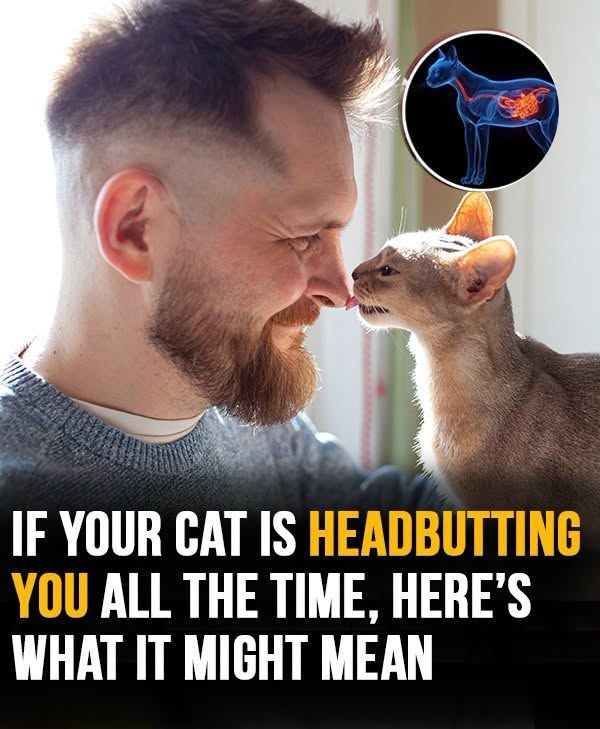
If you share your home with a cat, you have probably experienced the moment when your pet suddenly walks toward you, lowers its head, and gently presses its forehead against your hand, face, or leg. Sometimes the movement is soft and brief. Other times it is surprisingly forceful, as if your cat is determined to make sure you notice.
To many people, it simply looks adorable.
But according to feline behavior experts, this small gesture carries a meaning that goes far deeper than affection alone.
When a cat headbutts you, it is performing a behavior known as bunting. Far from being random, bunting is one of the clearest ways cats communicate trust, security, and emotional connection.
In the feline world, scent is everything.
Cats experience their environment differently from humans. While people rely heavily on sight and sound, cats depend enormously on scent to understand the world around them. Hidden within the cheeks, forehead, chin, and around the mouth are special scent glands that release unique chemical signals.
When your cat presses its head against you, these glands leave behind a scent that is invisible to humans but deeply meaningful to other cats.
In essence, your cat is saying:
You belong with me.
You are safe.
You are part of my world.
This is one of the highest forms of trust a cat can offer.
In the wild, cats rub against other cats they trust. Mothers rub against kittens. Bonded cats share scent by rubbing their faces together. This creates a shared group scent that helps establish familiarity and security.
When your cat chooses to include you in that scent group, you become part of their family.
For many cat owners, this realization changes the meaning of every gentle nudge.
That forehead against your cheek is not simply a request for food.
It is not always a demand for attention.
It is often a declaration of belonging.
Some cats perform dramatic headbutts.
They approach confidently, lean their entire body into you, and push with surprising strength. Others offer delicate little nudges that last only a second before they walk away.
Every cat has its own personality.
Some are bold and expressive.
Others are quiet and reserved.
A cat that gives soft head nudges may be expressing exactly the same affection as one that practically knocks your phone out of your hand.
The intensity of the gesture does not necessarily measure the strength of the bond.
What matters is that the cat chooses to do it at all.
Cats are highly selective creatures.
Unlike dogs, which often seek approval openly and frequently, cats tend to be cautious about physical contact. They choose when to approach, when to leave, and whom they trust.
That is why bunting carries so much significance.
A cat that presses its forehead against you has decided that you are safe enough to enter its private world.
Many owners notice that cats often headbutt specific areas.
The face.
The chin.
The hand.
The shoulder.
Sometimes even the feet.
These locations are often chosen because they are easy to reach or because they carry strong human scents that the cat wishes to combine with its own.
This mixing of scents creates comfort.
Your smell becomes connected to your cat’s smell.
Together, they form a shared environment that feels secure.
Headbutting is also frequently accompanied by other signs of affection.
Slow blinking is one of the most famous.
When a cat looks at you and slowly closes its eyes, it signals relaxation and trust. Many cats combine slow blinks with headbutts, purring, and gentle kneading with their paws.
These behaviors often appear together because they all reflect the same emotional state.
Safety.
Comfort.
Trust.
You may also notice your cat rubbing against furniture, walls, corners, or other pets.
The same scent-marking process is taking place.
Cats create scent maps throughout their environment. By leaving their scent behind, they establish territory that feels familiar and secure.
When they include you in this process, they are essentially making you part of their safe space.
Some owners worry when their cat suddenly begins headbutting more frequently.
In most cases, increased bunting simply reflects affection, routine, or emotional attachment.
Cats may become especially affectionate after being apart from their owners for several hours. They may greet people at the door with repeated headbutts, purring, and rubbing.
However, changes in behavior should always be observed carefully.
If head pressing appears different from normal bunting—such as pressing the head firmly against walls, furniture, or floors for extended periods—it may indicate a medical issue requiring veterinary attention.
Normal headbutting is gentle, social, and interactive.
The cat remains relaxed.
The eyes are soft.
The body language is calm.
True bunting is an act of connection, not distress.
Interestingly, not all cats headbutt.
Some cats express love in completely different ways.
A cat may follow you from room to room.
Sleep beside you.
Sit quietly nearby.
Bring you toys.
Roll onto its back.
Slow blink from across the room.
Every feline develops its own language of affection.
A cat that never headbutts can still love its owner deeply.
The important thing is understanding the individual personality behind the behavior.
For longtime cat owners, these small moments often become the most meaningful.
The cat that jumps onto the couch every evening.
The gentle forehead pressed against your hand while you read.
The soft bump against your face before bedtime.
These gestures may last only seconds, but they communicate something powerful.
Trust cannot be forced.
Cats decide for themselves whom they allow into their inner circle.
Unlike relationships built on obedience, feline affection often develops slowly through patience, consistency, and mutual respect.
That is what makes it so valuable.
When your cat chooses to headbutt you, it is offering something deeply personal.
It is sharing its scent.
Its security.
Its sense of home.
In a world that can often feel noisy and complicated, these quiet interactions remind us that connection does not always require words.
A small forehead pressed against your arm.
A gentle nudge while you work.
A sleepy cat rubbing against your cheek.
These moments may seem ordinary, but for your cat they carry enormous meaning.
The next time your cat walks over, closes its eyes, and presses its head gently against you, understand what is really happening.
This is not simply a habit.
It is not an accident.
It is not merely a request for attention.
It is your cat’s way of saying something that few animals can communicate so quietly and so clearly.
You are trusted.
You are safe.
You are family.
And in the language of cats, there may be no greater declaration than that.