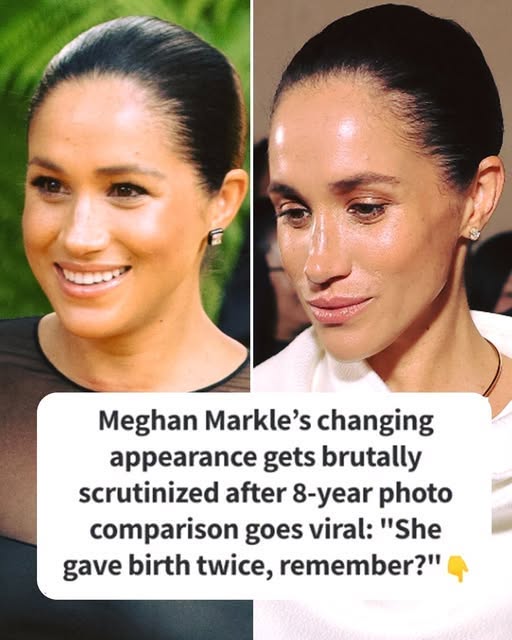
Every few months, a familiar cycle repeats itself online: side-by-side images of Meghan Markle appear across social media, accompanied by commentary dissecting every subtle shift in her appearance.
A slightly different jawline in one photo, a change in skin tone in another, or the effects of lighting in a public event are suddenly transformed into “evidence” in a wider narrative that often says more about the viewers than the subject.
What these comparisons tend to overlook is the simplest explanation of all: time. Meghan Markle’s public life spans years of intense visibility, personal transformation, and relentless scrutiny. She was an actress, then a royal figure, then a mother navigating global attention and public controversy, and now a private individual living under continued media focus. Across that timeline, she has experienced the same natural physical changes that every person does, only magnified under a microscope that rarely allows space for nuance.
Aging, stress, pregnancy, and motherhood all leave subtle but real marks on the human face and body. Hormonal changes alone can affect skin texture, facial fullness, and overall appearance. Sleep deprivation, especially during early parenthood, can influence how tired or defined someone looks in photographs. Even weight fluctuations that would go unnoticed in everyday life can become talking points when captured in high-resolution images and circulated online without context.
On top of these natural factors, there is the powerful influence of photography itself. Lighting conditions can dramatically alter facial structure. Camera angles can elongate or soften features. Professional makeup can reshape perception entirely, while candid photos taken in motion often produce completely different impressions than carefully staged portraits. Yet in the online environment, these technical variables are often ignored in favor of more dramatic interpretations.
For Meghan Markle, these variables are compounded by the intensity of public interest surrounding her life. From her entry into the British royal family to her departure and subsequent life in the United States, every stage has been documented, replayed, and analyzed. With each transition, her appearance has been used as a visual timeline for speculation, as if her face were a record that must remain static in order to avoid commentary.
The reality, however, is far less sensational. There is no single “before and after” moment that explains what people see in these comparisons. Instead, there is a continuous, gradual evolution shaped by ordinary human experience. Yet online discourse often resists that explanation, preferring instead to construct narratives around cosmetic procedures, secret interventions, or hidden transformations. These narratives spread quickly because they offer simplicity in place of complexity.
Despite persistent rumors, Meghan Markle has not publicly confirmed undergoing cosmetic surgery, and no verified evidence has been presented to support many of the claims circulating online. Still, speculation continues to fill the gaps left by absence of official statements. In the attention economy of social media, silence is rarely interpreted as neutrality; it is often treated as invitation for interpretation.
Experts in media literacy and photography frequently point out that images, especially those taken in different contexts and years apart, are not reliable indicators of medical or surgical history. They are snapshots influenced by countless variables, many of which are invisible to viewers. Yet these reminders often struggle to compete with viral posts designed to provoke curiosity or controversy.
What makes the ongoing discussion particularly persistent is not just interest in Meghan Markle herself, but the broader cultural relationship with aging and public figures. Women in the public eye are often held to contradictory standards: expected to look youthful while also appearing natural, criticized for changing while simultaneously being expected not to change at all. Every shift becomes a potential topic of debate, every photograph a point of comparison against an imagined fixed version of who they “should” be.
In this context, Meghan Markle’s images become less about her individual story and more about collective anxieties. The fascination with whether her appearance has changed “naturally” or “artificially” reflects deeper discomfort with the passage of time and the visible effects it has on the human body. It also reflects the modern tendency to treat public figures as ongoing projects of interpretation, where every detail is open to analysis and revision by strangers online.
At the same time, there is an emotional dimension to how these discussions unfold. For some, comparing images is framed as curiosity or harmless observation. For others, it becomes a form of entertainment, a way to engage in speculation about lives that feel distant yet highly visible. But for the individuals at the center of these discussions, the experience can be very different, turning personal appearance into a permanent subject of public debate.
The irony is that even as technology improves and images become sharper and more widely available, understanding often becomes more distorted. Higher resolution does not necessarily mean higher truth. Instead, it can amplify minor differences and encourage overinterpretation of details that would otherwise go unnoticed.
Ultimately, the ongoing conversation around Meghan Markle’s appearance reveals less about any definitive change in her face and more about the way modern audiences consume images. It shows how easily visual information can be detached from context and repurposed into narratives shaped by assumption rather than fact.
In the end, what the comparisons truly highlight is not transformation, but perception. A life lived in public will always be subject to scrutiny, but it does not require explanation for every visible change. A face can age, shift, and adapt to life’s experiences without becoming a mystery to be solved.