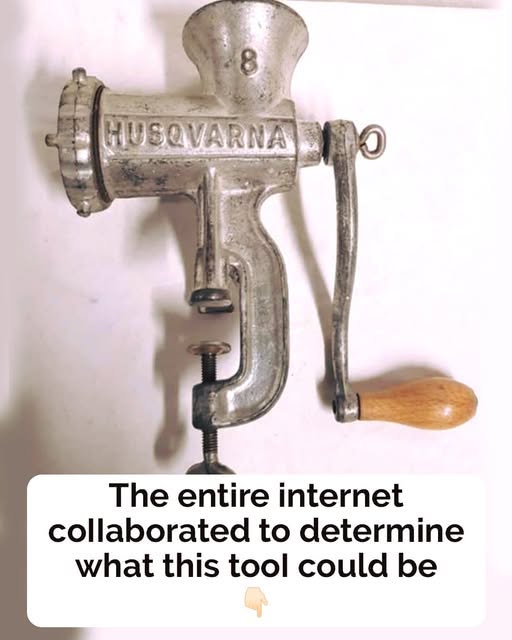
It started with a single photograph of an unfamiliar object posted online, the kind of image that tends to spark instant curiosity across the internet. The item looked heavy, mechanical, and oddly intimidating, with a solid metal frame, a hand crank on the side, and a grinding mechanism that seemed designed for some kind of industrial task.
No one who saw it could agree on what it was meant to do. Some thought it belonged in a factory, others suggested it might be a broken piece of farming equipment, and a few even speculated it could be part of an old machine used in workshops or small manufacturing plants.
As more people weighed in, the mystery only deepened. The object had the unmistakable look of something once widely used but now forgotten, a relic from a time when household tools were built entirely differently. It didn’t resemble anything commonly seen in modern kitchens or garages, which made it even more intriguing. The discussion spread quickly across online communities where users specialize in identifying obscure tools, antiques, and forgotten technology. These groups are known for solving mysteries that often stump even experienced collectors.
After hours of speculation and comparison with historical images, the answer finally emerged. The mysterious object was identified as a traditional manual meat grinder, also known as a meat mincer. Once this explanation appeared, many users immediately recognized it, while others were surprised to learn that such a simple household tool could look so unfamiliar to modern eyes.
Before electric appliances became widespread, this device played an essential role in kitchens around the world. It was designed to process raw meat by hand, turning solid cuts into ground meat that could be used for cooking a wide variety of meals. Families relied on it for both convenience and practicality, especially in times when pre-packaged food options were rare or expensive. Owning a meat grinder meant having more control over ingredients, freshness, and texture, which was especially important in home cooking traditions.
The design of the meat grinder is deceptively simple but highly effective. Meat is placed into a metal opening at the top of the device, where it is pushed downward toward an internal screw mechanism. When the side crank is turned manually, the screw rotates and forces the meat forward through a perforated metal plate. The result is finely ground meat emerging from the front of the machine in consistent strands. Despite its basic appearance, the mechanism was an important innovation in food preparation technology.
Over time, these tools were used for far more than just grinding meat. Depending on the attachments and design, they could also process vegetables, fish, fruits, and even dough-like mixtures. Many households used them to prepare sausages, spreads, fillings, and other traditional recipes passed down through generations. Their versatility made them a staple in both rural and urban kitchens long before electric mixers and food processors became common.
The origins of the meat grinder date back to the nineteenth century, a period of rapid mechanical invention. During this era, inventors were constantly developing tools to reduce manual labor in everyday tasks. Early versions of meat grinding devices began to appear in Europe, with several designs contributing to what eventually became the modern grinder. One of the figures often associated with early mechanical innovation in this field is German inventor Karl Drais, whose era of experimentation helped inspire many practical household mechanisms.
In the nineteenth and early twentieth centuries, food preparation required significant physical effort. Without refrigeration or modern packaging, people often purchased large cuts of meat and processed them at home. The meat grinder made this process faster, safer, and more efficient. It also reduced waste by allowing families to use nearly every part of the meat they bought. In many households, it became a tool that symbolized both practicality and self-sufficiency.
Many early models were made from cast iron or other durable metals, designed to last for decades. Their weight and construction made them extremely stable during use, especially since they were often clamped onto tables or countertops. This ensured that the device would not move while being operated, even when significant force was applied to the crank. Some of these antique grinders still exist today and can remain functional if properly restored and maintained, which is why they are sometimes found in flea markets, attics, or old family collections.
As electricity became more common in homes during the twentieth century, kitchen technology began to evolve rapidly. Manual tools like the hand-cranked grinder gradually gave way to electric versions. These newer machines could process meat much faster and with far less effort, making them more appealing for everyday use. Over time, the manual grinder became less of a necessity and more of a specialized or nostalgic item.
Modern electric meat grinders are capable of handling large quantities of food in a short amount of time. Many include multiple grinding plates for different textures, allowing users to choose between coarse or fine results. Additional attachments also enable the production of sausages, specialty dishes, and custom meat blends. These advancements have transformed the grinder from a simple household tool into a multifunctional kitchen appliance.
Despite technological progress, some people still prefer manual or home grinding methods. For them, the appeal lies in control and transparency. Grinding meat at home allows full knowledge of ingredients, quality, and freshness, which is especially important for those who prioritize food preparation standards or specific dietary needs. In some cases, it is also about tradition, preserving older cooking methods that have been passed down through families.
The rediscovery of objects like the meat grinder highlights how quickly everyday technology can become unfamiliar. What was once a common household item can, within a few generations, turn into a puzzling artifact. Younger people encountering such tools for the first time may have no context for their purpose, which is why online communities often play a crucial role in preserving this knowledge.
These digital spaces bring together collectors, historians, hobbyists, and curious individuals who enjoy identifying forgotten objects. Through collaboration and shared knowledge, they help reconstruct the stories behind items that might otherwise be lost to time. In doing so, they also preserve a record of how people once lived, cooked, and worked.
Antique kitchen tools like the meat grinder offer a fascinating window into domestic history. They reflect a time when daily tasks required more manual effort and when innovation focused on mechanical simplicity rather than automation. Each tool carries a story not only of function but of adaptation, showing how people solved practical problems with the technology available to them.
Many vintage grinders are now collected for their historical value and craftsmanship. Some are displayed in museums, while others are restored for demonstration or occasional use. Their continued interest among collectors shows that even the most ordinary household tools can become meaningful cultural artifacts over time.
The story of the meat grinder is ultimately a story of evolution. A once-essential manual device gradually transformed into an electric appliance, mirroring broader changes in technology and lifestyle. Yet the core idea behind it has remained unchanged for over a century. It continues to represent human ingenuity in making everyday tasks more efficient.
What began as a mysterious, unrecognizable object online ended up revealing a rich history of domestic innovation, shared knowledge, and changing technology. In the end, the internet’s collective curiosity turned confusion into understanding, proving once again that even the most puzzling objects often have surprisingly ordinary and fascinating origins.