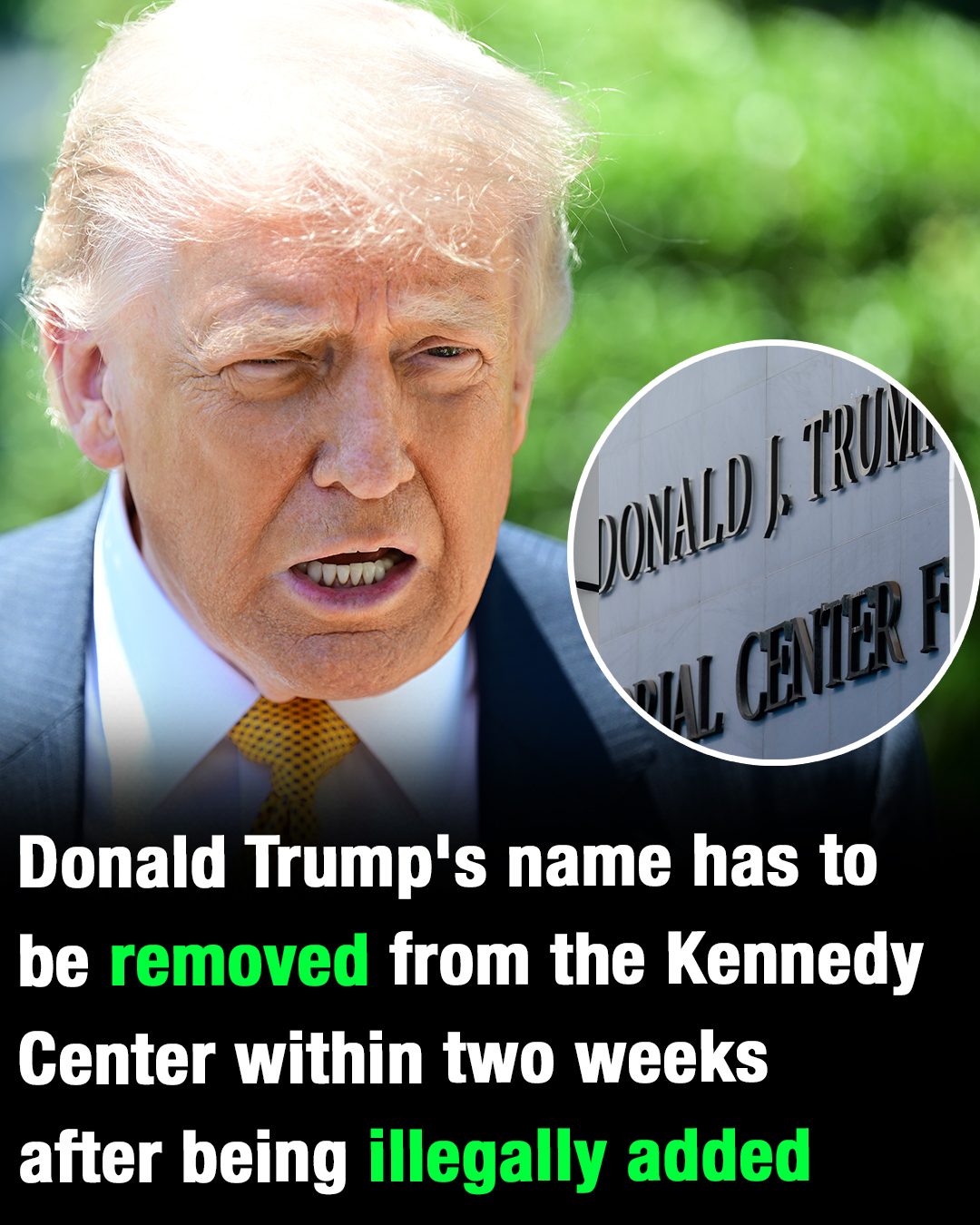
A courtroom decision has ignited a fresh national debate about power, legacy, and who ultimately has the authority to shape the symbols that represent American history.
At the center of the controversy is one of the country’s most recognizable cultural institutions, a landmark long associated with public service, the arts, and the enduring legacy of one of America’s most famous political families. What began as a dispute over a name has evolved into a much larger conversation about law, tradition, and the limits of political influence.
According to the ruling, the effort to attach Donald Trump’s name to the institution cannot stand under the current legal framework, setting the stage for a significant reversal and triggering strong reactions from supporters and critics alike.
For some observers, the decision is about far more than signs, plaques, or official documents.
They see it as a test of whether historical institutions can be reshaped through political momentum alone or whether established legal procedures must always take precedence.
The dispute had been building for months.
Supporters of the naming effort argued that prominent public figures often leave lasting marks on national institutions and that honoring political leaders through naming rights is hardly unusual in American life. Across the country, countless buildings, highways, schools, libraries, and public spaces bear the names of presidents, lawmakers, military leaders, and other influential figures.
From that perspective, attaching a modern political figure’s name to a major institution appeared to some as a continuation of a long-standing tradition.
Opponents viewed the matter very differently.
They argued that the institution already possessed a deeply established identity connected to its original purpose and historical significance. Any attempt to alter that identity, they claimed, required formal legal authorization rather than internal decisions or political maneuvering.
As tensions grew, the dispute eventually reached federal court.
The resulting decision centered on a fundamental question.
Who actually has the authority to rename a federally established cultural institution?
The court’s answer was clear.
According to the ruling, such authority rests with Congress, not with individual administrators, temporary governing bodies, or political allies acting independently.
That conclusion immediately transformed what many had dismissed as a symbolic disagreement into a major legal precedent.
The ruling suggested that regardless of political popularity, public influence, or institutional support, established procedures cannot simply be bypassed.
Supporters of the lawsuit celebrated the outcome.
Many described the decision as a victory for legal consistency and institutional integrity. They argued that preserving clear rules is essential because political winds inevitably change.
Today’s majority eventually becomes tomorrow’s minority.
Public opinion shifts.
Administrations come and go.
Laws, however, are meant to provide stability.
From their perspective, the court’s decision reaffirmed that important national institutions belong to the public rather than to any single political movement.
For members of the Kennedy family and those who value the center’s historical identity, the ruling carried emotional significance as well.
The institution was originally established to honor President John F. Kennedy’s contributions to the nation and his support for arts and culture. Over decades, the building evolved into a symbol recognized around the world, attracting performers, artists, diplomats, and visitors from countless countries.
Many supporters felt that preserving that identity was not merely a legal issue but a matter of historical continuity.
To them, the decision represented a restoration of the institution’s intended purpose.
Others viewed the ruling through a political lens.
Trump supporters criticized the outcome, arguing that opponents were motivated more by political disagreement than by procedural concerns. Some suggested that legal challenges have increasingly become a tool used to block initiatives associated with controversial political figures.
They questioned whether similar scrutiny would have emerged under different circumstances involving other leaders.
The disagreement reflects broader divisions that continue to shape American political life.
Questions about monuments, memorials, public symbols, and historical recognition have become increasingly contentious in recent years. Debates that once seemed limited to academic discussions now frequently dominate headlines and social media conversations.
Every decision involving public memory appears capable of triggering national controversy.
That reality helps explain why this particular case attracted so much attention.
At first glance, the issue may appear straightforward.
A name is added.
A name is removed.
Signs are changed.
Documents are updated.
Yet beneath those practical details lies a much deeper question about how societies remember their leaders and who controls that process.
Names attached to public institutions carry symbolic weight.
They communicate values.
They reflect priorities.
They tell future generations which individuals and achievements deserve recognition.
Because of that significance, disputes over naming rights often become battles over historical interpretation itself.
The court’s decision emphasizes that such changes must occur through established democratic processes rather than through informal arrangements or temporary exercises of influence.
Legal experts note that the ruling may have implications extending beyond this specific case.
Institutions across the country periodically face disputes involving naming rights, honorary designations, and commemorative recognition. Clarifying who possesses the authority to make those decisions could affect future controversies involving public landmarks and cultural organizations.
For now, attention has shifted toward implementation.
Officials must determine how quickly existing materials will be updated and what practical steps are required to comply with the ruling. Signage, promotional materials, digital resources, and official records may all require revision depending on the final scope of the decision.
Workers responsible for those changes face a logistical challenge, but for many observers the symbolism matters far more than the mechanics.
The visual removal of a name represents the conclusion of one chapter and the beginning of another.
Some see that outcome as a correction.
Others view it as a setback.
Few regard it as insignificant.
Political analysts suggest the controversy is likely to continue long after any physical changes are completed. Supporters and critics remain deeply divided over the broader issues involved, ensuring that discussions surrounding the case will persist in public discourse.
As reactions continue pouring in from across the political spectrum, the ruling serves as a reminder of an enduring principle within democratic systems.
Power has limits.
Influence has limits.
Even the most prominent public figures operate within structures designed to outlast individual careers and administrations.
Those structures can be challenged.
They can be debated.
They can sometimes be changed.
But they cannot simply be ignored.
Whether viewed as a triumph of legal order or a politically charged setback, the court’s decision has transformed a naming dispute into a national conversation about authority, history, and the role of law in preserving public institutions.
In the end, the controversy is not only about a building.
It is about who gets to shape the stories a nation tells about itself and whether those stories are written through personal influence or through the rules that govern everyone equally.
As the institution returns to the identity many believe it was always intended to maintain, the debate surrounding its future may fade, but the larger questions raised by the case are likely to remain part of the national conversation for years to come.