
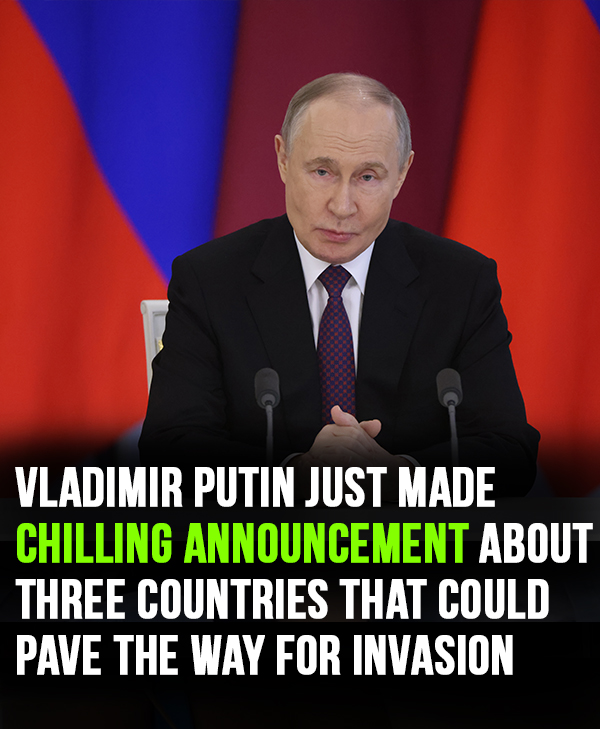
A new wave of anxiety is spreading across Europe after recent remarks from Russian leadership reignited fears about the future of the Baltic region.
What may appear on the surface as another tense diplomatic dispute is being interpreted by many analysts and former officials as something potentially far more serious: the early stages of a familiar and deeply unsettling pattern.
For people who closely followed the years leading up to previous Russian military actions, the language now being used feels painfully recognizable. Claims about discrimination against Russian speakers, accusations of rising hostility toward Russian culture, and warnings about alleged “Russophobia” have all surfaced before during moments of escalating tension between Moscow and neighboring countries.
To some observers, those narratives are not random political talking points. They are warning signs.
Among the voices drawing attention to the similarities is Anton Gerashchenko, a former adviser to Ukraine’s interior ministry, who has publicly warned that the rhetoric now directed toward Latvia, Lithuania, and Estonia echoes language used before earlier confrontations involving Russia and former Soviet territories. His concern is rooted not in abstract theory, but in experience.
Gerashchenko and others watched similar narratives emerge before the conflict in Georgia in 2008. They heard comparable accusations before Crimea was annexed in 2014. And they witnessed the same themes repeated repeatedly in the months leading up to the large-scale Russian offensive against Ukraine in 2022.
Each time, the sequence followed a disturbingly familiar rhythm.
First came claims that Russian-speaking populations were facing cultural suppression or discrimination. Then came legal arguments, public condemnations, and diplomatic pressure. Russian officials framed themselves as defenders of vulnerable communities allegedly threatened by hostile governments. The narrative gradually intensified until what initially appeared to be political messaging evolved into something far more dangerous.
That history is why the latest statements surrounding the Baltic nations have triggered unease far beyond Eastern Europe.
Latvia, Lithuania, and Estonia occupy a uniquely sensitive position in modern geopolitics. Unlike Ukraine or Georgia during earlier periods of confrontation, the Baltic states are members of NATO. Any direct military conflict involving them would immediately carry consequences extending far beyond the region itself. Under NATO’s collective defense principles, an attack on one member is considered an attack on all.
That reality dramatically changes the stakes.
For decades, the Baltic nations have existed at the center of one of Europe’s most delicate security balances. Each country shares historical ties to Soviet occupation while also maintaining sizable Russian-speaking populations. Since gaining independence, all three have worked to strengthen integration with Western institutions while simultaneously navigating the lingering political and cultural influence of neighboring Russia.
Those tensions have periodically surfaced in disputes involving language laws, education policies, citizenship requirements, and questions of national identity. Russian officials have repeatedly criticized Baltic governments over treatment of Russian-speaking minorities, portraying such policies as discriminatory or hostile.
Baltic leaders, however, strongly reject those accusations. They argue that their policies are aimed at preserving national identity, strengthening sovereignty, and reducing vulnerability to foreign influence after decades of Soviet domination. From their perspective, the issue is not ethnic hostility, but national security and cultural survival.
What worries analysts now is not necessarily the prospect of an immediate conventional military assault. Even experts who view the situation seriously acknowledge that an open attack against NATO territory would carry enormous risks for Moscow. Instead, many fear a different type of escalation—one designed to pressure, destabilize, and intimidate without crossing into full-scale war.
Modern geopolitical conflict no longer depends solely on tanks crossing borders.
Hybrid tactics have become increasingly central to international confrontations. Cyberattacks, disinformation campaigns, economic pressure, political manipulation, legal disputes, border incidents, and psychological operations can all create instability without triggering traditional military responses. These methods allow states to test opponents gradually while maintaining plausible deniability.
In the Baltic context, that possibility has become a growing concern.
Security experts warn that Russia may seek to exploit ethnic tensions, amplify social divisions, or create political crises within Baltic societies rather than launching a direct invasion. Information warfare remains particularly powerful in regions where historical memory, language identity, and geopolitical loyalties already carry emotional weight.
The fear is not simply about physical conflict. It is about uncertainty itself.
When populations begin questioning whether alliances will hold, whether governments can protect them, or whether tensions might spiral unpredictably, psychological pressure alone can become a strategic weapon. Analysts argue that keeping neighboring countries in a constant state of anxiety may itself serve geopolitical objectives.
That atmosphere of uncertainty has intensified across Europe since the conflict in Ukraine dramatically reshaped regional security calculations. Countries once viewed as relatively insulated from direct confrontation now openly discuss military preparedness, civil defense, and long-term geopolitical instability. Governments throughout the region have increased defense spending, strengthened alliances, and reassessed vulnerabilities once considered unlikely.
The Baltic nations, in particular, have responded with heightened vigilance.
Military exercises involving NATO forces have expanded in visibility and scale. Border security measures have tightened. Discussions about energy independence, cyber defense, and disinformation resilience have become central political priorities. Public awareness campaigns about emergency preparedness have also increased, reflecting growing recognition that modern conflict can affect civilian life long before traditional warfare begins.
At the same time, officials across Europe remain careful about avoiding panic.
Many leaders stress that deterrence works precisely because NATO’s commitments are clear and credible. The presence of multinational forces in the Baltic region is intended not only for defense, but also as a visible signal that collective security guarantees remain intact. Western governments continue emphasizing unity, coordination, and preparedness in response to escalating rhetoric from Moscow.
Still, historical memory weighs heavily across Eastern Europe.
For countries that experienced Soviet occupation or Cold War pressure firsthand, political language carries meaning beyond diplomacy alone. Words about “protecting Russian speakers” or confronting alleged anti-Russian hostility are not heard as abstract geopolitical arguments. They evoke memories of earlier periods when similar narratives preceded dramatic shifts in regional stability.
That emotional history explains why even indirect statements can produce widespread concern.
At the same time, experts caution against assuming that every rhetorical escalation automatically points toward imminent military action. Geopolitical messaging often serves multiple purposes simultaneously: influencing domestic audiences, testing international reactions, strengthening negotiating positions, or creating strategic ambiguity. Public statements can function as tools of pressure without necessarily signaling immediate operational plans.
The challenge, however, lies in distinguishing political theater from genuine escalation risk.
That uncertainty is what makes the situation so psychologically powerful. Every speech, military movement, diplomatic dispute, or provocative statement becomes subject to intense scrutiny. In an era shaped by rapid information flows and constant online speculation, fear can spread faster than verified facts.
For ordinary people living in the Baltic region, the tension is not theoretical. Families who built lives during decades of relative peace now find themselves once again discussing security, alliances, and regional instability in everyday conversation. Younger generations raised in a post-Cold War Europe increasingly confront questions many believed belonged to history books rather than modern life.
The broader international community also faces difficult questions about deterrence, diplomacy, and escalation management. Maintaining stability requires balancing firmness with caution, preparedness with restraint, and solidarity with efforts to prevent miscalculation.
As tensions continue unfolding, one reality remains painfully clear: Europe’s security landscape has fundamentally changed.
The assumptions that shaped much of the post-Cold War era about stable borders, predictable diplomacy, and gradually diminishing geopolitical confrontation have been shaken profoundly in recent years. In their place stands a far more uncertain environment where information warfare, strategic pressure, and regional anxiety operate alongside traditional military power.
Whether the current tensions surrounding the Baltic states remain rhetorical or evolve into something more serious, the psychological impact is already being felt across the continent.
For many observers, the deepest fear is not necessarily that history will repeat itself exactly, but that the warning signs of instability have become impossible to ignore.