Pam Bondi spent years operating in one of the harshest environments in America: the intersection of politics, media pressure, and loyalty to Donald Trump.
As Florida’s former attorney general and later one of Trump’s most visible legal allies, she built a reputation as a fierce public defender of conservative policies and a relentless presence on television. But behind the headlines, speeches, and courtroom appearances, a far more personal struggle was unfolding one that few outside her inner circle knew anything about.
Reports surrounding Bondi’s departure from Trump’s orbit initially sounded routine. Public statements framed her exit as a normal transition, the kind that happens constantly in Washington’s revolving political world. Allies praised her service, political commentators speculated about her next move, and news cycles quickly shifted to the next controversy. Yet according to later accounts from people close to her, the reality was far more complicated and far more painful.
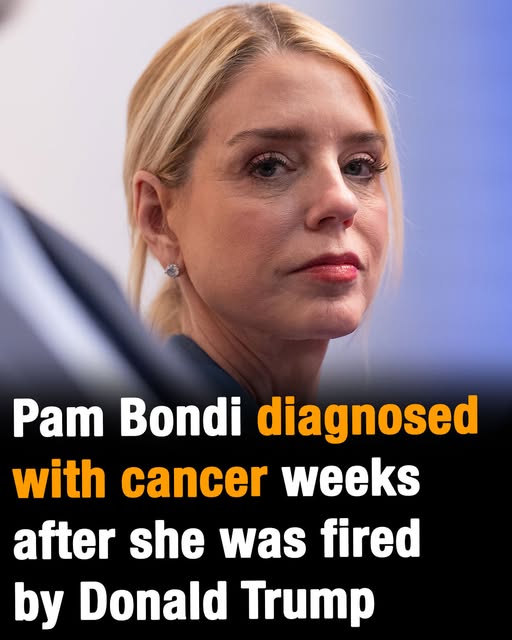
Within weeks of stepping away from her high-profile role, Bondi reportedly received devastating medical news. What had started as routine examinations and consultations turned into a diagnosis that forced her to temporarily leave behind the political battlefield she had spent years navigating. Suddenly, the aggressive pace of Washington politics no longer mattered as much as doctors’ appointments, treatment plans, recovery timelines, and the frightening uncertainty that accompanies any serious illness.
For someone known publicly as disciplined, composed, and politically tough, the experience marked a dramatic shift. Political strategy sessions were replaced with medical evaluations. Television appearances gave way to private moments spent confronting fear, exhaustion, and vulnerability. Those close to Bondi later described the period as emotionally draining, especially because it unfolded while intense public speculation surrounded her professional future.
Health battles involving public figures often become magnified through the lens of politics, and Bondi’s case was no different. Some observers viewed her sudden disappearance from public life as evidence of political tension within Trump’s circle. Others assumed she was quietly repositioning herself for another influential role. Few realized that behind the scenes, she was focused not on political survival, but personal survival.
According to accounts later shared by allies, Bondi approached treatment with the same determination that had defined her legal and political career. Rather than publicly discussing every detail, she reportedly chose to keep much of the process private, allowing only close family members and trusted associates into the reality of what she was facing. In a political culture obsessed with appearances and image control, the decision to step away quietly reflected a different side of Bondi than many Americans were used to seeing.
Those familiar with her recovery described long weeks filled with uncertainty, physical exhaustion, and emotional strain. Serious illness has a way of stripping away public personas, leaving behind only the human reality underneath. Titles, television interviews, and political influence suddenly become secondary to ordinary but deeply important things: strength, support, patience, and hope.
At the same time, Trump’s public comments regarding Bondi remained notably positive. Even after her departure, he continued praising her loyalty and legal work, describing her as someone who had consistently fought hard for his administration’s priorities. That public support fueled speculation that despite her exit, the relationship between the two had not fractured as dramatically as some political insiders initially believed.
Washington, however, rarely pauses for personal hardship. Rumors continued to circulate about why Bondi had really left, whether she had been pushed aside politically, and what role she might eventually return to. Behind closed doors, though, the focus was reportedly far less dramatic. Friends say Bondi concentrated almost entirely on her recovery, determined to regain her strength before considering any return to public life.
The story also highlighted a broader reality about political figures that often gets lost beneath headlines and partisan arguments. Public officials are frequently treated like symbols rather than people. They become representatives of ideologies, targets for criticism, or champions for supporters. But illness has a way of dissolving those labels, reminding even critics that behind every political figure is a human being vulnerable to the same fears and fragility as everyone else.
In recent years, conversations about health transparency among public officials have become increasingly common. Voters often demand openness regarding the physical condition of leaders and influential figures, particularly those operating close to presidential administrations. Yet there is also an undeniable tension between public interest and personal privacy. Bondi’s situation seemed to exist directly in that uncomfortable space between legitimate curiosity and the deeply personal nature of medical struggles.
As reports about her condition became more widely known, reactions online shifted noticeably. Even many political opponents expressed sympathy and support, temporarily putting aside ideological battles to acknowledge the seriousness of what she had endured. Supporters praised her resilience, describing her recovery as another example of her determination under pressure.
People close to Bondi later suggested that the experience profoundly changed her perspective. Serious health scares often force individuals to reevaluate priorities, relationships, and the pace of life itself. For someone who spent years immersed in the relentless intensity of national politics, the sudden confrontation with mortality reportedly created moments of reflection far removed from campaign strategies and television debates.
Eventually, news emerged that her prognosis was positive and recovery was progressing well. The reports brought relief to supporters who had followed the story closely and reignited speculation about whether Bondi would eventually reenter public service. Discussions soon surfaced regarding potential advisory roles and renewed involvement within conservative political circles.
What made the story resonate so strongly was not simply the political dimension, but the deeply human contrast at its center. One moment Bondi was navigating the brutal calculations of Washington power dynamics; the next she was confronting something entirely outside politics and beyond personal control. It served as a reminder that illness does not care about status, influence, ideology, or public reputation.
Throughout modern political history, many public figures have faced private medical battles while operating under extraordinary scrutiny. Some choose full transparency, while others guard their privacy carefully. Bondi appeared to take a middle path acknowledging recovery while avoiding turning her illness into a public spectacle. That approach earned respect from supporters who admired her resilience and discretion alike.
The experience also reinforced how quickly life can change, even for people who appear powerful and untouchable from the outside. Political careers are often measured in victories, losses, headlines, and influence. Yet moments of personal crisis reveal a different measure entirely: endurance, perspective, and the ability to continue moving forward after facing fear up close.
As Bondi gradually steps back into public view, her story now carries a dimension that goes beyond politics. She is no longer seen solely as a combative legal figure or loyal Trump ally. To many observers, she has also become someone who quietly fought through one of life’s most frightening challenges while the public speculated from afar.
Whether her future includes another major political role or a quieter chapter outside the spotlight, the experience has undeniably reshaped the narrative surrounding her life. The headlines may focus on power shifts, administration drama, or political alliances, but beneath all of that lies a far more universal story about resilience, uncertainty, and survival.
In the end, Pam Bondi’s journey became more than a Washington story. It became a reminder that behind every public figure exists a private reality the cameras rarely capture one filled not with speeches or strategy, but with fear, strength, hope, and the determination to keep going when life suddenly changes course.