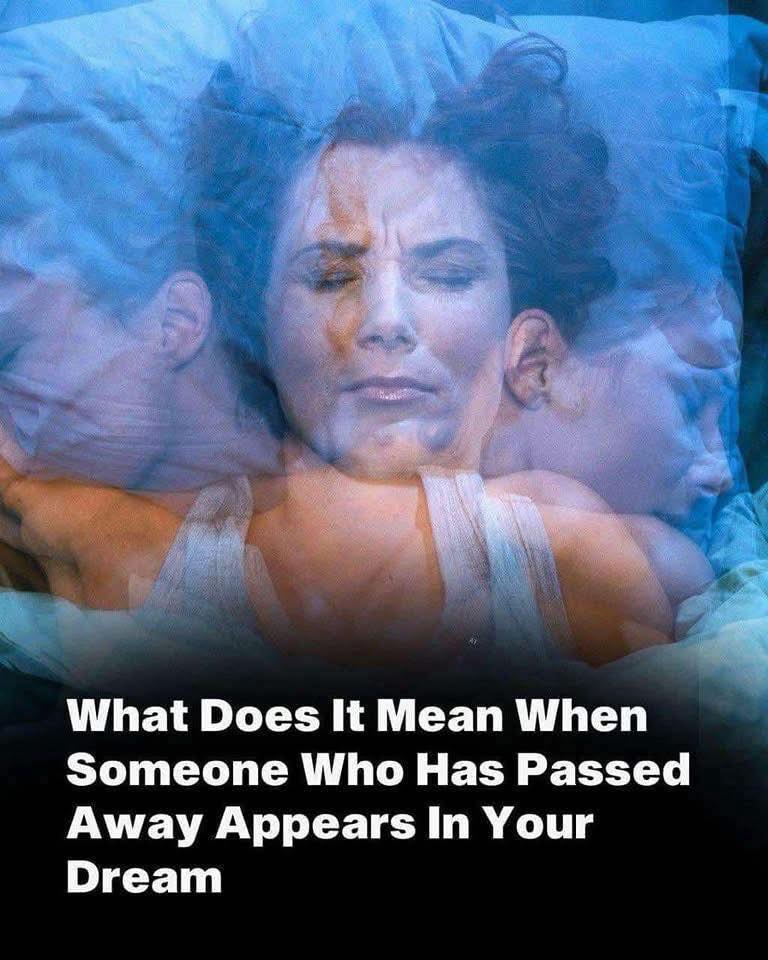
Few experiences stay with us as powerfully as dreaming about someone who has died. Long after we wake up, the emotions often linger: comfort, sadness, confusion, peace, guilt, longing, or even fear.
Sometimes the dream feels so vivid that for a brief moment we forget the person is gone. Other times, it feels less like imagination and more like a visit from somewhere beyond our understanding.
For centuries, human beings have tried to explain why the dead appear in dreams. Some believe these dreams are spiritual messages, moments where the boundary between worlds briefly opens while we sleep. Others insist dreams are entirely psychological, created by the brain as it processes memory, emotion, fear, and grief. Science and spirituality often collide on this subject, yet both sides agree on one thing: dreams involving deceased loved ones tend to affect us more deeply than ordinary dreams.
What makes them so powerful is not only what we see, but what we feel.
Unlike random dreams that disappear within minutes, dreams about someone who has passed away often feel emotionally charged and strangely real. People frequently remember tiny details: the sound of a voice, the warmth of a hug, a familiar smile, or a sentence that seemed profoundly important. Some wake up crying. Others wake up comforted. Many spend the entire day replaying the dream in their minds, wondering what it truly meant.
Sleep researchers explain that the brain remains intensely active while we sleep, especially during REM cycles associated with vivid dreaming. During these periods, the mind sorts through emotions, memories, fears, unresolved conflicts, and experiences from waking life. Dreams may appear chaotic on the surface, but they are often deeply connected to what we are carrying emotionally beneath conscious awareness.
That may explain why dreams about deceased people frequently appear during periods of transition.
Many people report these dreams while going through major life changes: moving to a new city, beginning a new relationship, starting a different job, becoming a parent, experiencing illness, or facing uncertainty about the future. At moments when life feels unstable or emotionally overwhelming, the mind often reaches toward familiar emotional anchors. A loved one who once offered protection, guidance, or unconditional love may reappear in dreams because their memory still represents safety and emotional grounding.
Psychologists who study dream interpretation suggest these dreams can act as emotional bridges between past and present. The deceased person may symbolize comfort, unfinished feelings, wisdom, regret, or even parts of ourselves we associate with them.
For example, someone dreaming of a late grandmother during a stressful period may not simply miss her presence. The dream may reflect a deeper longing for the security, gentleness, or emotional stability she represented during life. Similarly, dreaming of a deceased parent before a major decision may reflect a subconscious desire for reassurance or guidance.
But grief also plays a powerful role.
Losing someone changes the brain as much as it changes the heart. When people die, relationships do not simply vanish emotionally. The bond often continues internally through memories, habits, emotions, and identity itself. Dreams become one of the places where those bonds remain alive.
For many grieving people, dreams provide temporary reunion. In sleep, the mind briefly suspends reality, allowing conversations and moments that can no longer happen while awake. That is why dreams of deceased loved ones sometimes feel painfully beautiful. For a few fleeting moments, the loss disappears.
Experts often divide these dreams into several emotional categories.
One common type involves unresolved emotions. If a relationship ended with conflict, regret, guilt, or unfinished conversations, the brain may repeatedly revisit that emotional wound through dreams. Someone who never had the chance to apologize, forgive, or say goodbye may dream of the deceased person because the mind continues searching for closure it never received in reality.
Another type centers around reflection and identity. Sometimes people dream of deceased individuals because they unconsciously recognize similar traits within themselves. A person who struggled with addiction may dream of a relative who battled the same issue. Someone becoming emotionally distant may suddenly dream of a parent who behaved similarly. In these cases, the dream may function less as communication and more as self-awareness.
Then there are dreams that feel undeniably spiritual.
Even people who normally dismiss supernatural ideas sometimes describe certain dreams as impossible to explain logically. These dreams often feel unusually calm, vivid, and emotionally intense. The deceased person may appear healthy, peaceful, smiling, or dressed beautifully. They may say only a few words, offer reassurance, or simply stand silently before disappearing. Unlike chaotic nightmares, these dreams often leave behind an overwhelming feeling of peace.
Many people interpret such experiences as genuine visitations.
Across cultures and religions, dreams have long been viewed as spaces where spiritual contact becomes possible. Indigenous traditions, ancient civilizations, and many modern spiritual beliefs treat dreaming as more than random brain activity. In some traditions, dreams are considered essential connections between the physical and spiritual worlds.
Even today, countless people believe deceased loved ones visit through dreams to provide comfort, warnings, reassurance, or closure.
Science cannot prove this interpretation, but it also cannot fully erase the emotional reality many people experience after such dreams. Sometimes the comfort they bring feels too profound to dismiss easily.
Sleep psychologist Rubin Naiman, who has spent years studying dreams and consciousness, has argued that modern society often underestimates the importance of dreaming. Some neuroscientists describe dreams as little more than accidental mental “noise” created while the brain performs maintenance during sleep. Yet others believe dreams reveal emotional truths hidden beneath daily distractions and rational thinking.
In many ways, dreams operate through symbolism rather than logic. The people we encounter in dreams may represent memories, emotions, fears, or desires rather than literal messages. Still, the emotional impact remains real regardless of interpretation.
That may be why dreams of deceased loved ones often stay with us longer than other dreams. They force us to confront questions humans have asked for thousands of years: What happens after death? Do relationships truly end? Can love survive absence? Is grief simply pain, or is it proof that connection continues somehow beyond physical life?
There are no universally accepted answers.
What is certain is that dreams reveal how deeply human beings remain connected to those they lose. Death may remove a person physically, but emotionally, psychologically, and spiritually, many relationships continue in unexpected ways. Memories survive in habits, phrases, gestures, smells, songs, and dreams.
Sometimes a dream arrives years after someone has passed, just when we least expect it. A familiar face appears. A voice speaks again. A hand touches ours. For a moment, the separation between past and present dissolves.
Whether those moments come from the subconscious mind, emotional healing, spiritual mystery, or some combination of all three, they remind us of something profoundly human: love rarely disappears as quickly as the body does.
And perhaps that is why these dreams feel so powerful.
Because deep down, many people do not simply want explanations for them.
They want to believe that somewhere, somehow, the connection still exists.