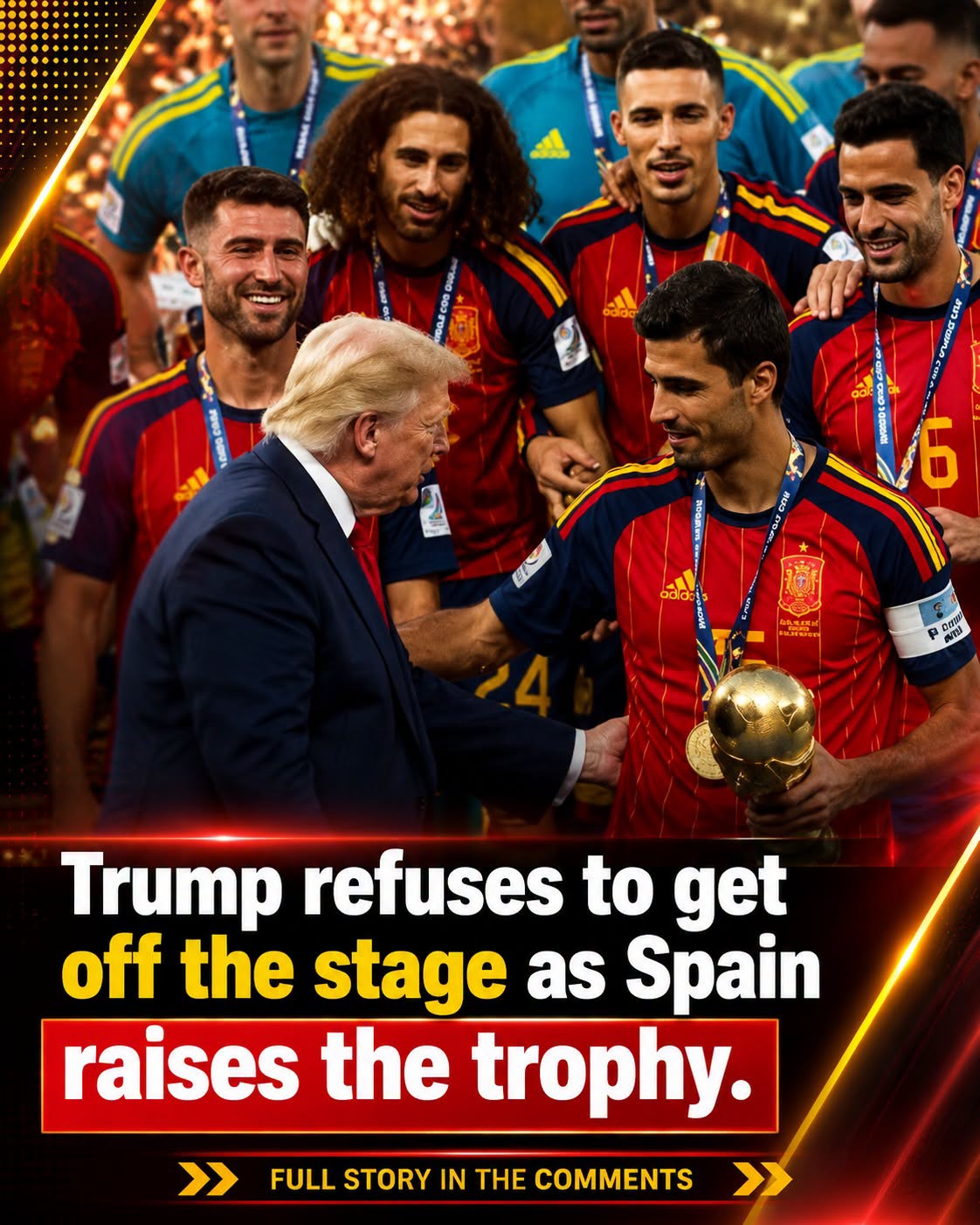
The internet has seen plenty of strange political moments over the years, but even longtime observers were stunned by the flood of surreal images suddenly posted by Donald Trump late one night across social media.
Within just a few hours, dozens of bizarre AI-generated pictures appeared online, transforming the president into something closer to a science-fiction commander than a political leader. The images spread at lightning speed, igniting confusion, ridicule, fascination, and outrage all at once.
Some showed Trump floating high above Earth in glowing armor while explosions erupted beneath him. Others placed him inside futuristic war rooms surrounded by giant digital screens tracking missiles streaking across space. One image portrayed him seated before a massive red launch button as military generals stood silently behind him, reduced to tiny figures in the shadow of his oversized presence. Another showed a dramatic outer-space battlefield with Trump staring into the stars while alien spacecraft hovered nearby.
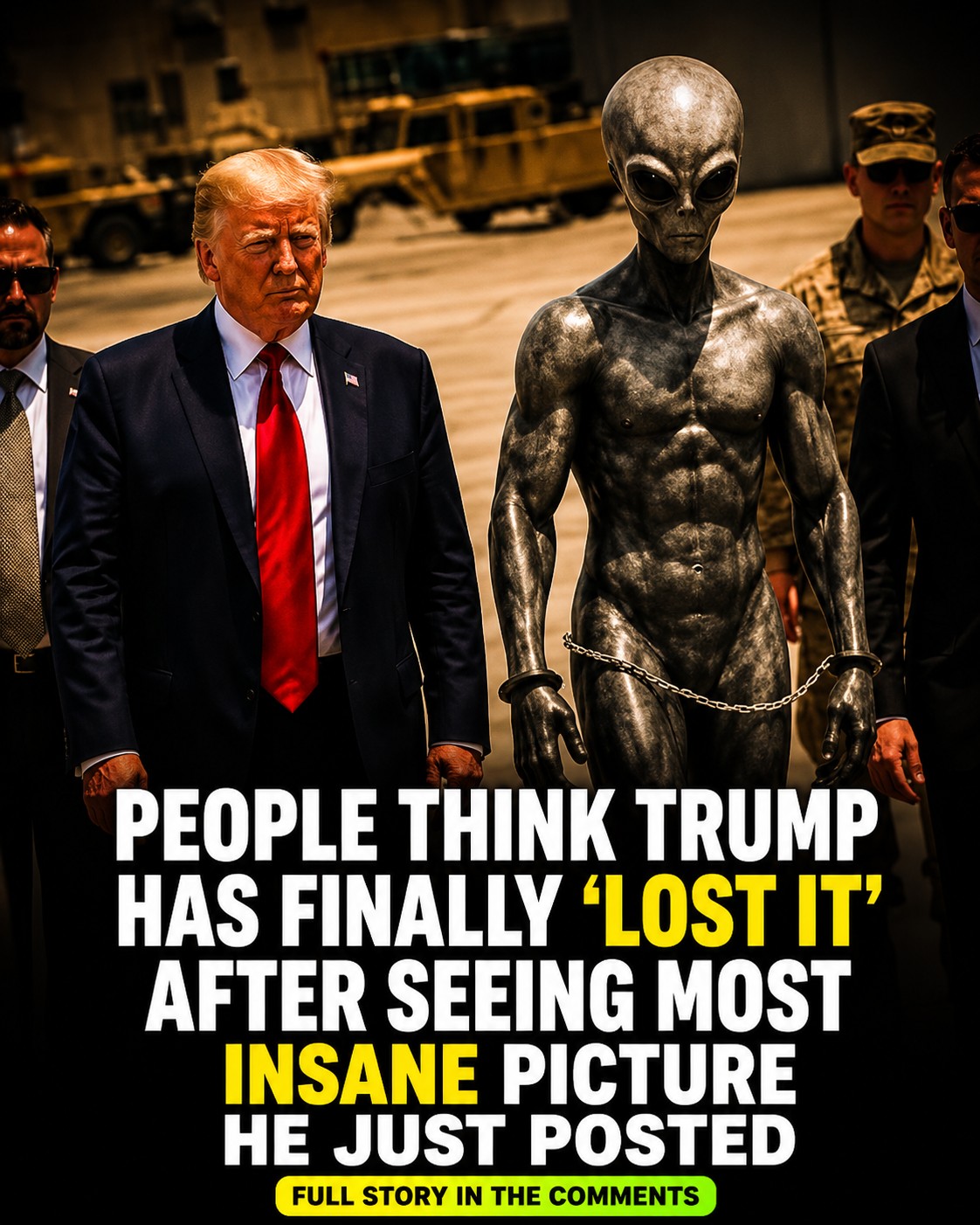
But the image that truly sent social media into overdrive looked almost intentionally designed to blur reality itself.
It resembled a grainy, secretly captured photograph. Trump appeared walking at night beside a tall extraterrestrial-looking figure while Secret Service agents followed several steps behind. The composition looked uncannily like a leaked surveillance photo someone was never supposed to see. Shadows stretched across the pavement. Flashlights glowed in the distance. The “alien” figure leaned slightly toward Trump as if engaged in private conversation.
Within minutes, millions of people were debating whether the posts were parody, propaganda, trolling, satire, distraction, or something else entirely.
Supporters immediately defended the images as part of a larger campaign connected to newly declassified UFO materials released by what Trump allies have reportedly begun referring to as the “Department of War.” According to those promoting the files, the documents contain long-hidden information involving alleged extraterrestrial encounters, military sightings, unexplained aerial phenomena, and secret Cold War-era experiments.
The declassified material itself became another source of online obsession.
Posts circulating alongside the images referenced alleged sightings by military pilots, strange lights observed during space missions, rumored Nazi UFO research projects, and reports tied to Apollo-era astronauts. Forums exploded with speculation. Some users insisted the timing proved the government was finally preparing the public for disclosure about non-human intelligence. Others dismissed the entire thing as political theater wrapped in science-fiction aesthetics.
Yet what unsettled critics most was not the content alone, but the timing.
The image barrage arrived during a period of growing political pressure surrounding stalled international negotiations, rising tensions in the Middle East, and intensifying criticism over civilian casualties connected to ongoing conflicts abroad. Headlines surrounding Trump had already become increasingly hostile, with opponents accusing him of mishandling foreign policy crises while others raised questions about investigations and political scandals still lingering in public discussion.
That context changed the way many people interpreted the posts.
To supporters, the bizarre imagery felt rebellious, entertaining, and disruptive in exactly the way they believe modern politics should be. Trump has long cultivated a public persona built around spectacle, unpredictability, and dominating attention cycles. His followers often argue that traditional politicians operate within scripted boundaries while Trump deliberately smashes them apart. In that interpretation, the alien and space-war imagery was simply another example of refusing to behave like a conventional leader.
But critics saw something far darker.
Many argued the flood of AI-generated content looked less like humor and more like deliberate distraction a carefully timed avalanche of visual chaos meant to overwhelm public conversation and redirect media attention away from more politically damaging stories.
That accusation reflects a growing fear already spreading across modern politics: the belief that reality itself is becoming harder to separate from performance.
Artificial intelligence has radically transformed the speed and scale of online manipulation. Images that once required professional editing teams can now be generated within seconds. Videos can be fabricated convincingly enough to fool millions. Fictional scenes spread online before fact-checkers can even begin responding. In that environment, the emotional impact of content often matters more than whether it is true.
Trump’s posts seemed to weaponize that exact confusion.
The images were absurd enough to generate ridicule, yet realistic enough to provoke uncertainty. Some people laughed at them immediately. Others stared longer than they wanted to admit, wondering why the pictures felt strangely believable despite their obvious fantasy elements. The internet became flooded with reactions ranging from memes to panic to conspiracy theories.
Comment sections quickly split into camps.
One group praised Trump for “telling the truth” about hidden government secrets and mocked critics for refusing to accept disclosure about extraterrestrial life. Another group accused him of intentionally feeding conspiracy culture to energize supporters while drowning legitimate political scrutiny beneath waves of spectacle.
A third group simply appeared exhausted.
Many users described the posts as another example of how impossible it now feels to distinguish political communication from entertainment, manipulation, or psychological warfare. In previous generations, bizarre claims about aliens and secret government programs might have remained isolated to fringe corners of the internet. Now they arrive directly from political figures with massive audiences capable of amplifying confusion globally within minutes.
That collapse of boundaries may be the most important part of the entire story.
Modern politics increasingly operates like an attention battlefield where outrage, absurdity, fear, humor, and conspiracy all compete simultaneously. Leaders no longer communicate only through speeches or press conferences. They communicate through viral moments, algorithmic chaos, and emotionally charged images designed to dominate public focus.
Trump understands that ecosystem better than almost anyone in politics.
For years, critics and supporters alike have acknowledged his unusual ability to seize control of public conversation through provocation alone. Even when people condemn him, they often remain trapped discussing whatever he posted, said, or implied. The alien imagery seemed engineered perfectly for that environment: impossible to ignore, impossible to fully explain, and almost impossible not to share.
At the same time, the posts revealed something deeper about the current state of public trust.
The reason so many people entertained the possibility of hidden truths behind obviously surreal images is because confidence in institutions has already eroded dramatically. Large portions of the public no longer fully trust governments, media organizations, intelligence agencies, or corporations. That distrust creates fertile ground for conspiracy theories and alternative narratives, especially during periods of political tension and global uncertainty.
When official information feels unreliable, even ridiculous stories begin attracting believers.
That dynamic became painfully obvious as social media users began dissecting every detail of the images. People zoomed into reflections, analyzed shadows, debated military insignias, and searched for supposed hidden messages embedded in backgrounds. Entire livestreams emerged dedicated to decoding the posts. Some claimed the alien imagery symbolized secret diplomatic contacts. Others argued it hinted at classified military technology.
Meanwhile, critics warned that the real danger was not whether anyone believed the images literally, but how effectively such content normalizes confusion itself.
If politics becomes indistinguishable from spectacle, then outrage loses meaning. Scandal becomes entertainment. Truth competes equally with fiction. Citizens stop knowing what deserves serious attention and what is merely designed to hijack emotional reaction.
That may explain why the reaction to Trump’s posts felt so intense.
The issue was never really about aliens.
It was about exhaustion.
Exhaustion from living inside an information environment where reality constantly feels manipulated, fragmented, and unstable. Exhaustion from watching politics increasingly resemble performance art powered by algorithms and artificial intelligence. Exhaustion from wondering whether public figures are communicating sincerely, strategically, ironically, or manipulatively at any given moment.
The images themselves may eventually fade into another strange chapter of internet history.
But the deeper anxiety they exposed will not disappear nearly as easily.
Because beneath the jokes, memes, and outrage lies a growing fear shared across political lines: that in an age flooded with AI-generated spectacle, the line separating distraction from truth is becoming harder to recognize with every passing day.