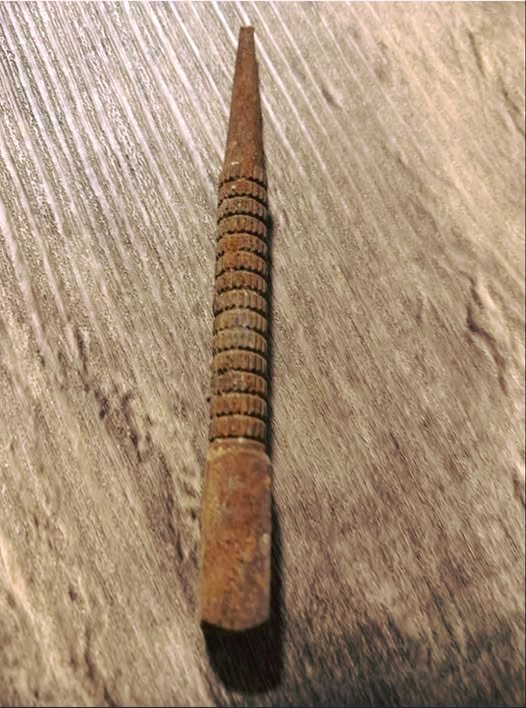
Some tools demand attention the moment you see them. Power drills roar to life, electric saws throw sparks and dust into the air, and high-tech gadgets come packed with buttons, screens, and promises of innovation.
Then there are the quieter tools the ones that sit unnoticed in old wooden drawers or tucked into the corner of a workbench, waiting patiently for the exact moment they are needed. One of those forgotten heroes is the nail punch, a tiny tool that has survived centuries of changing technology without losing its purpose.
At first glance, many people mistake it for a metal rod, a broken screwdriver, or some strange attachment whose purpose has long been forgotten. It looks too simple to matter. Yet carpenters, woodworkers, furniture restorers, and builders know better. This unassuming tool has helped shape homes, furniture, and craftsmanship for generations, and despite the rise of modern machinery, it remains almost impossible to replace completely.
The nail punch, also called a nail set, exists for one specific task: driving a nail slightly below the surface of wood without damaging the surrounding material. That tiny action may sound insignificant, but it is often the difference between rough amateur work and a smooth professional finish. Anyone can hammer a nail into wood. Making it disappear neatly beneath the surface requires precision, patience, and the right tool.
The process itself is surprisingly simple. After a nail has been hammered almost flush with the wood, the pointed tip of the nail punch is placed directly onto the nail head. A quick strike from a hammer pushes the nail slightly deeper into the material. The result is a tiny indentation that can later be filled with wood putty, sanded smooth, and painted or stained until the nail becomes almost invisible.
Without this step, finished woodwork often looks unfinished. Nail heads remain exposed, paint jobs appear uneven, and surfaces lose that polished, seamless appearance people associate with quality craftsmanship. For centuries, the nail punch has quietly solved this problem with remarkable efficiency.
Its origins stretch far deeper into history than many people realize. Long before hardware stores existed, early builders faced the same challenge: how to secure materials firmly while keeping surfaces smooth and functional. Ancient craftsmen improvised using sharpened metal pieces, chisels, and primitive hand tools to sink fasteners beneath wooden surfaces. Those early methods eventually evolved into specialized tools designed specifically for precision finishing work.
As civilizations advanced, woodworking became more refined. Furniture grew more decorative, homes became more detailed, and carpenters needed cleaner techniques. By the time the Industrial Revolution transformed manufacturing in the 18th and 19th centuries, the nail punch had become an essential part of the professional toolkit. Factories produced nails in massive quantities, construction expanded rapidly, and craftsmen needed reliable tools that delivered consistency every single time.
The beauty of the nail punch lies in its simplicity. Unlike modern power tools that require batteries, chargers, software updates, or maintenance, this tiny instrument relies entirely on mechanical precision. Most versions are made from hardened steel capable of enduring thousands of hammer strikes without bending or breaking. One end tapers into a fine point designed to fit various nail heads, while the opposite end is flat enough to absorb impact repeatedly.
Over time, manufacturers refined the design without changing its fundamental purpose. Some modern nail punches now feature textured ergonomic grips to reduce slipping. Others include color-coded handles for identifying different sizes quickly. Automatic spring-loaded versions even allow users to operate the tool without a separate hammer. Yet despite these improvements, the core idea remains almost identical to what craftsmen used generations ago.
Part of what makes the nail punch so respected among professionals is its ability to protect delicate materials. Hammering directly onto a nail near finished wood can leave ugly dents, scratches, or splits. Soft woods especially are vulnerable to damage during finishing work. A nail punch provides controlled force exactly where it is needed, preventing accidental marks that can ruin hours of careful labor.
Furniture makers rely on this precision constantly. Cabinets, trim work, hardwood flooring, and decorative molding all require hidden fasteners to maintain a clean appearance. A visible nail head might seem minor to some people, but in fine carpentry, details define quality. One poorly finished nail can disrupt the entire visual flow of a carefully crafted piece.
Restoration experts value the tool for another reason entirely: preservation. Antique furniture often cannot withstand aggressive modern techniques. Delicate wood that has aged for decades or even centuries can crack under too much pressure. Nail punches allow restorers to work slowly and carefully, preserving the integrity of historical pieces while still securing loose components effectively.
Even in today’s world of pneumatic nail guns and automated woodworking systems, the nail punch refuses to disappear. In fact, many professionals consider it indispensable precisely because machines cannot always provide the same level of detail. Nail guns may drive fasteners quickly, but they do not always sink them perfectly beneath the surface. Finish carpenters often follow behind with a nail punch to achieve the exact depth needed for flawless results.
Homeowners and DIY enthusiasts have also kept the tool alive. Small home repairs, craft projects, furniture assembly, and trim installation frequently require precision that oversized tools cannot deliver. For beginners learning woodworking, using a nail punch often becomes one of the first lessons in understanding patience and attention to detail.
There is also something strangely satisfying about using such a straightforward tool. In a world dominated by digital devices and disposable products, the nail punch represents a kind of timeless practicality. It does not try to impress anyone. It simply works. Generations of builders have trusted it because its purpose is clear and dependable.
That reliability explains why so many old toolboxes still contain one. A carpenter may replace drills, upgrade saws, or invest in newer equipment, but the nail punch often survives untouched through decades of changing technology. It becomes one of those tools quietly passed from one generation to the next, carrying scratches, dents, and stories from years of use.
The internet occasionally rediscovers tools like this when younger generations stumble across them in garages, flea markets, or inherited workshops. Photos circulate online with people guessing wildly about their purpose. Some think they are weapons, others mistake them for industrial scraps, and many are shocked to learn that such a small object serves such an important role. That confusion says something larger about modern life: people have become so accustomed to complexity that simple tools now appear mysterious.
Yet simplicity is exactly what gives the nail punch its lasting power. It solves one problem exceptionally well without requiring electricity, instructions, or upgrades. It asks for no attention and rarely receives praise, but it continues shaping the details people notice every day without realizing it.
Smooth walls, elegant trim, polished furniture, clean cabinetry countless finished surfaces owe their appearance to this tiny overlooked instrument. Behind every seamless wooden surface is often a nail punch working quietly in the background, hidden just like the nails it helps conceal.
In many ways, the nail punch is more than just a woodworking tool. It is proof that not every great invention needs to be revolutionary or complicated. Sometimes the most enduring designs are the ones that solve small problems perfectly, generation after generation, without ever demanding recognition.
Long after newer technologies become outdated, replaced, or forgotten, this simple piece of steel will likely still be sitting in workshops around the world, waiting for the next careful strike of a hammer and the next perfectly finished piece of woodwork.