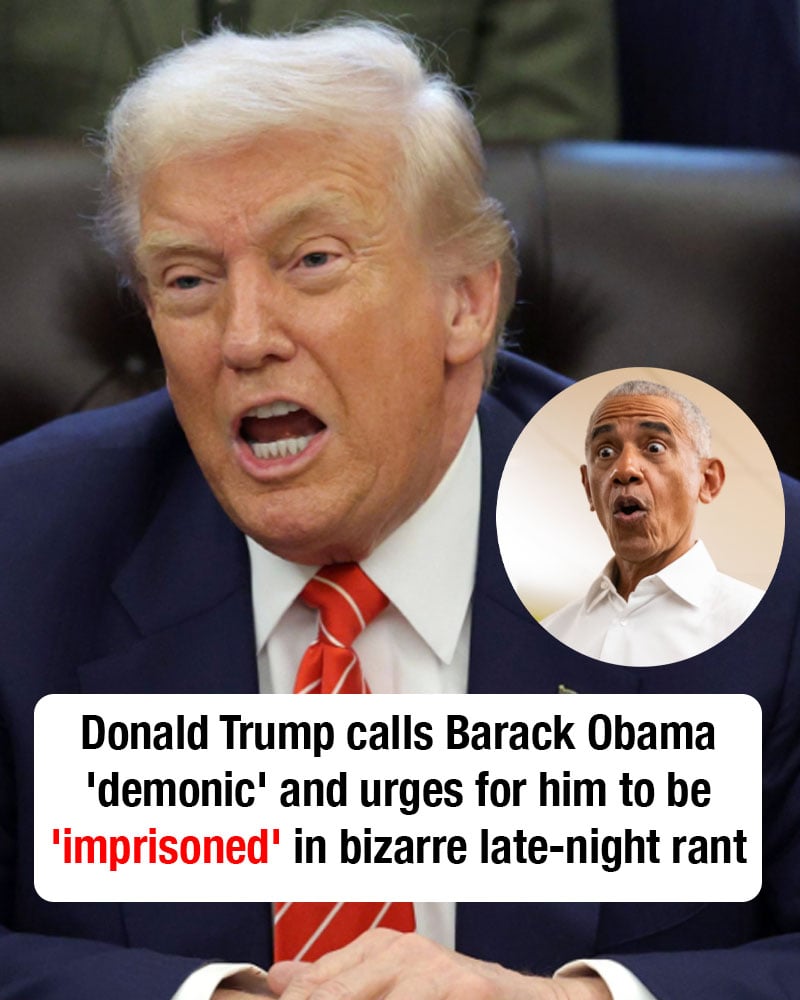
The political rivalry between Donald Trump and Barack Obama has once again exploded into public view, this time following a wave of late-night online posts that triggered outrage, debate, and renewed concern about the increasingly hostile tone dominating American politics.
What began as another overnight social media barrage quickly transformed into a national conversation about power, rhetoric, and the dangerous emotional temperature surrounding modern political culture.
Trump’s posts, filled with accusations, inflammatory language, and recycled conspiracy claims, targeted Obama directly while amplifying messages from supporters demanding investigations, arrests, and punishment against the former president. Among the most controversial moments was Trump reportedly endorsing or echoing claims describing Obama as “demonic” while encouraging narratives suggesting he should face imprisonment.
The reaction was immediate.
Critics accused Trump of deliberately escalating political hostility by transforming ordinary political disagreement into something darker and more personal. Supporters, meanwhile, argued he was merely expressing frustration over longstanding grievances tied to investigations, intelligence disputes, and allegations surrounding past elections.
But regardless of political perspective, the intensity of the language drew widespread attention.
The late-night posting spree reflected something much larger than one political argument.
It exposed how deeply American politics has shifted away from traditional ideological conflict and toward a culture increasingly fueled by outrage, suspicion, and permanent emotional warfare. Public figures are no longer treated simply as opponents to debate. More and more often, they are framed as existential enemies who must be defeated, punished, or publicly destroyed.
That transformation has altered the emotional landscape of the country.
For years, Trump has relied heavily on direct communication through social media and public statements that bypass traditional political norms. His style thrives on confrontation, unpredictability, and emotional intensity. Supporters view it as authenticity and refusal to conform to establishment expectations. Critics see something far more dangerous: a strategy that continuously raises public anger while weakening boundaries between disagreement and hostility.
The latest posts involving Obama reignited that entire debate.
Particularly controversial were references reviving previously debunked claims involving spying allegations, election interference theories, and accusations connected to earlier federal investigations. Though many of these narratives have circulated online for years, their reappearance from such a prominent political figure amplified them dramatically once again.
The effect was immediate across social media platforms.
Supporters rallied behind Trump’s accusations.
Critics warned that rhetoric portraying political opponents as criminals or enemies of the nation risks normalizing extreme hostility and political paranoia. Some observers expressed concern not only about the content itself, but about the growing inability of public discourse to distinguish between factual disagreement and emotionally charged conspiracy narratives.
At the center of the controversy stood Barack Obama, whose response contrasted sharply with Trump’s combative tone.
Obama has historically maintained a far more restrained public posture regarding Trump, often choosing measured commentary over direct escalation. Yet recent attacks reportedly involving AI-generated imagery targeting both him and Michelle Obama pushed the situation into more personal territory.
According to accounts surrounding the controversy, Obama dismissed some attacks against himself as part of modern political life but drew a firm boundary when it came to his family. The use of manipulated imagery and dehumanizing depictions involving Michelle Obama and their children reportedly angered him deeply.
That distinction resonated strongly with many observers.
While politicians have long attacked one another fiercely, families traditionally occupied more protected territory within public life. Increasingly, however, even spouses and children have become targets in online political warfare, meme culture, and social media outrage campaigns.
Obama’s reported reaction reflected growing concern over that erosion of limits.
The clash highlighted two radically different approaches to public conflict.
On one side stood Trump’s aggressive political style, fueled by confrontation, emotional escalation, and direct attacks designed to energize supporters while dominating media attention. On the other stood Obama’s more controlled posture, emphasizing restraint even while acknowledging how toxic modern political discourse has become.
For many Americans, the divide felt symbolic of the country’s larger fracture.
One vision of politics now operates through constant conflict, emotional mobilization, and perpetual outrage. The other warns that continually escalating hostility eventually carries consequences society may not fully control once released.
That tension has defined American politics increasingly over the last decade.
Every controversy now seems to move instantly beyond policy disagreement into something more emotionally explosive. Elections become existential battles. Opponents become threats to democracy itself. Online platforms reward outrage, fear, and emotional intensity because those emotions spread faster than moderation or nuance ever can.
As a result, political identity has become deeply personal for millions of people.
Criticism aimed at political figures often feels to supporters like criticism aimed at themselves. That emotional attachment makes compromise far more difficult because disagreement no longer feels intellectual alone it feels moral, cultural, and deeply emotional.
The Trump-Obama conflict embodies that transformation perfectly.
Neither man simply represents policy anymore.
Each has become a symbol around which millions project hopes, fears, frustrations, anger, and identity. For Trump supporters, attacks on him often feel like attacks on anti-establishment resistance itself. For Obama supporters, criticism directed toward him often feels connected to broader battles over race, democracy, and institutional trust.
Those emotional layers explain why even late-night social media posts now generate enormous national reactions.
The controversy also underscored how technology continues accelerating political tension. AI-generated imagery, manipulated videos, and viral misinformation increasingly blur distinctions between satire, propaganda, and harassment. What once might have remained fringe content online can now spread globally within minutes, amplified by influencers, political activists, and massive digital audiences.
That environment creates extraordinary pressure on public figures and ordinary citizens alike.
Every statement becomes weaponized instantly.
Every controversy escalates faster.
Every emotional reaction fuels another cycle of outrage.
Observers across the political spectrum increasingly warn that the cumulative effect may be damaging public trust and emotional stability nationwide. When politics operates constantly at maximum intensity, people begin viewing one another less as fellow citizens and more as enemies divided into opposing camps.
The danger, critics argue, is not simply anger itself.
Democracy has always involved fierce disagreement.
The deeper concern is what happens when political culture stops recognizing limits entirely when humiliation replaces debate, conspiracy replaces evidence, and emotional escalation becomes the dominant language of public life.
That fear lingered heavily beneath reactions to the Trump-Obama controversy.
Because ultimately, the argument was never just about two former presidents.
It was about what kind of political culture America is becoming.
A culture where every disagreement turns apocalyptic.
Where outrage never cools.
Where hostility becomes entertainment.
And where the line between political conflict and personal destruction grows thinner with every passing year.
As millions watched the latest clash unfold online, one truth became increasingly difficult to ignore: the country’s political divisions are no longer simmering quietly beneath the surface.
They are now shaping nearly every conversation, every institution, and every public moment in plain view.