
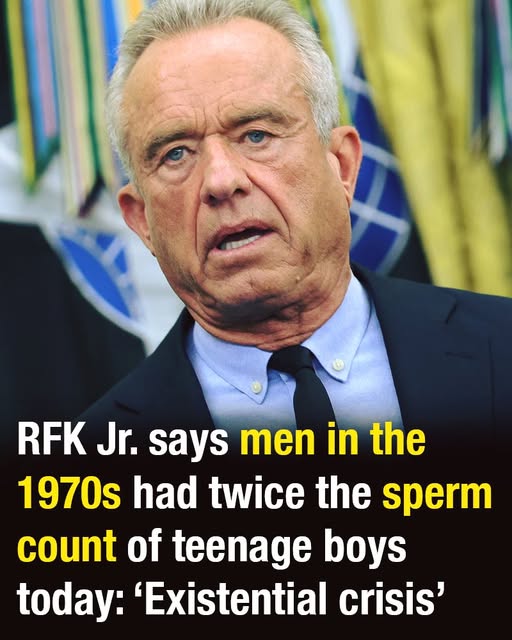
A growing debate about men’s health, fertility, and modern lifestyles has erupted once again after Robert F. Kennedy Jr. made alarming claims about declining sperm counts among younger generations.
During recent remarks that quickly spread online, Kennedy argued that sperm counts among men in the 1970s were reportedly far higher than those seen in many teenage boys and young men today, warning that society may be facing what he described as a serious public health crisis.
His comments immediately ignited fierce reactions across political, medical, and social media circles.
Some praised him for drawing attention to a topic many believe is overlooked or ignored. Others accused him of exaggerating complex scientific findings in order to provoke fear. Yet beneath the controversy lies a deeper issue that researchers around the world have been discussing for years: concerns about reproductive health appear to be growing, especially among younger men.
The conversation touches something deeply personal and emotional for many people.
Fertility is not simply a medical topic. It is tied to identity, family, aging, masculinity, relationships, and fears about the future. That emotional weight helps explain why discussions surrounding declining sperm counts often trigger intense reactions far beyond scientific debate alone.
For decades, scientists have studied evidence suggesting that average sperm counts in parts of the world may be decreasing over time. Several widely discussed studies have pointed toward long-term downward trends, particularly in Western countries, though experts continue debating the exact scale of the decline and what factors may be contributing most strongly.
Kennedy’s comments brought those anxieties back into public focus dramatically.
He framed the issue not merely as an isolated health concern, but as evidence of something larger happening to the modern human body itself. According to his argument, environmental toxins, processed foods, chemical exposure, stress, sedentary lifestyles, and industrial pollution may all be contributing to widespread biological changes affecting younger generations.
For many listeners, the warning felt unsettling because it connected everyday life to invisible long-term consequences.
Modern society surrounds people with plastics, pesticides, synthetic chemicals, artificial additives, air pollution, and constant technological exposure in ways previous generations never experienced at the same scale. While scientists remain cautious about drawing direct conclusions, growing numbers of researchers continue investigating whether environmental factors may influence hormone systems, fertility, and reproductive development over time.
The human body evolved slowly across thousands of years.
Modern industrial life changed dramatically within only a few generations.
That contrast fuels much of the concern surrounding the debate.
Some studies have specifically examined substances known as endocrine disruptors chemicals capable of interfering with hormonal systems inside the body. These compounds can appear in plastics, household products, food packaging, cosmetics, pesticides, and even water supplies. Researchers continue studying whether long-term exposure may affect fertility, development, or reproductive health.
Though conclusions remain complex and sometimes disputed, the possibility alone has created widespread anxiety.
Many people now wonder whether modern convenience has quietly introduced hidden biological costs society still does not fully understand.
At the same time, doctors caution against oversimplifying the issue.
Fertility is influenced by numerous factors, including genetics, diet, sleep, obesity, smoking, alcohol use, chronic stress, physical activity, medications, underlying medical conditions, and overall health. Measuring sperm counts across generations is also scientifically challenging because testing methods, population sampling, and medical standards have changed significantly over time.
That complexity often disappears once debates move online.
Social media thrives on alarming headlines and emotionally charged narratives, especially when topics involve masculinity, health, or fears about the future. Claims about “collapsing fertility” spread rapidly because they tap into broader cultural anxieties surrounding modern life itself.
Many younger men already feel growing pressure related to health, finances, relationships, and identity in an increasingly unstable world. Discussions about declining fertility add another layer of uncertainty to those fears. Some interpret the conversation medically. Others view it symbolically, as evidence that something fundamental about modern society may be damaging people physically and emotionally.
That emotional atmosphere helps explain why Kennedy’s comments gained such traction.
He did not present the issue as a narrow scientific question alone.
He framed it as part of a broader warning about industrialization, environmental damage, government oversight, and the hidden consequences of modern systems many people already distrust deeply.
Supporters argue that public health conversations often ignore chronic environmental issues until problems become impossible to deny. They point to rising rates of obesity, anxiety, hormonal disorders, chronic illness, and reproductive challenges as evidence that society should take long-term health trends more seriously.
Critics, however, warn that dramatic rhetoric can create unnecessary panic or distort scientific uncertainty into definitive conclusions that current evidence may not fully support.
The truth likely exists somewhere in between.
Most major medical experts acknowledge that fertility trends deserve continued research and attention. At the same time, they emphasize that reproductive health cannot be reduced to one single cause or one sweeping narrative.
Human biology is extraordinarily complicated.
Modern life affects people differently based on genetics, environment, lifestyle, and healthcare access. Some men experience fertility problems while others remain completely healthy. Population-wide statistics also do not necessarily predict individual outcomes.
Yet even with those cautions, the broader cultural concern continues growing.
Younger generations increasingly question whether modern living is truly making people healthier, happier, or more physically resilient over time. Rising mental health struggles, chronic stress, processed diets, lack of sleep, social isolation, and environmental concerns have all contributed to a sense that many people feel disconnected from the healthier rhythms previous generations may have experienced.
The fertility debate has therefore become symbolic of something larger.
It reflects fears that technological progress and industrial convenience may have arrived alongside unintended biological consequences people are only beginning to understand fully.
For parents, the conversation feels especially emotional.
Questions about children’s health, development, and future fertility touch deeply rooted instincts involving protection and survival. Any suggestion that younger generations may face invisible health risks naturally creates anxiety, even when scientific conclusions remain incomplete.
Meanwhile, public trust in institutions continues eroding across much of society.
That distrust makes conversations about environmental health especially volatile. Many people no longer feel confident that governments, corporations, or regulatory agencies always prioritize long-term public wellbeing over profit or politics. As a result, warnings like Kennedy’s often resonate strongly among audiences already skeptical of official assurances.
Whether one agrees with his conclusions or not, his remarks succeeded in reigniting a conversation many experts believe will only become more important in coming decades.
Because beyond politics and controversy lies a difficult reality: modern humans are participating in one of the largest uncontrolled environmental experiments in history.
Never before have people lived surrounded by so many synthetic substances, artificial systems, processed foods, digital technologies, and industrial chemicals simultaneously across an entire planet.
Scientists are still trying to understand what that means for the human body long term.
And until clearer answers emerge, the debate over fertility, health, and the future of younger generations will likely continue growing louder.
Not simply because people fear declining sperm counts alone.
But because beneath that fear lies a much larger question haunting modern society itself:
What if progress came with consequences nobody fully recognized until it was already changing us?