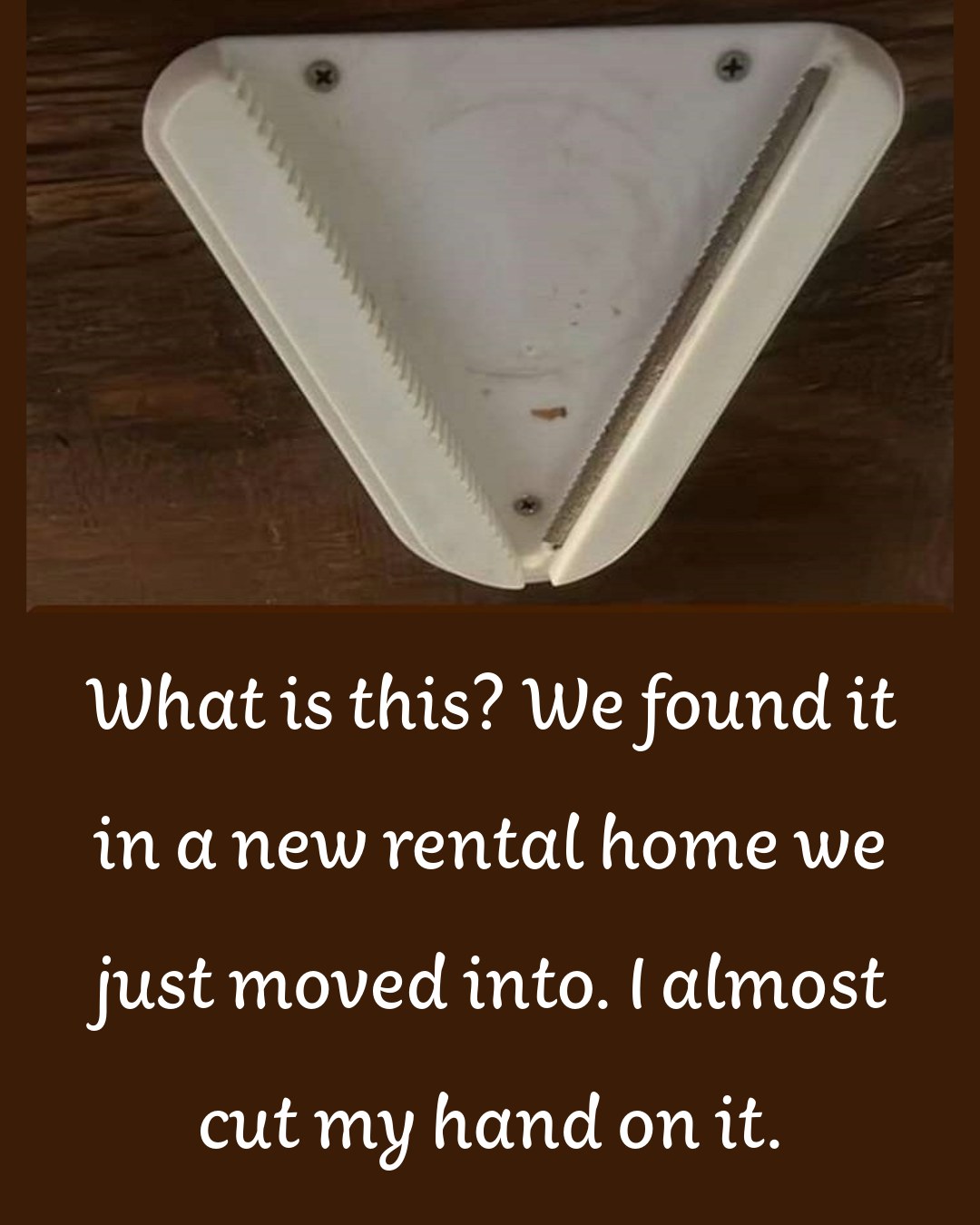
It usually begins the same way. Someone moves into an older house, starts cleaning the kitchen, and suddenly notices a strange metal object screwed beneath one of the cabinets.
It sits there quietly, almost invisible unless you crouch low enough to see it. For younger homeowners especially, the reaction is often immediate confusion.
“What is this thing?”
Photos start appearing online. Thousands of people begin guessing. Some think it is part of an old alarm system. Others assume it is a forgotten tool holder, a bottle opener, or even some kind of hidden surveillance device left behind decades ago. The mystery spreads because the object looks oddly mechanical yet frustratingly simple, like a forgotten piece of another era that no longer fits modern life.
But the truth turns out to be wonderfully ordinary.
It is an under-cabinet jar opener.
And once people discover its purpose, many become unexpectedly emotional about it.
The device itself is brilliantly simple. Mounted discreetly beneath a cabinet, it remains completely out of the way until needed. A person places a stubborn jar lid into its gripping metal teeth, twists the jar, and suddenly a lid that refused to budge pops open with surprising ease. No batteries. No electricity. No digital features. Just leverage, grip, and practical engineering doing exactly what it was designed to do.
For decades, these little tools quietly lived in kitchens across America and beyond, especially throughout the 1970s, 1980s, and early 1990s. They were inexpensive, nearly indestructible, and deeply useful for anyone struggling with factory-sealed lids. Elderly homeowners loved them. Parents relied on them. Children grew up watching grandparents use them without thinking twice about it.
Then, slowly, they disappeared from public memory.
Modern kitchens evolved into spaces dominated by sleek aesthetics and disposable convenience. Gadgets became electronic. Appliances became smarter. Simplicity quietly lost status. Somewhere along the way, tools designed to last decades without replacement stopped feeling exciting enough for modern marketing.
Yet these forgotten jar openers never really disappeared.
They simply stayed where they had always been, hidden beneath cabinets in aging homes, waiting for new owners to stumble across them years later.
What surprises many people is how effective they still are.
Unlike modern “smart” gadgets that require charging cables, software updates, or fragile plastic parts, these old jar openers continue functioning perfectly after thirty or forty years. Dusty? Maybe. Slightly rusted? Sometimes. But broken? Rarely.
That durability strikes a nerve in people now.
In a world flooded with products designed for short lifespans, the under-cabinet jar opener feels almost rebellious. It belongs to a generation of household tools created with a very different philosophy: solve one problem well, survive forever, and stay out of the way when not needed.
There is something strangely comforting about that.
Part of the emotional reaction comes from nostalgia, even among people too young to remember these gadgets firsthand. Older kitchens carried a certain practicality modern spaces sometimes lack. Cabinets were filled with odd little tools whose purpose was purely functional. Egg slicers. Hand-crank mixers. Wall-mounted can openers. Heavy-duty peelers that outlived entire marriages. None of them were flashy, but they worked reliably year after year.
The jar opener fits perfectly into that world.
Its design reflects an era when household objects were built around durability rather than replacement cycles. Nobody expected to buy a “new and improved” jar opener every two years. Once installed, it simply became part of the kitchen itself, almost permanent.
That permanence feels rare now.
Today, people often replace gadgets before they fail. Products become outdated not because they stop working, but because technology moves on or trends change. Kitchens once filled with sturdy metal tools now overflow with specialized devices that break quickly, occupy too much space, or depend entirely on electricity.
Against that backdrop, discovering an old under-cabinet jar opener feels unexpectedly refreshing.
Online reactions reveal something deeper than curiosity. Many people describe the gadget as “comforting,” “ingenious,” or “proof things used to be made better.” Others admit they initially planned to remove it during renovations but changed their minds after trying it once. Some clean and restore the device immediately, tightening loose screws like caretakers preserving a small piece of domestic history.
And perhaps that emotional response makes sense.
Because the jar opener represents more than hardware.
It represents a mindset.
A quieter era of design where usefulness mattered more than novelty. Where tools stayed hidden until needed instead of constantly demanding attention. Where practicality itself carried a kind of dignity.
There is also something deeply human about the object’s invisibility. Mounted under cabinets, it existed almost anonymously. Nobody showed it off to guests. Nobody posted photos of it online in the 1980s. It simply waited patiently for moments when someone struggled to open a jar of pickles, sauce, or jam.
Then it solved the problem instantly.
That humble reliability feels almost emotional now because modern life often feels so complicated. People are exhausted by subscriptions, upgrades, notifications, and endless consumption disguised as innovation. A tiny metal gadget that quietly performs one task perfectly for decades suddenly feels strangely profound.
The rediscovery of these tools has also sparked conversations about how homes preserve invisible history. Every old house contains traces of previous lives hidden in small details. Scratches on doorframes. Worn floorboards. Hooks installed for purposes long forgotten. Under-cabinet jar openers belong to that category of quiet domestic archaeology.
They remind new homeowners that kitchens were once deeply personal spaces shaped around real daily needs rather than showroom perfection.
Some younger people even describe feeling connected to previous homeowners through these forgotten objects. A widow installing it because arthritis made jars painful to open. A grandfather using it every morning without fail. A busy parent preparing dinner while children ran through the house. The object carries invisible memories despite its simplicity.
That emotional layer is part of why so many people decide to keep them.
What initially looked outdated suddenly feels timeless.
And perhaps that says something larger about the moment we are living in. People increasingly crave objects that feel grounded, dependable, and honest. Not everything needs to be reinvented with touchscreens and artificial intelligence. Sometimes the best design is the simplest: a sturdy tool solving a common problem quietly and effectively.
The under-cabinet jar opener survives because it never tried to be impressive.
It only tried to be useful.
And in a culture obsessed with constant upgrades, that humble little device hidden beneath an old cabinet now feels like a tiny act of resistance against unnecessary complexity.
So when homeowners discover one today, many no longer rush to unscrew it and throw it away.
Instead, they wipe off the dust.
Test it carefully.
Feel the satisfying grip clamp onto a stubborn lid.
And suddenly, a forgotten piece of the past becomes part of dinner once again.