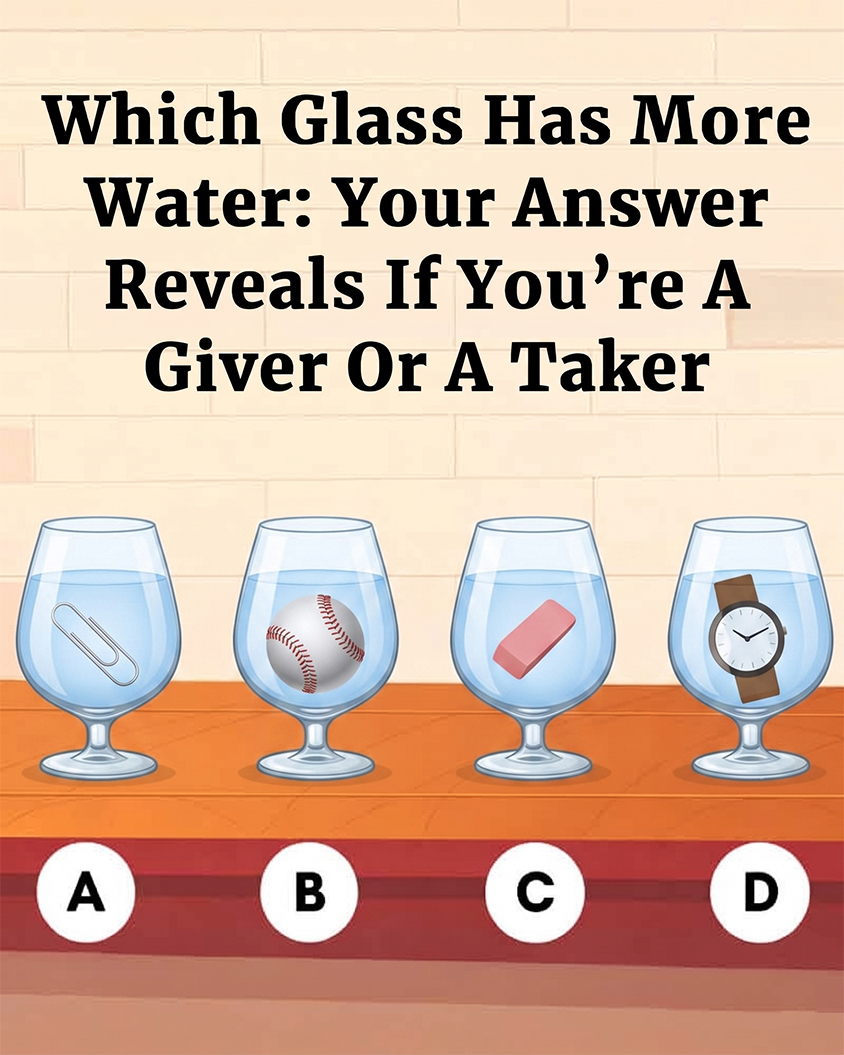
At first glance, the challenge looks almost laughably easy. Four identical glasses sit side by side, each labeled with a single letter: A, B, C, and D.
Every glass appears to hold nearly the same amount of water. But inside each one is a different object a paperclip, a baseball, an eraser, and a wristwatch.
The question sounds simple enough:
Which glass contains the most water?
Most people answer immediately. Some confidently point to the glass with the baseball because it looks fuller. Others choose the wristwatch because it appears heavier or more valuable. A few carefully analyze the sizes of the objects before deciding.
What surprises people is not just the answer, but the idea that their first instinct may reveal subtle clues about how they think, make decisions, and interact with the people around them.
That is why this puzzle has exploded online, sparking debates across social media and personality forums. What seems like a basic science question quickly becomes something more personal. People begin defending their choices, comparing interpretations, and wondering what their instinctive answer might quietly say about them.
The hidden trick behind the puzzle is rooted in a simple scientific principle many people learned in school but rarely think about in everyday life: displacement.
Whenever an object is placed inside water, it takes up space. The larger the object, the more water it displaces. That means the object itself affects how much actual water can fit inside the glass.
In other words, even if all four glasses appear equally full, the glass containing the smallest object must hold the most water because the object occupies the least amount of space.
Once people realize this, the answer becomes much clearer.
The paperclip in Glass A is significantly smaller than the baseball, eraser, or wristwatch. Because it takes up almost no room, Glass A contains more actual water than the others.
That makes Glass A the correct answer.
Yet what keeps this puzzle circulating online is not the science itself. It is the psychological twist attached to the choice.
Many people claim your instinctive answer reflects the way you approach life, relationships, and decision-making. Whether scientifically accurate or not, the interpretations fascinate people because they feel oddly personal.
If you chose Glass A, the one with the paperclip, many personality interpretations suggest you are observant, analytical, and thoughtful. You likely notice details other people overlook. Rather than reacting impulsively, you take time to think beneath the surface before making decisions.
People who choose A are often described as quiet givers. They may not always seek recognition for their actions, but they value substance over appearance. Instead of focusing on dramatic gestures, they understand that small things often matter most.
According to the interpretation, these individuals are careful with their energy, emotions, and generosity. They give intentionally rather than recklessly. Friends may see them as dependable, thoughtful, and emotionally aware, even if they are not always the loudest person in the room.
Those who choose Glass B, the baseball, are often described very differently.
Because the baseball is the largest and most visually dominant object, selecting it may suggest a tendency to focus on what immediately stands out. Personality interpretations claim these individuals are drawn toward boldness, confidence, and visible impact.
This does not necessarily make someone selfish or careless. Instead, it may indicate a mindset shaped by action, speed, and first impressions. People who pick B are often described as energetic and direct, preferring obvious solutions over subtle analysis.
At the same time, some interpretations suggest they can occasionally overlook deeper details because they react quickly to what seems most important on the surface.
Glass C, the eraser, tends to attract people who see themselves as balanced thinkers.
The eraser sits somewhere in the middle neither the smallest nor the largest object. People who choose it are often described as adaptable, fair-minded, and practical. Rather than leaning strongly toward giving or taking, they tend to respond based on the situation and the people involved.
These individuals may value harmony and reciprocity. They often try to avoid extremes, preferring measured responses over emotional reactions. Friends might describe them as reliable mediators who naturally seek compromise and balance in difficult situations.
Then there is Glass D, the wristwatch.
This choice is often associated with people who think deeply and emotionally. The watch itself carries symbolic meaning beyond its physical size. It represents time, memory, responsibility, and emotional attachment.
People who choose D are frequently described as reflective and sensitive. They may overanalyze situations or struggle to make quick decisions because they naturally search for deeper meaning in everything around them.
According to personality interpretations, these individuals often give a great deal emotionally but may also pull back when they feel overwhelmed or uncertain. They tend to live in a space between logic and emotion, constantly weighing timing, intention, and emotional consequences.
Of course, puzzles like this are not scientific personality tests.
They cannot truly define whether someone is a giver, a taker, analytical, emotional, selfish, or generous. Human personality is far more complicated than a single answer to a visual puzzle.
Still, these challenges remain popular because they encourage self-reflection in a playful way.
People enjoy discovering hidden patterns in themselves. Even when the interpretations are simplistic, they create moments of curiosity about how instinct shapes behavior. Why do some people immediately focus on details while others focus on appearance? Why do certain minds slow down and analyze while others rely on intuition?
The puzzle works because it taps into those questions.
It also highlights something important about perception itself. Most people do not fail the puzzle because they lack intelligence. They fail because the brain naturally prioritizes visual assumptions over careful reasoning.
At first glance, the glasses appear equal. The eye notices the visible objects before considering the invisible concept of displacement. That quick mental shortcut leads many people toward the wrong conclusion.
In everyday life, similar shortcuts happen constantly.
People judge situations based on appearance, first impressions, emotion, or instinct before slowing down to examine deeper truths. Sometimes those instincts help us. Other times they mislead us completely.
That may be the real reason puzzles like this resonate so strongly online. Beneath the playful personality labels lies a deeper reminder about human thinking itself.
The smallest detail can completely change the outcome.
The paperclip, the least impressive object in the entire image, quietly holds the key to the correct answer. It barely draws attention, yet it changes everything once you notice it.
And perhaps that is the most interesting lesson hidden inside the puzzle.
In a world obsessed with what looks biggest, loudest, or most important, the truth is often found in the tiny details almost everyone ignores at first glance.