Every year, the Met Gala transforms New York City into the center of the fashion world, bringing together celebrities, designers, artists, and cultural icons for one of the most visually extravagant nights in entertainment.
Held at the Metropolitan Museum of Art, the event is famous not only for luxury fashion but also for daring creativity, theatrical concepts, and headline-making appearances that often dominate social media for days afterward.
The 2026 Met Gala proved no different.
As cameras flashed across the red carpet and celebrities unveiled carefully crafted interpretations of the year’s theme, one appearance immediately rose above the rest in terms of public conversation and controversy. Supermodel Heidi Klum arrived in a dramatic sculptural transformation that left fans stunned, confused, fascinated, and deeply divided online.
Known throughout her career for embracing bold fashion risks and elaborate costume artistry, Klum once again pushed the boundaries of celebrity style. But this time, many viewers barely recognized her.
Within minutes of her arrival, images and videos spread rapidly across social media platforms, sparking intense debate over whether her appearance represented artistic brilliance or an example of fashion taken too far. Some praised the extraordinary craftsmanship behind the look, while others questioned whether it belonged on a fashion carpet at all.
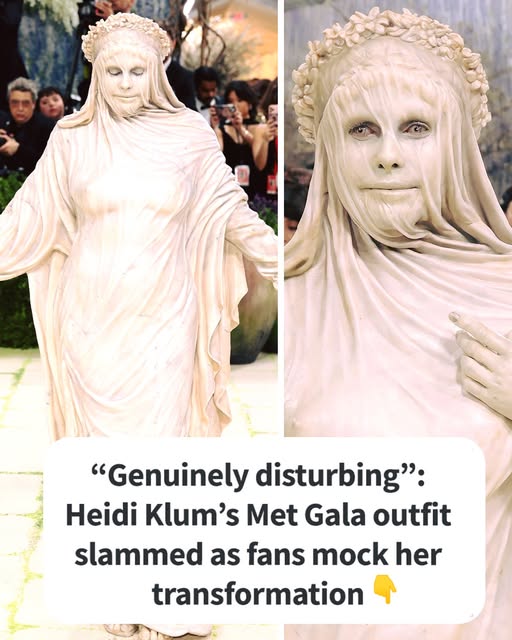
What made the transformation especially striking was its complete departure from Klum’s familiar glamorous image. Instead of appearing in a traditional couture gown or sleek designer ensemble, she emerged as what many described as a “living marble sculpture,” blurring the line between fashion, performance art, and illusion.
The concept was developed in collaboration with renowned prosthetics and special effects artist Mike Marino, whose work has previously transformed actors and celebrities for film and theatrical productions. Together, they created an intricate visual presentation inspired by classical sculpture and Renaissance-era artistry.
The design drew influence from famous marble masterpieces known for their lifelike details and flowing stone textures. Observers pointed to similarities with iconic sculptural works such as the Veiled Christ, celebrated for its illusion of delicate fabric carved from solid marble. Klum’s team reportedly sought to recreate that same surreal balance between softness and stone.
Achieving the effect required hours of preparation and extensive technical artistry. Prosthetic layers, specialized makeup, textured body paint, and sculpted materials were carefully combined to create the illusion that Klum herself had been transformed into carved stone. Every detail was designed to mimic the shading, cracks, and depth associated with classical marble statues.
The result was both mesmerizing and unsettling.
As she walked the carpet, cameras captured every angle of the transformation, highlighting how thoroughly the design altered her appearance. Her skin appeared stone-like, her facial structure seemed reshaped, and portions of the outfit blended seamlessly into the illusion of sculpted marble.
For supporters, the look represented exactly what the Met Gala is meant to celebrate: fearless artistic interpretation.
Many fashion enthusiasts applauded Klum for fully committing to the event’s spirit instead of playing it safe. In an era when some critics argue that red carpet fashion has become increasingly predictable, supporters viewed her appearance as a refreshing reminder that fashion can still shock, challenge, and provoke conversation.
Fans praised not only the creativity of the concept but also the sheer dedication required to execute it successfully. Social media users described the transformation as “museum-worthy,” “living art,” and one of the boldest looks of the night.
Some fashion commentators argued that Klum succeeded in doing something many celebrities fail to accomplish at the Met Gala: becoming unforgettable.
But not everyone reacted positively.
Criticism emerged almost immediately from viewers who found the transformation excessive, uncomfortable, or disconnected from what they consider high fashion. Some online users compared the look more to a Halloween costume or horror-film prosthetics than couture artistry. Others admitted they found the appearance disturbing rather than beautiful.
A major point of discussion centered around recognizability. Many viewers commented that they could hardly tell it was Heidi Klum beneath the layers of prosthetics and styling. For some critics, that became the central issue. They argued that fashion should enhance individuality rather than completely erase it.
Others questioned whether celebrity red carpets are becoming increasingly focused on shock value rather than elegance or wearable design. In their view, the transformation crossed a line where costume overtook fashion entirely.
Still, defenders of Klum quickly pointed out that the Met Gala has never been about ordinary glamour alone.
Unlike traditional award shows, the Met Gala encourages artistic experimentation and theatrical storytelling. Over the years, attendees have appeared dressed as religious icons, futuristic robots, fantasy creatures, historical references, and surreal artistic concepts. The event itself has evolved into a cultural spectacle where risk-taking is often rewarded more than conventional beauty.
In that context, supporters argued that Klum’s marble-inspired transformation fit perfectly within the event’s purpose.
The debate surrounding her appearance also reflects a larger conversation within modern fashion culture. Increasingly, fashion is no longer viewed solely as clothing. It has become intertwined with performance, identity, visual storytelling, and social media impact. Designers and celebrities now compete not only to look stylish but to create moments that dominate online attention.
Klum has built much of her public image around exactly that kind of transformation.
For years, she has earned recognition for elaborate Halloween costumes that often involve extreme prosthetics, body modifications, and full-character immersion. From aging herself decades into the future to appearing as mythological creatures and surreal fantasy figures, she has consistently demonstrated a willingness to disappear entirely into artistic concepts.
That fearlessness has become part of her brand.
Rather than maintaining a carefully controlled image of timeless glamour, Klum often embraces unpredictability. She treats appearance as a form of visual storytelling rather than simply an exercise in beauty. For many fans, that willingness to experiment is exactly why she remains relevant after decades in the public eye.
At the same time, reactions to her Met Gala appearance reveal how deeply personal fashion interpretation can be.
What one person sees as visionary artistry, another may see as excessive spectacle. Public response often depends on individual expectations, cultural preferences, and emotional reactions to unfamiliar visuals. Fashion, especially at events like the Met Gala, rarely produces universal agreement.
That tension between admiration and discomfort is often what keeps these moments alive in public conversation long after the event ends.
In many ways, Klum’s transformation succeeded precisely because it provoked such strong reactions. People debated it endlessly online. Fashion analysts dissected every detail. Social media users shared memes, praise, criticism, and theories about the artistic symbolism behind the design.
Very few attendees generated the same level of sustained attention.
As discussions continued, some observers noted that the strongest fashion moments are not always the safest or most conventionally attractive. Sometimes they are the ones that challenge audiences, force interpretation, and push viewers outside their comfort zones.
Whether admired or criticized, Heidi Klum’s appearance accomplished something undeniably powerful: it became impossible to ignore.
The transformation reminded audiences that fashion can still function as spectacle, conversation, and artistic experimentation rather than simple luxury branding. It also reinforced Klum’s long-standing reputation as one of entertainment’s most fearless style risk-takers.
By the end of the night, one thing had become clear. While countless celebrities walked the carpet in expensive gowns and polished tailoring, Heidi Klum delivered a moment people would continue discussing long after the cameras stopped flashing.
And in the world of the Met Gala, that may be the ultimate success of all.