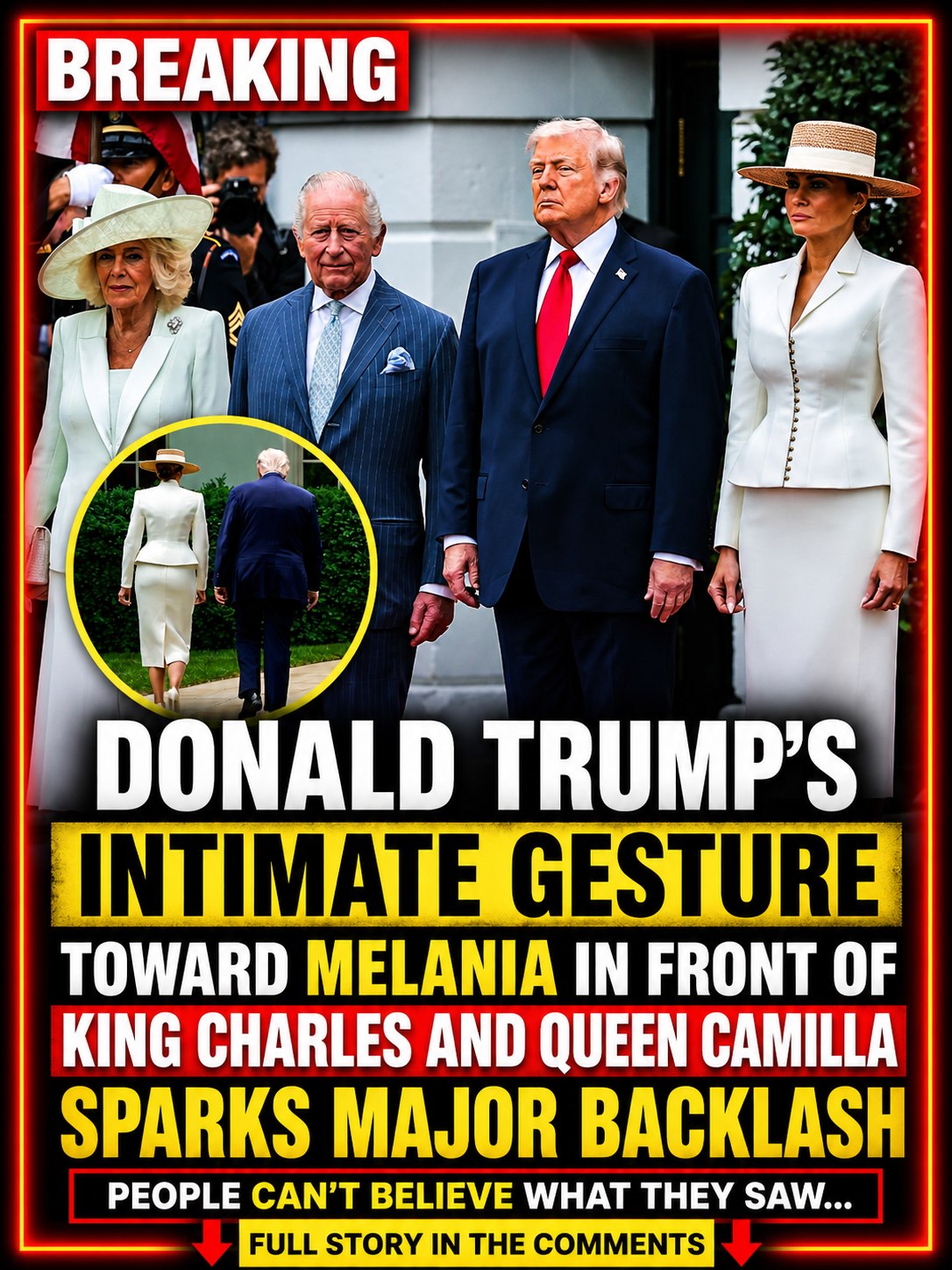
In Washington, every detail had been orchestrated with precision.
The atmosphere carried the weight of history, ceremony, and diplomacy, as Donald Trump and Melania Trump welcomed King Charles III and Queen Camilla for a high-profile state visit designed to symbolize unity between two longstanding allies. The setting was carefully curated to reflect stability and tradition, from the formal greetings to the ceremonial displays that unfolded across the capital.
A 21-gun salute echoed through the air, its sharp rhythm reinforcing the significance of the occasion. The Washington Monument stood as a silent witness in the background, framing a moment intended to project strength, continuity, and mutual respect. Inside the White House, the tone shifted to something more intimate yet equally controlled, with conversations unfolding in elegant rooms where every gesture, every word, carried meaning beyond the immediate exchange.
The visit followed a familiar script, one refined over decades of diplomatic practice. There were moments for public display and moments for private dialogue, each designed to reinforce the relationship between nations while showcasing the individuals at the center of it. The Green Room hosted quiet conversations over tea, while later events promised grandeur, including a formal banquet and an address that would mark the visit as historically significant.
Yet in the midst of this carefully constructed sequence, a single, unscripted moment altered the narrative. As the four figures moved together, side by side, in a display of unity and coordination, attention shifted unexpectedly. What had been a scene defined by symmetry and control became the focus of intense scrutiny, not because of a planned statement or a formal announcement, but because of a brief physical gesture that was captured and replayed from multiple angles.
The moment itself was fleeting, lasting only seconds, but its impact extended far beyond its duration. Observers interpreted it in sharply different ways, each perspective shaped by broader views on leadership, behavior, and public conduct. For some, it represented a break from established norms, an intrusion of personal informality into a setting defined by tradition and protocol. For others, it was seen as a natural expression of familiarity within a long-standing relationship, something that, in another context, might have gone unnoticed.
What followed was less about the gesture itself and more about what people believed it symbolized. In an era where public figures are constantly observed, analyzed, and interpreted, even the smallest actions can become focal points for larger debates. The incident became a lens through which individuals projected their expectations and assumptions, turning a brief interaction into a broader discussion about respect, boundaries, and the nature of public life.
Critics viewed the moment as inappropriate within the context of a formal diplomatic event. They argued that such occasions demand a heightened level of awareness and restraint, where personal behavior is expected to align with the gravity of the setting. From this perspective, the gesture was seen as a departure from those expectations, raising questions about the balance between personal expression and public responsibility.
Supporters, however, offered a different interpretation. They framed the moment as harmless, emphasizing the human element within relationships that exist even in the most formal environments. For them, the gesture did not diminish the significance of the event, but rather highlighted the authenticity of the individuals involved. In their view, the reaction to the moment said more about the observers than about the action itself.
This divide reflects a broader reality in contemporary society. Public figures are no longer evaluated solely on their policies or decisions, but also on their behavior in moments that may once have been considered insignificant. The rise of constant media coverage and instant sharing has transformed how events are experienced and remembered. A single frame, a brief clip, can overshadow hours of carefully planned activity.
In this case, the larger purpose of the visit strengthening diplomatic ties, reaffirming alliances, and engaging in meaningful dialogue was partially eclipsed by the attention directed toward that one interaction. The ceremonies, the speeches, and the discussions continued, but the narrative had shifted. What was intended as a display of unity became, in part, a reflection of division in how people interpret and respond to public behavior.
The presence of King Charles III and Queen Camilla added another layer to the situation. Representing an institution deeply rooted in tradition, their participation underscored the contrast between established protocols and evolving expectations. The juxtaposition of different cultural and institutional norms highlighted how perceptions of appropriateness can vary depending on context.
At its core, the reaction to the moment reveals an ongoing tension between formality and authenticity. On one hand, there is an expectation that public figures adhere to certain standards, particularly in settings that carry symbolic weight. On the other, there is a recognition that individuals bring their own personalities and relationships into those spaces, sometimes in ways that do not align perfectly with tradition.
The intensity of the response also speaks to the broader environment in which such events take place. In a highly polarized landscape, actions are often interpreted through the lens of existing opinions. What one group sees as a minor detail, another may view as significant. This dynamic ensures that even the smallest moments can become points of contention.
As the state visit concluded, the official outcomes agreements, statements, and reaffirmed partnerships remained intact. The diplomatic objectives were pursued as planned, and the formal aspects of the event proceeded without disruption. Yet the lingering conversation centered not on those achievements, but on the interpretation of a single, brief gesture.
In the end, the incident serves as a reminder of how public life has evolved. Leadership is no longer defined solely by decisions made behind closed doors, but also by the countless moments captured in the open, each subject to interpretation. The boundaries between personal and public behavior continue to shift, influenced by changing expectations and the ever-present gaze of an engaged audience.
What remains clear is that such moments, however small, have the power to shape perception. They can redirect attention, spark debate, and reveal underlying divisions in how people understand respect, connection, and leadership. In a setting designed to project unity and control, it was this unexpected detail that ultimately captured the world’s attention, illustrating how even the most carefully planned events can be redefined in an instant.