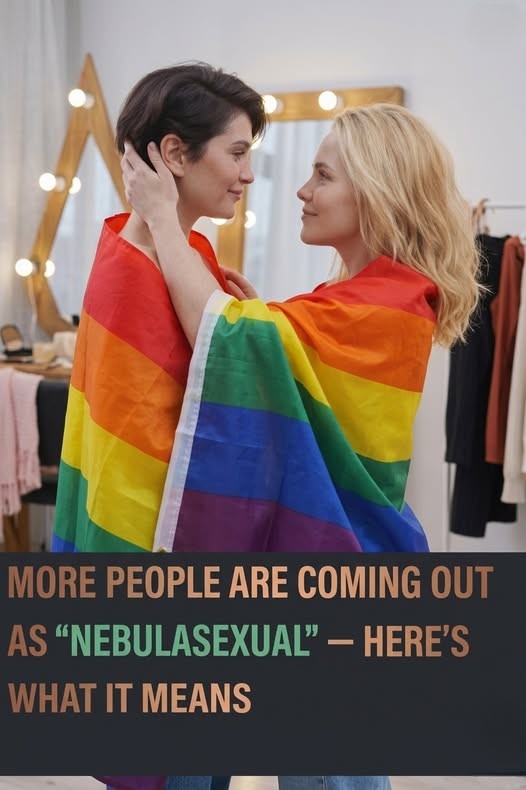
In a world where language is constantly evolving to better reflect human experience, a new term has begun to surface in conversations about identity and attraction: Nebulasexuality. For some, it sounds unfamiliar or even unnecessary.
For others, it represents something far more meaningful a long-overdue way to describe feelings that have never quite fit into existing categories.
At its core, nebulasexuality challenges the idea that attraction must be clearly defined or easily categorized. For individuals who identify with this term, attraction is not something that can be neatly labeled as sexual, romantic, or aesthetic. Instead, it feels fluid, indistinct, and often difficult to interpret. It is not a simple matter of uncertainty or indecision, but rather a consistent experience of ambiguity that shapes how they connect with others.
People who resonate with this identity often describe their feelings as existing in a kind of emotional and psychological haze. They may deeply value closeness, companionship, and emotional intimacy, yet struggle to pinpoint exactly what form their attraction takes. The traditional language of relationships terms that separate desire into clear categories can feel limiting or even inaccurate when applied to their experiences.
For many, the absence of a fitting term has historically led to frustration. Without language to describe what they were feeling, individuals were often left questioning themselves, wondering whether their experiences were valid or simply misunderstood. Nebulasexuality, in this sense, provides something more than a label. It offers recognition, a way of saying that this gray area is not an error but a legitimate way of experiencing connection.
The emergence of this term has also sparked conversation and, in some cases, criticism. Detractors argue that the growing number of identity labels complicates rather than clarifies the conversation around sexuality. They see it as an unnecessary fragmentation of concepts that could be understood more simply. From this perspective, adding new terminology risks creating confusion rather than fostering understanding.
However, for those who identify with nebulasexuality, such critiques often miss the point. The value of the term lies not in categorizing people for the sake of classification, but in giving voice to experiences that have long been overlooked. It is less about creating divisions and more about acknowledging nuance.
This nuance is particularly significant for individuals who are Neurodivergence, including those who experience the world through conditions such as ADHD, autism, or other cognitive differences. For some of these individuals, the boundaries between different types of thoughts and feelings can be less distinct. Intrusive thoughts, emotional attachments, and patterns of focus may overlap in ways that make it difficult to separate attraction from other mental experiences.
In such cases, the traditional frameworks for understanding sexuality can feel insufficient. The challenge is not simply about identifying attraction, but about distinguishing it from other internal processes. Hyperfocus, for example, might resemble romantic or emotional intensity, while neutrality might be mistaken for disinterest or aversion. Nebulasexuality provides a way to articulate these complexities without forcing them into rigid definitions.
The term also reflects a broader shift in how identity is understood. Rather than viewing attraction as something fixed and easily defined, there is growing recognition that human experience can be fluid, layered, and sometimes contradictory. This shift does not eliminate existing identities, but it expands the conversation to include those who do not see themselves reflected in traditional categories.
For many people, discovering a term like nebulasexuality can be a moment of clarity rather than confusion. It offers a sense of validation, confirming that their experiences are shared by others and are worthy of acknowledgment. This can be especially important for individuals who have spent years feeling out of place, unable to fully relate to the identities around them.
At the same time, the rise of new identity terms inevitably brings tension. Language evolves unevenly, and not everyone moves at the same pace. What feels liberating to one person may feel unnecessary or overwhelming to another. These differences in perspective often reflect deeper questions about how society defines identity, belonging, and authenticity.
Despite the debate, one thing remains clear: the conversation itself is significant. It highlights the ongoing effort to better understand the diversity of human experience, even when that understanding is incomplete or evolving. Terms like nebulasexuality are part of that process, offering new ways to think about connection, attraction, and identity.
Importantly, identifying with nebulasexuality does not require certainty in the traditional sense. In fact, it embraces uncertainty as a defining feature rather than a problem to be solved. It acknowledges that not all experiences fit neatly into predefined boxes, and that this does not make them any less real or meaningful.
For those who live within this gray space, the term can feel like a quiet affirmation. It says that their experiences do not need to be simplified or forced into clarity to be valid. Instead, they can exist as they are complex, shifting, and sometimes difficult to articulate.
In a broader cultural context, the emergence of such terms reflects a growing willingness to explore identity in more nuanced ways. It challenges the assumption that everything must be easily categorized and invites a more open-ended understanding of human connection.
Ultimately, nebulasexuality is not just about defining a specific group of people. It is about expanding the language we use to describe ourselves and each other. It is about recognizing that some experiences resist clear definition, and that this resistance is not a flaw but a feature of human diversity.
As discussions continue and perspectives evolve, the term may gain wider recognition or remain a niche concept within certain communities. Regardless of its future, its existence already serves a purpose. It provides a name for something that once went unnamed, offering a sense of belonging to those who need it.
In that sense, the impact of nebulasexuality goes beyond the word itself. It lies in the message it carries that even the most indistinct feelings, the ones that seem hardest to explain, are still part of the human experience. And by giving them language, however imperfect, we take a step closer to understanding not just others, but ourselves.