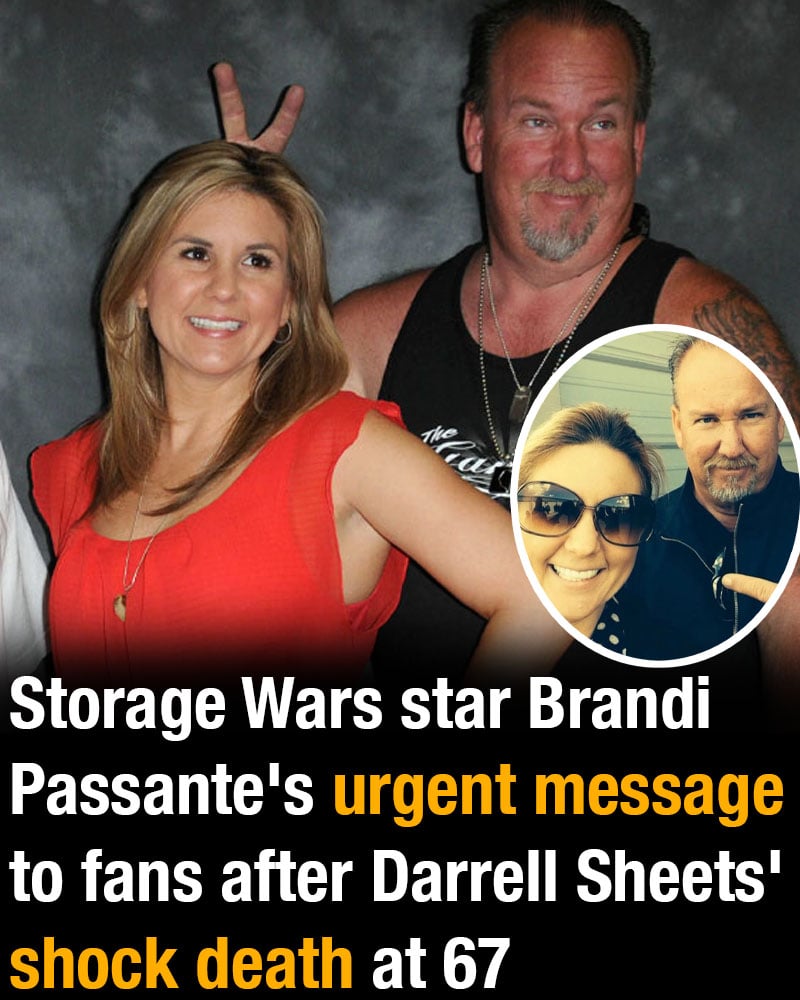
The sudden passing of Darrell Sheets has sent shockwaves through the tight-knit world of Storage Wars, leaving behind not just grief, but a heavy silence that words struggle to fill.
For those who knew him beyond the cameras, this loss is not simply about the absence of a familiar face it is about the disappearance of a personality that once felt larger than life. Among those most affected is Brandi Passante, who has chosen to respond not with distance, but with honesty that cuts straight to the heart of what this moment truly represents.
In the days following the news, Brandi did not retreat into private mourning alone. Instead, she stepped forward with a message that carried both the weight of her grief and the urgency of something far bigger than one loss. Her words were not polished or carefully filtered. They were direct, emotional, and grounded in a reality that often goes unseen. What she shared was not just about Darrell, but about the kind of struggles that can exist quietly beneath even the most outgoing and recognizable personalities.
For many viewers, Darrell Sheets was known as “The Gambler,” a bold, risk-taking figure who brought energy and unpredictability to every auction. He appeared confident, outspoken, and fully in control a presence that seemed immune to the kinds of struggles people associate with vulnerability. That image, however, is exactly what makes his loss so difficult to process. It challenges the assumptions people make about strength, about resilience, and about what it really means to be okay.
Brandi’s response reflects that complexity. She has made it clear that this is not just about remembering a colleague or honoring a friend. It is about confronting the uncomfortable truth that pain does not always announce itself. It does not always look the way people expect it to look. Sometimes, it exists quietly, hidden behind humor, confidence, or success. And when it goes unnoticed or unspoken, it can grow in ways that become impossible to ignore only when it is too late.
Her message is shaped by that understanding. Rather than focusing solely on loss, she has chosen to use this moment as a way to reach outward. By encouraging people to seek help, to speak up, and to recognize their own value, she is attempting to transform something deeply painful into something that might prevent another tragedy. It is not an easy thing to do to take personal grief and turn it into a public call for awareness but it is precisely that choice that gives her words such impact.
At the center of her message is a reminder that feelings of hopelessness, no matter how overwhelming they may seem, are not permanent and do not have to be faced alone. She urges those who are struggling to reach out, whether to a friend, a family member, or a professional resource. In the United States, she specifically points to the 988 helpline, a direct connection to support for those in crisis. It is a simple action, but one that can create a crucial moment of interruption a chance for someone to pause, to be heard, and to find a path forward.
What makes her message resonate so strongly is its honesty about the ripple effects of loss. She does not frame it in abstract terms or distant language. Instead, she speaks about the reality that when someone is gone, the pain does not disappear. It shifts. It spreads. It settles into the lives of those left behind, often in ways that are difficult to articulate. Questions linger. Regret takes root. Memories become both a comfort and a source of ache. The absence becomes something that cannot be undone.
By acknowledging this, Brandi is not trying to assign blame or simplify something inherently complex. Rather, she is highlighting the importance of connection the idea that reaching out, even in a moment of uncertainty or fear, can make a difference that is impossible to measure in advance. Her words emphasize that no one is a burden simply for struggling, and that asking for help is not a sign of weakness, but of courage.
There is also a broader message woven into her response, one that speaks to the culture surrounding mental health more generally. Too often, people are encouraged to appear strong, to keep their struggles private, or to push through difficult emotions without acknowledging them. This creates an environment where vulnerability feels risky, where silence feels safer than honesty. Brandi’s message challenges that pattern, suggesting that openness and support are not just helpful, but necessary.
The reaction from fans has reflected the depth of what she shared. Many have expressed appreciation not only for her willingness to speak out, but for the way she reframed the conversation. What could have remained a moment of mourning has instead become a moment of awareness, prompting people to reflect on their own lives and the lives of those around them. It has encouraged conversations that might not have happened otherwise.
At the same time, her message does not erase the grief that brought it into existence. The loss of Darrell Sheets remains deeply felt, both by those who knew him personally and by those who came to know him through television. His presence, his personality, and his contributions to the show are part of a legacy that will not be forgotten. But alongside that legacy is now something else a reminder of the importance of looking beyond appearances and recognizing the humanity behind them.
In the end, what Brandi Passante has shared is not just a response to tragedy. It is an invitation to pay closer attention, to check in with others, and to take seriously the emotional struggles that often remain hidden. It is a call to action that extends far beyond one moment, one person, or one loss.
Her message is simple, but it carries weight: you matter more than you think, your struggles are valid, and there is always someone willing to listen if you are willing to reach out. In a world where it is easy to feel isolated, those words have the power to create connection and sometimes, that connection can make all the difference.