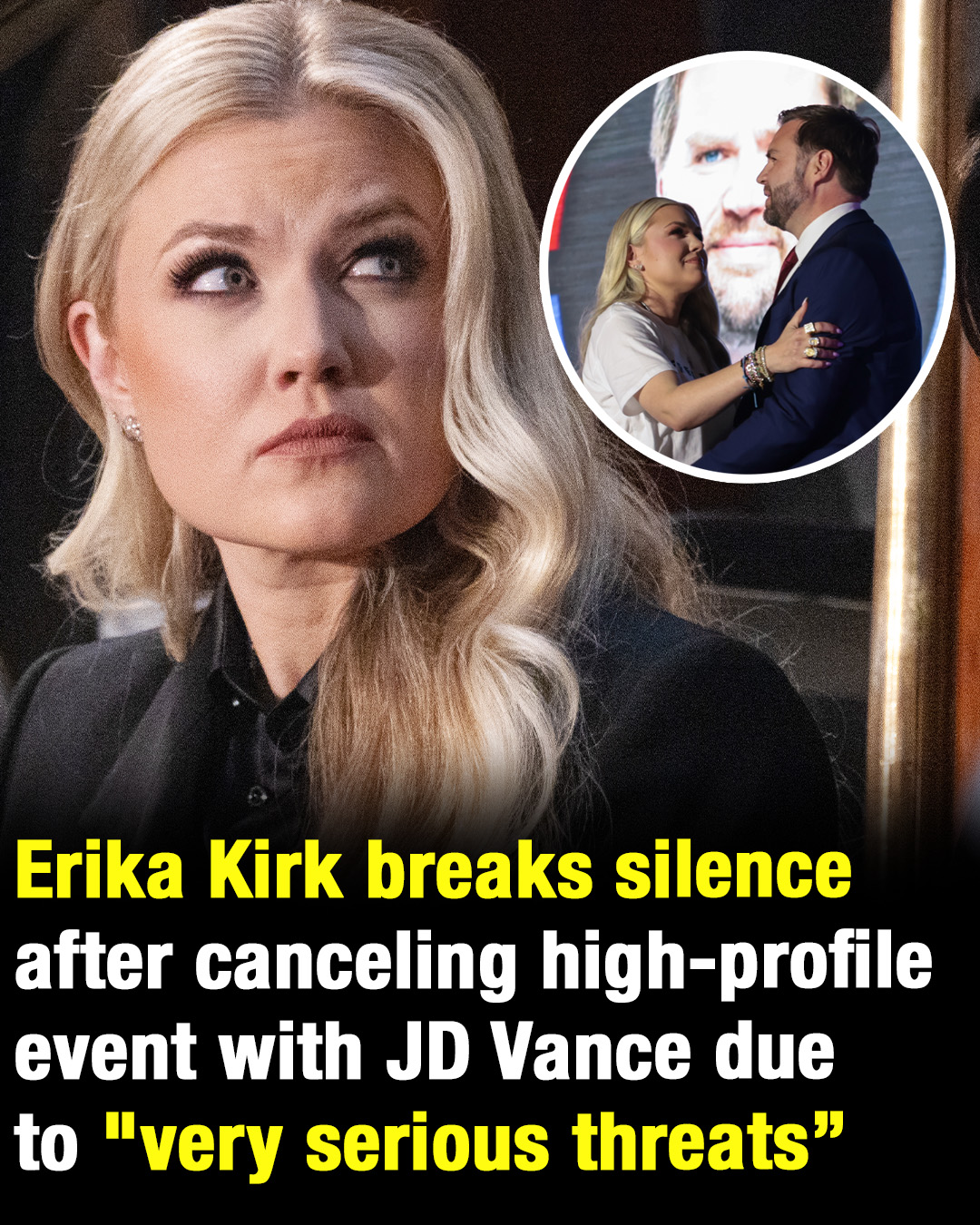
Erika Kirk has spoken publicly for the first time about her decision to withdraw from a highly anticipated appearance at the University of Georgia, offering a glimpse into the difficult circumstances that led to her absence.
What might have appeared to some as a sudden cancellation was, in reality, the result of a deeply serious and personal decision shaped by safety concerns and recent trauma.
In the months leading up to the event, Erika had been navigating a profound transformation in her life. Following the tragic loss of her husband, Charlie Kirk, she found herself stepping into a more visible role, both publicly and within Turning Point USA. The transition was not only professional but deeply emotional, as she worked to carry forward a legacy while also coping with grief that had not yet had time to settle.
Her appearances alongside JD Vance had begun to draw attention, symbolizing a sense of continuity and resilience. At a previous event in Mississippi, the two shared a moment onstage that resonated with many in attendance. It reflected not only a political alignment but also a personal narrative of perseverance in the face of loss. For supporters, these appearances signaled that Erika was finding strength and purpose despite the circumstances she had endured.
The scheduled event in Georgia was expected to continue that trajectory. It was seen as another step in her reemergence into public life, an opportunity to connect with audiences and reinforce the message she had been building in recent months. However, as the date approached, the situation began to shift.
According to statements that later emerged, credible and “very serious threats” were identified ahead of the event. While specific details were not publicly disclosed, the language used made it clear that the concerns were significant enough to warrant immediate attention. Security considerations quickly became the central focus, overshadowing the original purpose of the gathering.
JD Vance himself acknowledged the gravity of the situation, indicating that there had been real uncertainty about whether the event could proceed at all. The possibility of a full cancellation was openly discussed, highlighting the level of risk that organizers and participants were being asked to consider.
For Erika, the decision was not a simple one. It required balancing multiple factors, including her personal safety, the well-being of those around her, and the emotional weight of her recent experiences. Having already faced a traumatic loss connected to a public setting, the emergence of new threats carried a different kind of impact. It was not just about the present moment, but about the memories and fears that such warnings could revive.
Ultimately, she chose to step back.
The decision was made quietly, without dramatic announcements or extended explanations at the time. Instead, she deferred to the guidance of her security team and those advising her on how best to handle the situation. In doing so, she prioritized caution over visibility, a choice that reflects the complex realities faced by individuals in the public eye.
When she later addressed the cancellation, her message was measured and composed. She expressed gratitude for the support she had received and reaffirmed her faith, but she also made it clear that the decision had been necessary. There was no attempt to sensationalize the situation or draw attention to herself. Instead, her words conveyed a sense of resolve and clarity.
The response to her announcement revealed the broader context in which this event had taken place. Supporters expressed understanding and concern, recognizing the difficult position she had been in. Others pointed to the incident as an example of the challenges associated with public engagement in a highly polarized environment.
The situation also raises larger questions about the nature of public life today. For individuals who step into visible roles, particularly in areas connected to politics or advocacy, the risks are not always abstract. They can become immediate and personal, requiring decisions that go beyond professional considerations.
Erika’s experience underscores how quickly circumstances can change, and how the line between public duty and personal safety can become blurred. What begins as an opportunity to speak or connect with an audience can, under certain conditions, transform into a situation that demands caution and restraint.
There is also a deeper emotional dimension to her choice. Grief does not follow a fixed timeline, and the process of rebuilding after loss is rarely straightforward. For someone in her position, stepping into the spotlight again involves not only external expectations but also internal challenges. The presence of threats adds another layer to that process, making each decision more complex.
Her choice to withdraw does not signal retreat in a broader sense, but rather an acknowledgment of the realities she is facing. It reflects an understanding that resilience is not only about moving forward, but also about knowing when to pause. Strength can take different forms, and sometimes it is expressed through the willingness to step back when circumstances demand it.
The event at the University of Georgia ultimately proceeded without her, but her absence carried its own message. It served as a reminder that behind every public appearance is a series of considerations that are often unseen. The decision to attend, to speak, or to engage is never made in isolation from the broader context in which it occurs.
In a time when public figures are often expected to maintain constant visibility, Erika Kirk’s decision highlights a different perspective. It shows that there are moments when absence is not a sign of weakness, but of careful judgment. It emphasizes the importance of prioritizing safety and well-being, even when doing so may disappoint expectations.
Her story continues to unfold, shaped by both personal experience and public responsibility. As she navigates this path, her choices will likely continue to reflect the balance she is striving to maintain. Between honoring the past and moving forward, between visibility and caution, she represents a reality that is both deeply personal and widely relevant.
In the end, her decision to cancel the appearance was not defined by fear alone, but by awareness. It was a recognition of the environment she is operating in and the responsibilities she carries not just to an audience, but to herself and those closest to her.