I once believed miracles arrived wrapped in light — soft, almost unseen. But the miracle that saved my daughter came wrapped in leather, roaring on sixty-three thunderous motorcycles that shook the hospital courtyard to its core.
Exactly at 7 PM, as the sun sank behind the hills, the deep growl of 63 engines filled the evening air. It wasn’t chaotic — it was like a symphony made of steel and grit. For thirty seconds, they thundered together, then fell completely silent.

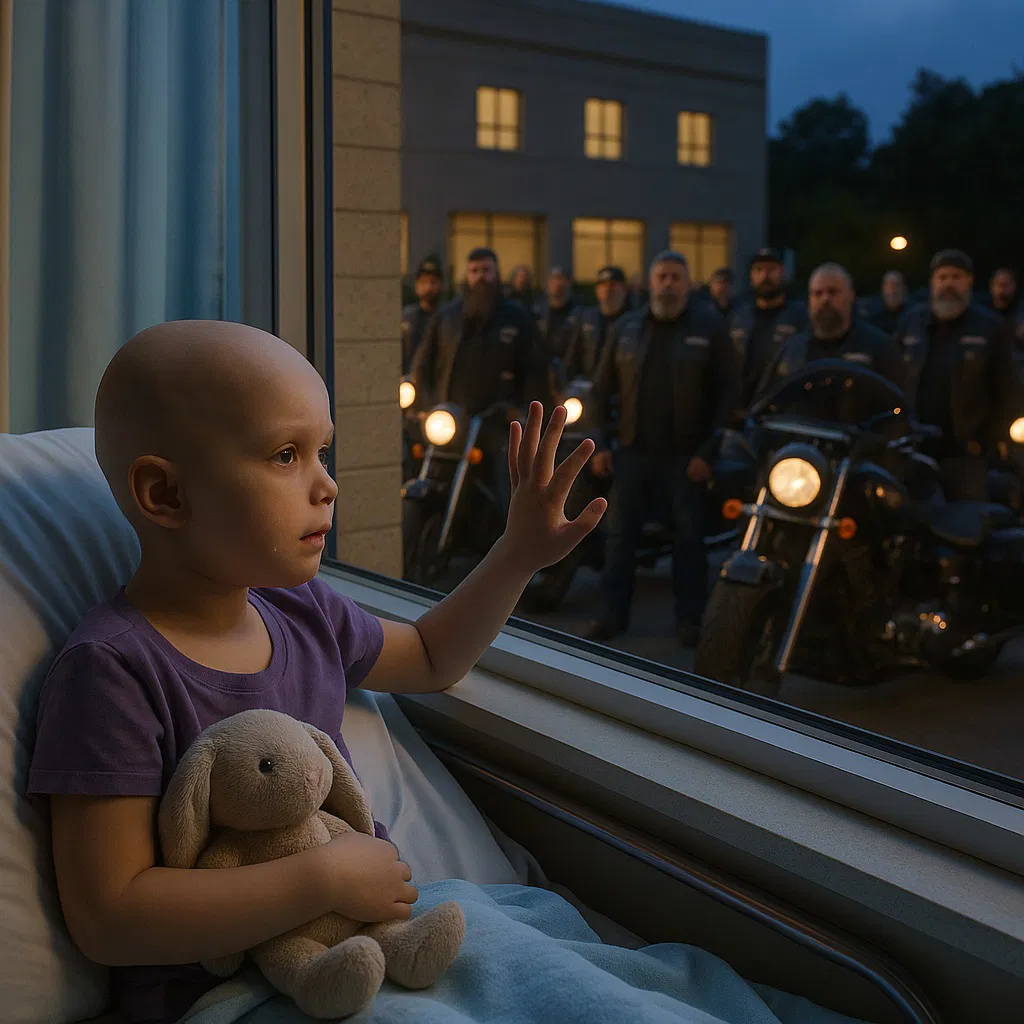
Inside, my daughter Emma — too weak to stand, her small body nestled beneath thick hospital blankets — reached out a trembling hand toward the window. Her eyes brightened. Her lips lifted into the faintest smile I hadn’t seen in weeks. And then the tears started.
They weren’t tears of pain. They were tears of happiness.
Just outside her window, lined up in a perfect arc, were 63 motorcycles and their riders. Men and women clad in leather vests, their faces weathered by wind and sun, stood quietly, some bowed heads, others gazing up at her window. But it wasn’t just the bikes or the people — it was the patches they wore.
On every vest was sewn a patch: a butterfly with fiery wings and a fierce, determined look. Beneath it, in bold lettering: Emma’s Warriors.
This wasn’t a show. These weren’t strangers. These were the Iron Hearts Motorcycle Club — a brotherhood of riders who had become our family in the battle against cancer. Who stood by us through every grim diagnosis, every hospital stay, every silent tear beside Emma’s bed.
They didn’t come just to ride.
They came because they loved her.
It all began nine months earlier on a spring morning that shattered my world.
Emma had always been a beacon — bright, curious, full of life. One day she was chasing butterflies in the yard, and the next, she lay on the floor, pale and struggling for breath.
The diagnosis was swift: acute lymphoblastic leukemia.
The words barely registered as I sat in Dr. Morrison’s office, gripping the armrests like they were lifelines. The best treatment was experimental. Hopeful. But outrageously costly: $200,000. Insurance wouldn’t cover it.
I remember stumbling to my car, numb, locking the doors. I sat outside Murphy’s Diner and sobbed. I couldn’t move, couldn’t breathe. My daughter’s life had a price tag — and I didn’t have the money to buy her more time.
Then I heard it — a low rumble, followed by the unmistakable sound of motorcycles arriving.
A dozen bikers pulled into the diner parking lot for their weekly meetup. I tried to hide my face, but one of them noticed me.
He was huge — built like a fortress, tattooed arms, a thick beard, a vest covered in patches. His name, stitched in red thread, read: Big Mike.
He approached my car and gently knocked on the window.
“Ma’am, are you okay?” he asked, his voice calm, steady, and kind.
I cracked the window and whispered the truth — all of it. Emma’s diagnosis. The cost. The hopelessness consuming me.
He listened quietly.
When I finished, he didn’t ask questions. He just nodded.
“No one fights alone,” he said, tapping his vest.
The next morning, the hospital parking attendant waved me through. I looked confused.
“Already paid,” he said. “Some biker group took care of your pass for the month.”
And just like that, they were with us.
One by one, the Iron Hearts showed up for appointments, sat with me during chemo sessions, brought Emma gifts — butterfly stickers, purple scarves, toy motorcycles, even a monarch plush she clutched every night.
At first, the nurses were doubtful. But then came the day when Tiny Tom — their shortest member with the biggest heart — held a newborn patient for three hours straight, cradling him in his inked arms and singing lullabies with a voice cracked by years but warm with soul.
From that day on, the staff welcomed them like family.
Emma especially adored Big Mike. She once whispered to him during a long chemo session, “I wish I had a vest like yours.”
Mike smiled. “What would it look like?”
She thought hard, then grinned. “A butterfly. But tough. A butterfly that fights back.”
Two weeks later, Mike returned with a tiny leather vest. On the back: a fierce butterfly with flaming wings and the words Emma’s Warrior.
She wore it over her hospital gown with pride. Bald head, IV lines, and all — she looked like the smallest rebel angel. She strutted through the halls like she owned them.
But the Iron Hearts didn’t stop at Emma. They began fundraising — organizing poker rides, cookouts, auctions. They founded the Iron Hearts Children’s Fund.
Their mission? To support families like mine.
Emma’s butterfly became their emblem — sewn onto every rider’s vest, painted onto bikes, even worn as necklaces.
One day, I was overwhelmed in the hospital lobby. Emma’s condition had worsened, and the next treatment would cost another $200,000. I hadn’t told anyone. They’d already given us so much.
But somehow, Mike knew.
He came up to me and said, “Family meeting. Clubhouse. Seven o’clock.”
I’d never been to the Iron Hearts’ clubhouse. I expected grit, smoke, maybe a jukebox. But instead, I found warmth.
Photos covered the walls. Laughter echoed. Sixty-three bikers sat waiting.
On the table: a wooden box.
Mike handed it to me. “Open it.”

Inside was a flood of hope — envelopes, checks, cash. Records of bake sales and charity events.
At the very bottom: a slip reading $237,000.
“For Emma,” Mike said, voice breaking. “And for every kid like her.”
I was speechless. Grown men wiped away tears as quietly as they could.
Unbeknownst to me, one of the riders — a documentary filmmaker — had been filming everything: the hospital visits, the fundraisers, Emma’s journey.
That film reached Rexon Pharmaceuticals — the company behind Emma’s treatment.
The next day, I got a call.
“We saw Emma’s story,” they said. “We’re covering her treatment. And launching the Emma Fund to help children nationwide.”
I dropped the phone and wept.
And that’s what led to the moment at 7 PM outside Emma’s window.
The roar of sixty-three bikes. The flash of butterfly patches. The silence that followed, broken only by the sound of my daughter breathing — smiling — watching.
But it wasn’t over yet.
Big Mike stepped forward and opened another wooden box. Inside: architectural plans. A plaque. A new address.
They hadn’t just raised money. They had purchased a building.
A home-away-from-home for families of children undergoing cancer treatment. A sanctuary.
It would be named Emma’s Butterfly House. Her butterfly would be painted on the front door. She would be its heart.

Three Years Later
Emma is now eleven. In remission. She’s grown into her vest — it’s two sizes bigger, but still bears that butterfly across the back.
At every charity ride, she rides behind Big Mike, arms wrapped tight around his leather jacket, wind in her hair, laughter on her lips.
The Butterfly House has now helped over 200 families.
Emma’s drawing is everywhere — on walls, brochures, stickers, t-shirts. It’s more than a symbol. It’s a promise.
At each fundraiser, Emma takes the mic and shares her story. She always ends with the same words:
“People think bikers are scary. But I see angels in leather. I see my warriors. I see my family.”
And every time — without fail — sixty-three tough men, many of whom have never cried in public, break down like children.
Because true warriors don’t fight with fists.
They fight with heart.
They fight with loyalty.
They fight with love.