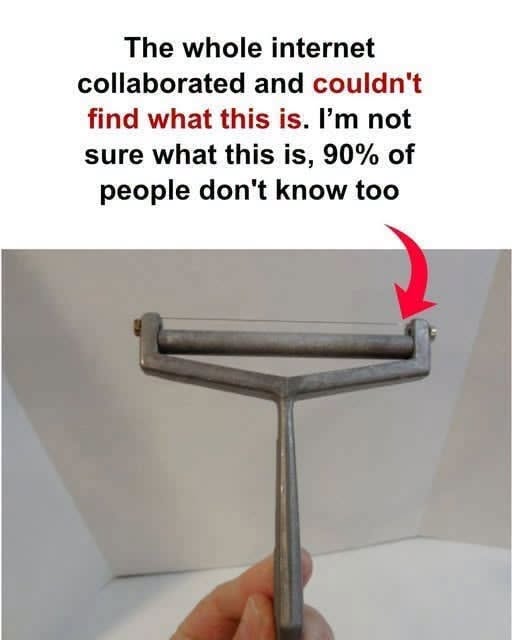
At first glance, it looks like something pulled from a forgotten workshop rather than a kitchen drawer. The unusual shape, the curved metal body, and the simple construction make many people stop and wonder: What exactly is this strange little device?
For modern eyes, surrounded by electric gadgets and smart appliances, old kitchen tools can seem mysterious. They often lack buttons, screens, and complicated mechanisms. Yet many of these vintage inventions were designed with a level of practicality and craftsmanship that still impresses today.
One such example is the Presto Aluminum Cheese Slicer, a small but ingenious kitchen tool that became popular during the 1940s and 1950s. Although it may look unusual now, it was once a common companion in many American kitchens, helping families prepare meals quickly and neatly.
Before pre-shredded cheese and convenient packaged foods became everyday staples, preparing ingredients by hand was simply part of cooking. Tools like the Presto Cheese Slicer were created to make those tasks easier while adding a touch of precision to ordinary meals.
The design was simple, but every detail had a purpose.
Made from lightweight aluminum, the slicer was easy to handle but strong enough to withstand daily use. Its curved handle was shaped to fit comfortably in the hand, allowing the user to apply steady pressure while moving the blade smoothly through a block of cheese.
The result was a clean, even slice.
Instead of uneven pieces cut with a regular knife, the slicer created uniform portions that were perfect for sandwiches, cheese boards, casseroles, and snacks. It transformed a basic kitchen task into something almost effortless.
What makes these tools fascinating is the way they reflect the design philosophy of the era. Manufacturers focused on creating objects that were functional, durable, and comfortable to use. There was no need for unnecessary complexity. The goal was simply to make everyday life easier.
The same philosophy can be seen in another forgotten kitchen tool from the same period: the Chapin Cream Dipper.
For people today, a small metal scoop with a ring-shaped handle may look confusing. But decades ago, it served an important purpose in homes that relied on fresh milk delivered in glass bottles.
Before modern processing methods became widespread, milk bottles often contained a naturally rich layer of cream that rose to the top. This cream was prized for its flavor and versatility. Families used it in coffee, desserts, baking recipes, and homemade dishes.
The challenge was collecting it without mixing the entire bottle together.
That is where the Chapin Cream Dipper came in.
Its narrow front edge was carefully designed to slide beneath the thick layer of cream sitting above the milk. With a gentle movement, the user could lift the cream away and transfer it wherever it was needed.
It was a small tool solving a very specific problem.
Today, many people have never experienced this process. Milk usually arrives homogenized, meaning the cream no longer separates naturally the way it once did. As a result, tools like the Chapin Cream Dipper have become reminders of a completely different era of food preparation.
Finding one today can feel like discovering a piece of everyday history.
These vintage kitchen items appear in antique stores, flea markets, thrift shops, and online collections. Some people purchase them because they collect old household objects. Others are drawn to them because they represent a slower, more hands-on way of living.
They remind us of a time when preparing food was not just about speed and convenience.
It was about involvement.
A person sliced their own cheese.
They collected their own cream.
They understood where ingredients came from and how simple tools could make a difference.
There is something charming about objects that were built to last. Many modern products are designed around replacement cycles, but older tools were often created with the expectation that they would remain in a household for years, sometimes even generations.
A cheese slicer was not just a gadget.
A cream dipper was not just a utensil.
They were part of daily routines.
They sat in kitchen drawers waiting for breakfast preparations, family meals, and quiet moments at home. They carried the marks of use, the scratches from years of work, and the memories of the people who handled them.
That is why these objects continue to capture attention today.
Their value is not only in what they do, but in what they represent.
They tell the story of innovation before technology took over the kitchen. They show how designers solved ordinary problems with simple materials and thoughtful engineering. They prove that creativity does not always require advanced machinery or complicated systems.
Sometimes, the smartest inventions are the ones that quietly disappear into everyday life.
The Presto Aluminum Cheese Slicer and the Chapin Cream Dipper are examples of that forgotten brilliance. They were never considered glamorous or revolutionary. They were simply useful tools that helped people prepare food more easily.
But decades later, their clever designs still inspire curiosity.
They remind us that every object has a story.
A strange piece of metal may have once been a daily necessity.
A small kitchen tool may have helped feed a family.
A forgotten invention may reveal how much thought went into the simplest parts of life.
In a world filled with disposable products and constant upgrades, these vintage tools offer a different message. They represent patience, practicality, and the beauty of things made with purpose.
What appears to be an ordinary old kitchen object may actually be a piece of history hiding in plain sight. And sometimes, the smallest tools reveal the biggest lessons about the way people once lived, worked, and created.