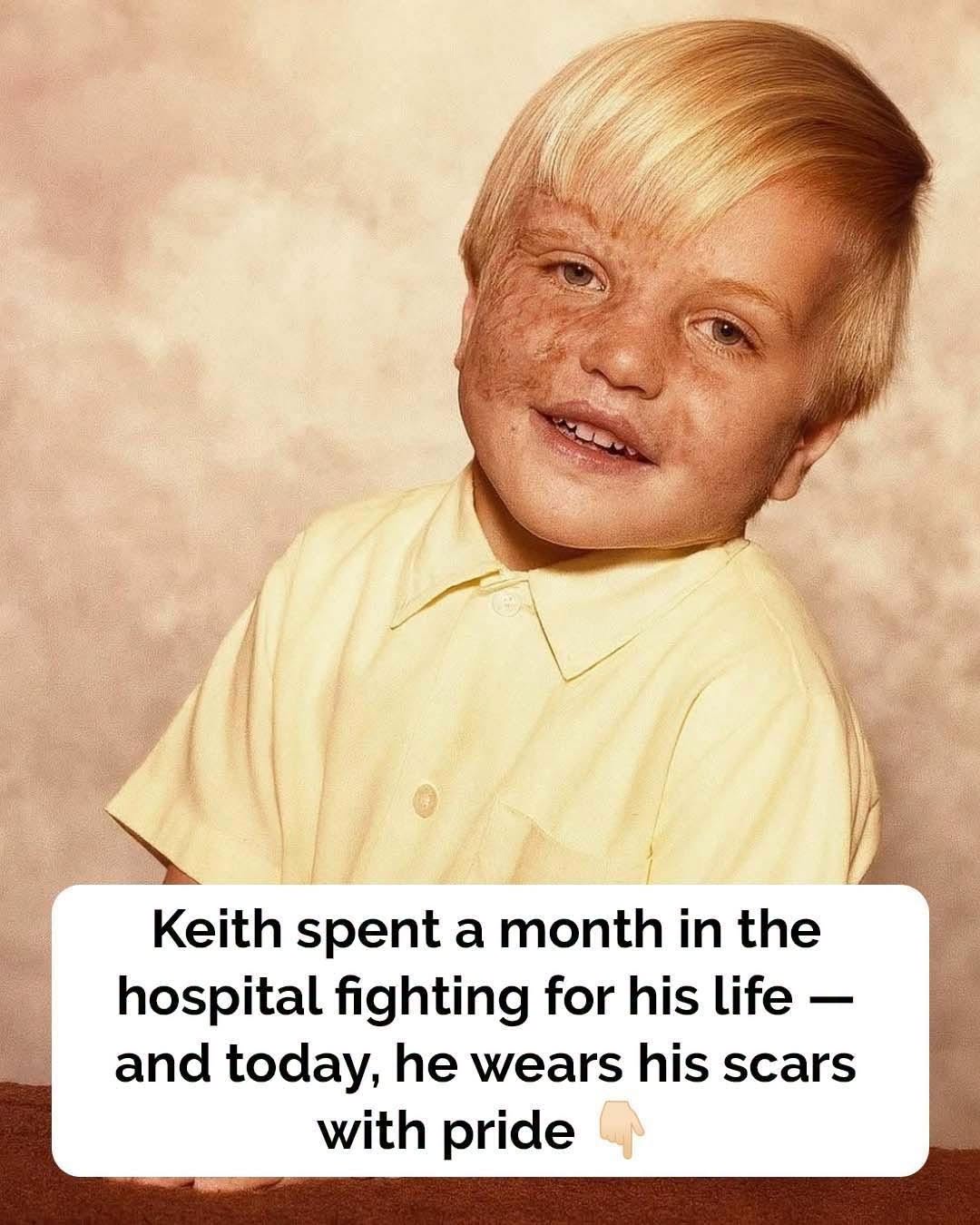
For much of his early life, Keith Edmonds believed the person staring back at him in the mirror was someone the world had already decided to reject.
Every reflection reminded him of what had happened.
Every glance from strangers carried the weight of memories he could never escape.
The scars on his body were visible, but the wounds they created inside him were far deeper.
As a child, Keith endured something no person should ever have to experience. The physical pain was only the beginning. The years that followed brought another kind of suffering being judged, isolated, and treated as though he was defined by what had been done to him.
Instead of seeing a child who had survived trauma, many people saw only the scars.
The stares were constant.
The whispers followed him.
The cruelty from others became another injury layered on top of the first.
For many survivors, the hardest part of trauma is not only the moment it happens. It is the struggle of trying to rebuild a life afterward while carrying memories that never completely disappear.
Keith understood that battle from a young age.
He felt different.
He felt angry.
And eventually, he felt lost.
The pain became something he carried everywhere.
There were years when he believed his life would always be controlled by anger and resentment. The world had failed him in ways that were difficult to understand. The legal system did not provide the sense of justice he hoped for. The person responsible for his suffering received a sentence that Keith felt did not reflect the damage caused.
To him, it felt like another betrayal.
The punishment did not match the pain.
The consequences did not seem large enough.
And as time passed, the anger grew.
For years, thoughts of revenge became an escape from feeling powerless. When someone has been hurt deeply and feels ignored, anger can sometimes feel like the only thing still protecting them.
But anger also has a cost.
It can consume the person holding onto it.
Keith eventually found himself trapped in a cycle of pain, using alcohol as a way to silence memories and escape emotions that felt impossible to control.
One drink became another.
One night became another.
Temporary relief replaced healing.
The alcohol did not erase what happened.
It only delayed the moment when he had to face it.
Looking back, Keith has described that period as a time when he was not truly living. He was surviving, but he was not moving forward.
The scars that others could see were only part of the story.
The invisible scars were the ones affecting his choices, his relationships, and his view of himself.
But even in the darkest moments, a different future was still possible.
The turning point did not come through revenge.
It came through a decision.
A difficult decision.
A decision to stop allowing someone else’s actions to control the rest of his life.
Keith began the long process of changing everything.
The first step was sobriety.
Walking away from alcohol meant confronting emotions he had spent years avoiding. It meant facing memories without trying to escape them. It meant learning how to live with the past without allowing the past to destroy the future.
Recovery was not immediate.
Healing was not simple.
But slowly, Keith began rebuilding himself.
The person who once believed his scars were his identity started discovering that they were only one chapter of his story.
Not the entire book.
With time, he developed confidence, found purpose, and created a life that looked completely different from the one he once imagined.
Instead of becoming defined by hatred, he became defined by helping others.
His own suffering became the foundation for compassion.
Keith realized that there were countless children experiencing abuse, trauma, and fear who needed someone who truly understood.
They needed someone who would not look away.
Someone who would not judge them.
Someone who could say, “I know what it feels like to believe your life is over. But it isn’t.”
That realization inspired him to create a mission centered around supporting vulnerable children and survivors of abuse.
Through his foundation and advocacy work, Keith began using his experiences to give hope to others.
His scars, once something he wanted to hide, became a symbol of survival.
They became proof that trauma does not have to be the final chapter.
For children facing unimaginable circumstances, seeing someone like Keith can change everything.
Survivors often struggle with shame.
They wonder if they are somehow damaged forever.
They question whether they can ever have a normal life.
Keith’s message challenges those fears.
He shows them that what happened to them is not who they are.
Their pain is real.
Their experiences matter.
But they still have the ability to choose what comes next.
Perhaps one of the most powerful parts of Keith’s journey is his decision to forgive.
Forgiveness, however, did not mean pretending the harm never happened.
It did not mean accepting what was done.
It did not mean removing responsibility from the person who caused the suffering.
Instead, forgiveness became a way for Keith to release himself from being permanently connected to the person who hurt him.
He realized that holding onto hatred gave the past continued power over his present.
Letting go was not weakness.
It was freedom.
His transformation represents something many survivors struggle to believe: a person can experience unimaginable pain and still create something beautiful afterward.
The child who once felt broken became an advocate.
The young man who once searched for revenge found purpose.
The survivor who once wanted to hide his scars now uses them to inspire others.
Keith Edmonds’ story is not one of forgetting.
It is not a story where the past magically disappears.
The scars remain.
The memories remain.
But they no longer control him.
Instead, they serve as reminders of everything he survived and everything he has accomplished.
His life has become a message for anyone who feels trapped by trauma.
A painful beginning does not have to determine the ending.
A person can come from darkness and still create light.
A person can be hurt and still choose kindness.
A person can lose years to pain and still find a reason to live.
Keith Edmonds did not allow the worst thing that happened to him to become the only thing people knew about him.
He turned suffering into strength.
He turned scars into a story.
And he turned his survival into a promise that other children would never have to face their pain alone.