Time has transformed countless Hollywood legends, but few have experienced a journey quite like Nick Nolte.
Once celebrated as one of the industry’s most rugged leading men, Nolte built a career on characters who were complicated, emotionally raw, and impossible to ignore. His distinctive voice, commanding screen presence, and willingness to portray deeply flawed individuals made him one of the most respected actors of his generation.
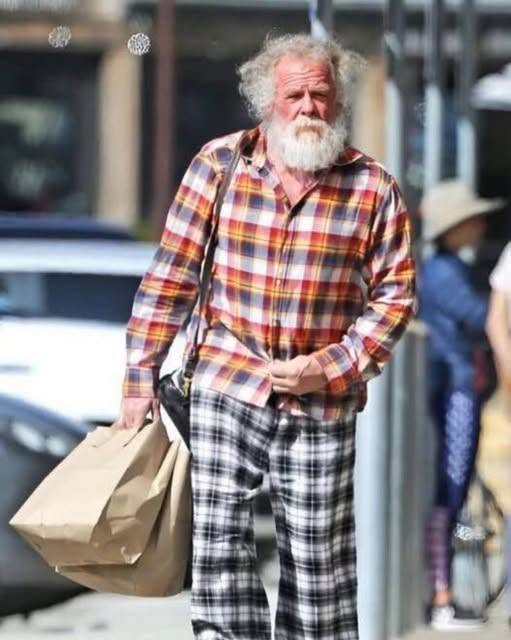
Today, at 83 years old, he looks dramatically different from the handsome star audiences first fell in love with decades ago.
Yet behind the changing appearance remains one of Hollywood’s most fascinating careers.
Nick Nolte was born in Omaha, Nebraska, in 1941.
His father worked as a salesman, while his mother had a passion for antiques and interior design. Growing up in the Midwest, Nolte lived a life far removed from movie studios, red carpets, and celebrity culture.
Like many young Americans of his generation, sports initially seemed to offer his greatest opportunity.
Football became an important part of his early years, and his athletic ability eventually earned him college scholarship opportunities.
For a while, it appeared that his future might unfold on the football field rather than on a movie set.
But something continued pulling him in another direction.
Although athletics brought success, acting sparked something much deeper.
Eventually, Nolte made a decision that would change the course of his life forever.
He left college behind and committed himself entirely to pursuing a career in acting.
It was an enormous gamble.
There were no guarantees.
No famous relatives.
No Hollywood connections waiting to open doors.
Only determination and a belief that he belonged in front of an audience.
To improve his craft, Nolte trained extensively.
He studied at respected acting institutions, including the Pasadena Playhouse and programs associated with legendary acting teacher Stella Adler.
Those years were anything but glamorous.
Like many aspiring performers, he worked numerous jobs simply to survive.
Modeling assignments helped pay the bills.
Temporary work filled the gaps.
Every opportunity allowed him to continue chasing the dream that still seemed frustratingly out of reach.
Years passed before Hollywood truly noticed him.
Then everything changed.
His breakthrough came with the television miniseries Rich Man, Poor Man.
The production introduced him to audiences across America and transformed him from an unknown performer into one of television’s biggest new stars.
His performance immediately attracted attention.
Viewers responded to the authenticity he brought to every scene.
Rather than portraying perfect heroes, Nolte specialized in characters carrying emotional wounds, inner conflict, and quiet vulnerability beneath their tough exteriors.
That unique quality quickly became his trademark.
Hollywood soon recognized that he possessed something many actors could not easily replicate.
He felt believable.
His performances rarely appeared polished or artificial.
Instead, they carried an honesty that resonated with audiences.
As film opportunities increased, Nolte established himself as one of the industry’s most dependable leading men.
Movies such as 48 Hrs. demonstrated his ability to combine intensity with humor, creating memorable partnerships and unforgettable characters.
His chemistry with fellow actors helped elevate many of the films in which he appeared.
He continued building an impressive career with performances in films that explored complicated relationships, personal struggles, and emotional redemption.
One of his most celebrated roles came in The Prince of Tides.
The film showcased another side of his talent, revealing emotional depth that surprised many viewers who had previously known him primarily through action-oriented performances.
His work earned widespread critical praise and strengthened his reputation as one of Hollywood’s finest dramatic actors.
He continued challenging himself with increasingly complex roles.
In Martin Scorsese’s Cape Fear, Nolte delivered another unforgettable performance opposite Robert De Niro in a psychological thriller that remains widely discussed decades later.
Rather than relying on physical action alone, Nolte consistently allowed emotion, fear, and vulnerability to drive his characters.
That willingness to expose emotional weakness became one of the defining characteristics of his career.
His role in Affliction further demonstrated his remarkable ability to portray damaged individuals searching for redemption.
The performance received tremendous critical acclaim and reinforced his standing among Hollywood’s most respected performers.
Years later, a new generation discovered his work through Warrior, where Nolte portrayed an aging father attempting to repair broken relationships with his sons.
Many critics considered it one of the strongest performances of his later career.
It served as a reminder that experience had only deepened his abilities as an actor.
Unlike many performers whose careers fade with age, Nolte continued finding meaningful work by embracing older, more layered characters.
His own life experiences seemed to add authenticity to every role.
Off-screen, however, Nolte’s journey was not without difficulty.
Over the years, he faced highly publicized personal struggles that often generated as much media attention as his acting.
Those challenges became regular topics in entertainment news.
For many celebrities, public setbacks can permanently damage careers.
Nolte’s experience proved different.
Instead of ending his professional life, those difficult periods seemed to reshape both the actor and the public’s understanding of him.
His performances gained additional emotional weight as audiences recognized similarities between his characters’ struggles and the resilience he demonstrated in his own life.
He never attempted to present himself as perfect.
That honesty earned respect from many colleagues and fans alike.
Throughout more than five decades in entertainment, Nolte accumulated an extraordinary body of work.
His films span multiple genres, from action and drama to comedy and psychological thrillers.
Few actors have displayed such remarkable versatility while maintaining such a distinctive screen presence.
Today, photographs of the 83-year-old actor often surprise people who remember his younger years.
The rugged leading man with flowing hair and unmistakable intensity has naturally changed with age.
Time has left visible marks on his face.
His appearance reflects decades of life, work, and experience.
Yet many longtime admirers see something far more important than physical transformation.
They see an artist who refused to chase perfection.
Instead, he embraced authenticity.
Unlike celebrities who devote enormous energy to preserving youthful appearances, Nolte seems comfortable allowing age to tell its own story.
That attitude mirrors the qualities that defined his career from the beginning.
Honesty.
Imperfection.
Depth.
Those characteristics made him unforgettable as a young actor.
They continue defining his legacy today.
While Hollywood constantly searches for the next rising star, careers like Nick Nolte’s become increasingly rare.
His success was never built on flawless appearances alone.
It came from emotional truth, fearless performances, and a willingness to reveal both strength and vulnerability on screen.
At 83 years old, Nick Nolte remains more than simply a former Hollywood heartthrob.
He represents a generation of actors who believed great performances came not from looking perfect, but from revealing genuine humanity.
His face may have changed over the decades, but the qualities that made him one of cinema’s most respected performers continue to define an extraordinary legacy that has endured far beyond the spotlight.