
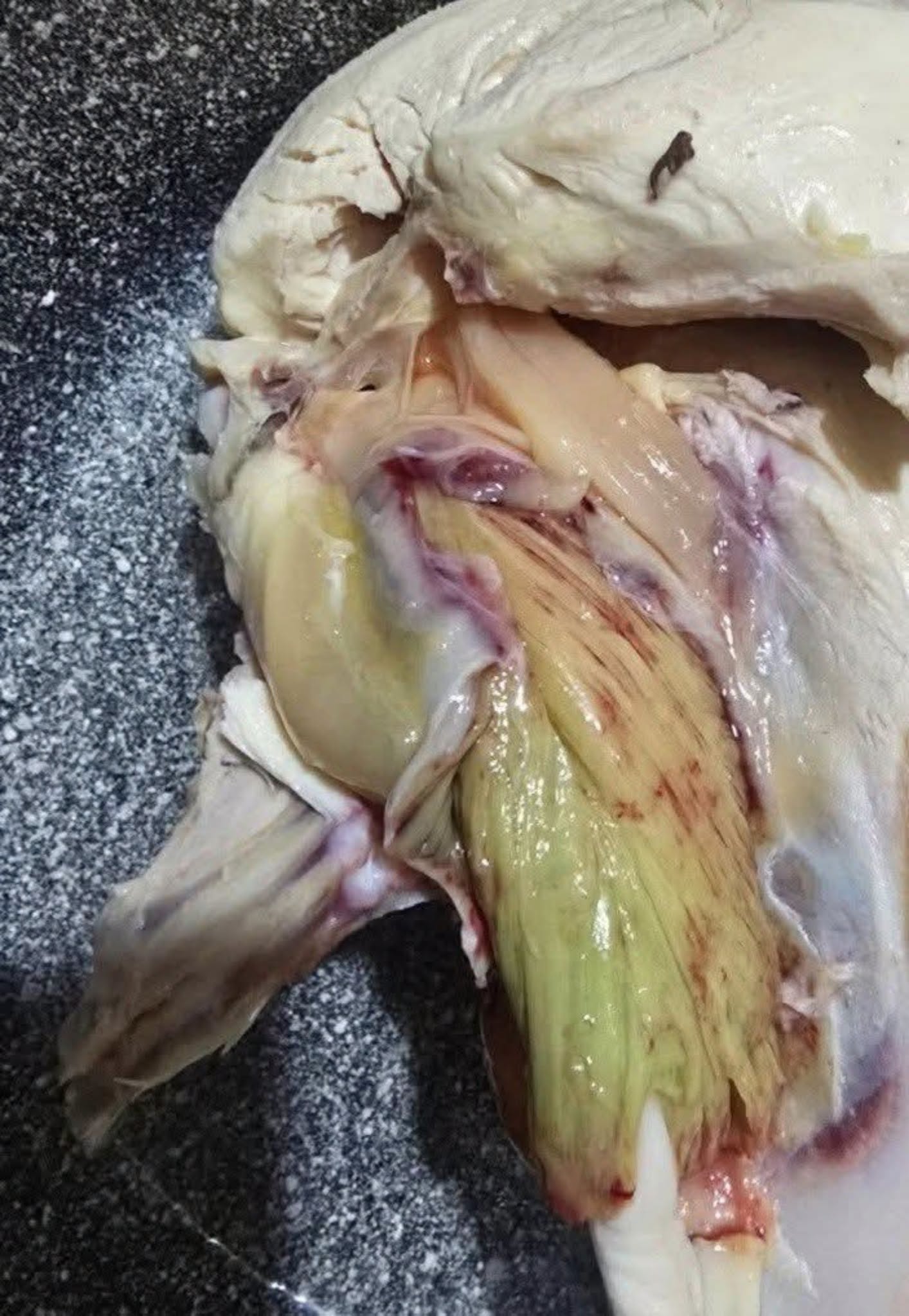
Few kitchen discoveries are as unsettling as cutting into a piece of raw chicken and finding an unexpected green patch hidden inside.
Most people freeze immediately.
Is the meat spoiled?
Is it contaminated?
Could eating it make someone seriously ill?
For many, the instinct is to throw the entire package into the trash without asking another question.
While that reaction is understandable, food safety experts explain that green discoloration inside chicken does not always mean the meat has gone bad.
In fact, several completely different conditions can produce green or greenish-colored areas, and some are far less dangerous than they appear.
The challenge is knowing the difference.
Understanding why chicken sometimes turns green can help you make safer decisions in the kitchen while avoiding unnecessary waste.
One of the most common explanations is bruising.
Just like people, chickens can develop bruises after physical injuries.
During transportation, handling, or processing, birds sometimes bump into equipment or flap their wings with enough force to damage small blood vessels beneath the skin or inside the muscle.
When bleeding occurs deep within the tissue, the trapped blood gradually changes color as it breaks down.
At first, the bruise may appear dark red or purple.
As time passes, chemical changes transform the pigments, causing the affected area to shift toward green or yellowish-green.
The same process happens when a bruise heals on human skin.
Although the appearance may seem alarming, this type of discoloration is generally cosmetic rather than dangerous.
The bruised tissue may taste slightly different or have a softer texture, but it is not automatically unsafe if the chicken has otherwise been stored and handled properly.
Another possible explanation is a condition known as green muscle disease.
Despite its frightening name, this condition is not caused by bacteria or mold.
Instead, it develops because certain muscles inside rapidly growing chickens receive insufficient oxygen.
Modern broiler chickens have been selectively bred to grow extremely quickly.
As their breast muscles become larger, the blood supply sometimes struggles to keep up with the increasing demand for oxygen.
When this happens, sections of muscle tissue begin to die.
Over time, those damaged areas change color, eventually becoming greenish-brown or gray-green.
The condition usually affects the small tenderloin muscle located beneath the larger breast meat.
Interestingly, the outside of the chicken often looks perfectly normal.
The discoloration may not become visible until someone slices into the meat.
The affected tissue frequently feels different as well.
Instead of being firm and smooth, it may appear stringy, spongy, or unusually soft.
Although green muscle disease makes the meat look unappetizing, food scientists generally consider it a quality issue rather than a food safety hazard.
If the bird was processed hygienically, refrigerated correctly, and thoroughly cooked, the condition itself is not considered harmful.
Still, many consumers choose to discard affected portions because of their unusual appearance and texture.
Sometimes, however, green discoloration signals something much more serious.
Spoilage remains the greatest concern whenever meat develops unexpected colors.
Unlike bruising or green muscle disease, spoiled chicken is often accompanied by additional warning signs.
The smell usually changes first.
Fresh chicken has little or no noticeable odor.
Spoiled chicken often develops a sour, sulfur-like, rotten, or ammonia-like smell that becomes immediately obvious when the package is opened.
Texture provides another important clue.
Healthy raw chicken feels moist but not sticky.
Spoiled meat often becomes slimy, tacky, or unusually slippery.
The surface may develop an unpleasant coating that remains even after rinsing.
If green discoloration appears alongside foul odors, sliminess, or an unusually mushy consistency, experts recommend discarding the entire product immediately.
No amount of cooking can restore spoiled meat to safe condition once decomposition has progressed.
Many people are surprised to learn that certain greenish appearances are actually optical illusions.
Occasionally, chicken develops a rainbow-colored or metallic sheen across its surface.
This effect often appears green, blue, or purple depending on how light reflects off the muscle fibers.
Scientists explain that this phenomenon occurs because microscopic structures inside the meat scatter light in much the same way that soap bubbles or oil films create colorful reflections.
Vacuum packaging can sometimes make these reflections appear even more noticeable.
Unlike spoilage, these shimmering colors do not indicate bacterial growth.
If the meat smells fresh, feels normal, and remains within its safe storage period, this type of iridescence is generally harmless.
Packaging itself can occasionally influence appearance as well.
Plastic films, refrigeration lighting, and condensation sometimes distort colors, making meat appear greener than it actually is.
Removing the chicken from its package and viewing it under natural lighting often reveals its true color.
Food safety specialists consistently emphasize that color alone should never determine whether meat is safe.
Instead, several factors should always be considered together.
Storage temperature is extremely important.
Raw chicken should remain refrigerated at or below 40 degrees Fahrenheit, or 4 degrees Celsius.
Leaving poultry at room temperature for extended periods allows bacteria to multiply rapidly, regardless of how the meat looks.
Expiration dates also matter.
While “best before” dates primarily indicate quality rather than absolute safety, meat that has significantly exceeded its recommended storage period deserves extra caution.
Proper cooking provides another essential layer of protection.
Chicken should always reach an internal temperature of 165 degrees Fahrenheit, or 74 degrees Celsius, to destroy harmful bacteria such as Salmonella and Campylobacter.
Using a food thermometer remains the most reliable way to confirm safe cooking.
Visual appearance alone cannot determine whether poultry has reached the proper temperature.
Many people wonder whether washing raw chicken helps remove unusual colors or bacteria.
Health authorities generally advise against rinsing raw poultry.
Running chicken under the faucet can spread bacteria through tiny water droplets that contaminate nearby countertops, utensils, and other foods.
Cooking, not washing, is what eliminates dangerous microorganisms.
If you discover a green spot while preparing chicken, inspect the surrounding meat carefully.
Does it smell normal?
Does the texture feel firm?
Has the chicken remained continuously refrigerated?
Is the discoloration isolated to one small area?
Answering these questions provides much better guidance than relying on color alone.
When uncertainty remains, however, experts offer simple advice.
Throw it away.
Food poisoning is never worth the risk of trying to save a few dollars.
Replacing a package of chicken costs far less than dealing with severe illness.
Fortunately, most green discoloration has harmless explanations.
Bruising.
Minor muscle damage.
Natural light reflections.
Quality defects.
None automatically indicate dangerous contamination.
Still, every cook benefits from trusting both scientific guidance and common sense.
If something appears seriously abnormal, smells unpleasant, or simply makes you uncomfortable, discarding it remains the safest choice.
In the end, food safety depends on paying attention to the complete picture rather than focusing on a single detail.
Color tells part of the story.
Smell tells another.
Texture, storage history, packaging condition, and cooking temperature complete the rest.
The next time you notice an unexpected green patch inside a piece of chicken, there’s no need to panic immediately.
Take a closer look.
Use your senses.
Understand what you’re seeing.
And when genuine warning signs appear, don’t hesitate to send the meat straight to the trash.
Sometimes the safest decision is also the simplest one.