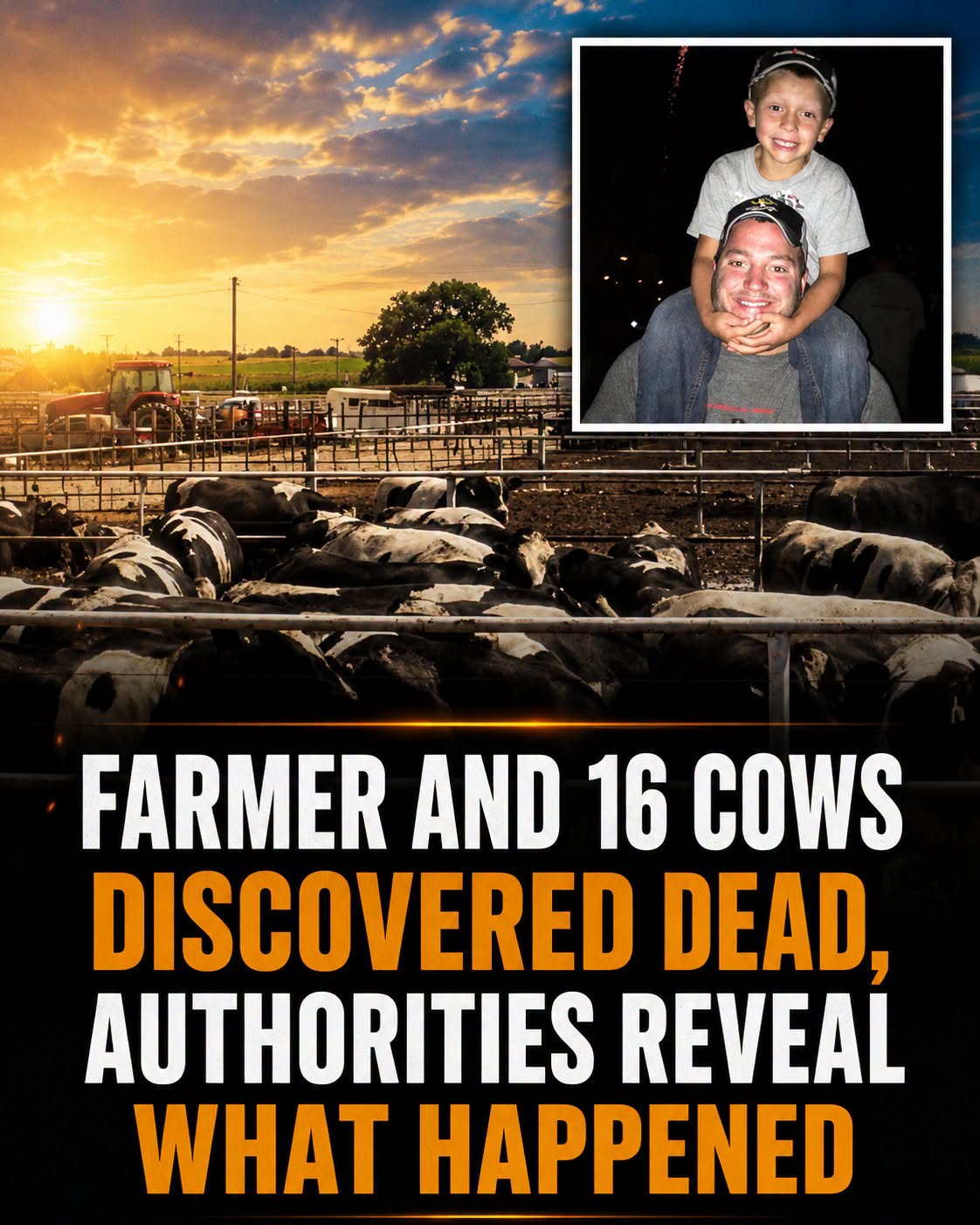
On a quiet summer morning in Amherst, Wisconsin, 29-year-old farmer Michael Biadasz stepped outside to complete a job that was a normal part of farm life.
It was the kind of task he had done before.
A responsibility that belonged to the daily rhythm of agriculture.
A job that thousands of farmers across the country perform as part of caring for their animals and maintaining their operations.
But that morning, something went terribly wrong.
Within hours, a routine farm chore became a heartbreaking tragedy that claimed the life of a young farmer and 16 cattle, leaving an entire community searching for answers.
Michael had gone to prepare a manure holding tank for pumping.
On a farm, manure management is a necessary part of maintaining healthy conditions for livestock. The work is familiar to experienced farmers, but it also carries hidden dangers that are not always visible.
Unlike many workplace hazards, the threat inside a manure pit or holding area cannot always be seen, heard, or smelled in time.
The danger comes from toxic gases that can accumulate during the decomposition process.
Among the most dangerous are methane and hydrogen sulfide gases that can quickly create a deadly environment when trapped in high concentrations.
According to investigators, unusual weather conditions played a major role in what happened that day.
A rare combination of atmospheric conditions created a situation where dangerous gases became trapped near the ground instead of dispersing naturally.
Warm air above cooler, stagnant air at the surface created what experts describe as an atmospheric inversion.
This invisible layer acted almost like a lid, preventing the gases from escaping.
Around the open manure tank, concentrations of toxic fumes increased.
The air that appeared normal was no longer safe.
There was no obvious warning.
No dramatic sign that something was wrong.
No visible danger that would have alerted someone approaching the area.
By the time the situation was discovered, it was already too late.
Michael was found dead near the manure holding area, along with 16 cattle that had also been overcome by the toxic environment.
The loss shocked not only his family but the entire agricultural community.
For those who knew him, Michael was more than just a farmer.
He was a young man deeply connected to the land, his animals, and the people around him.
Farming was not simply a job.
It was a way of life built on responsibility, dedication, and a commitment to providing for others.
His death became a painful reminder that even the most experienced workers can face dangers that are impossible to predict without proper precautions.
After the tragedy, Michael’s family and community gathered to honor his memory in a way that reflected the life he lived.
Along the roadside, tractors, farm trucks, and Michael’s black pickup were lined up as a quiet tribute.
The vehicles represented more than equipment.
They represented years of hard work, early mornings, long days, and the farming lifestyle that defined Michael’s world.
Neighbors, friends, and fellow farmers came together to support a grieving family and remember a man whose life ended far too soon.
But from that grief came a mission.
Michael’s loved ones wanted his death to serve as a warning and a lesson for others working in agriculture.
They began focusing on raising awareness about the dangers associated with manure storage areas and confined spaces.
Many farmers understand that these areas require caution, but tragedies like Michael’s show that knowledge alone is not always enough.
The danger is that toxic gases often do not announce themselves.
Hydrogen sulfide, sometimes called sewer gas, can be especially dangerous because high levels can overwhelm a person’s senses and ability to respond.
At lower concentrations, it may have a strong rotten egg smell.
But at higher levels, the sense of smell can become unreliable because the gas can quickly affect the nervous system.
Methane creates another serious risk because it can displace oxygen, making it difficult for people and animals nearby to breathe.
Together, these gases can create a deadly environment within moments.
Experts emphasize that farmers should never assume an area is safe simply because they have entered it many times before.
Conditions can change from one day to another depending on temperature, ventilation, weather, and other environmental factors.
Safety specialists recommend using proper ventilation, gas monitoring equipment, and avoiding entering confined manure spaces whenever possible.
They also stress the importance of never attempting a rescue without proper protection.
Many confined-space deaths occur when someone tries to save another person and unknowingly enters the same dangerous environment.
The tragedy involving Michael and his cattle has become part of a larger conversation about farm safety.
Agriculture remains one of the most demanding industries in the world, requiring workers to manage heavy equipment, unpredictable animals, extreme weather, and hazardous materials.
Many risks are visible.
But some of the most dangerous threats are the ones that cannot be seen.
For Michael’s family, the pain of losing him remains permanent.
A young farmer with plans, responsibilities, and a future ahead of him was suddenly gone.
Sixteen animals were also lost, representing not only financial value but living creatures that were part of the farm he cared for every day.
Yet his story continues through the awareness his family hopes to create.
They want other farmers to recognize the dangers hidden in everyday tasks.
They want families to talk openly about safety.
They want workers to understand that experience does not make someone immune to unseen hazards.
The heartbreaking reality is that Michael went to complete a familiar task and never returned.
His death was not caused by carelessness or a lack of dedication.
It was the result of a dangerous combination of environmental conditions and invisible gases that turned a normal morning into an unimaginable tragedy.
Today, his name serves as a reminder throughout farming communities that safety must always come first.
The work of farmers feeds communities, supports families, and requires incredible dedication.
But behind every farm is a person whose life matters far beyond the fields and barns.
Michael Biadasz was remembered not only for how he worked, but for who he was.
A farmer.
A neighbor.
A son.
A friend.
And someone whose final moments have inspired others to take greater precautions, hoping that another family will never have to experience the same devastating loss.