It catches your eye almost immediately.
You’re walking through a hotel room, helping a friend move into a new house, or rearranging furniture in your own living room when you notice something that doesn’t seem quite right.
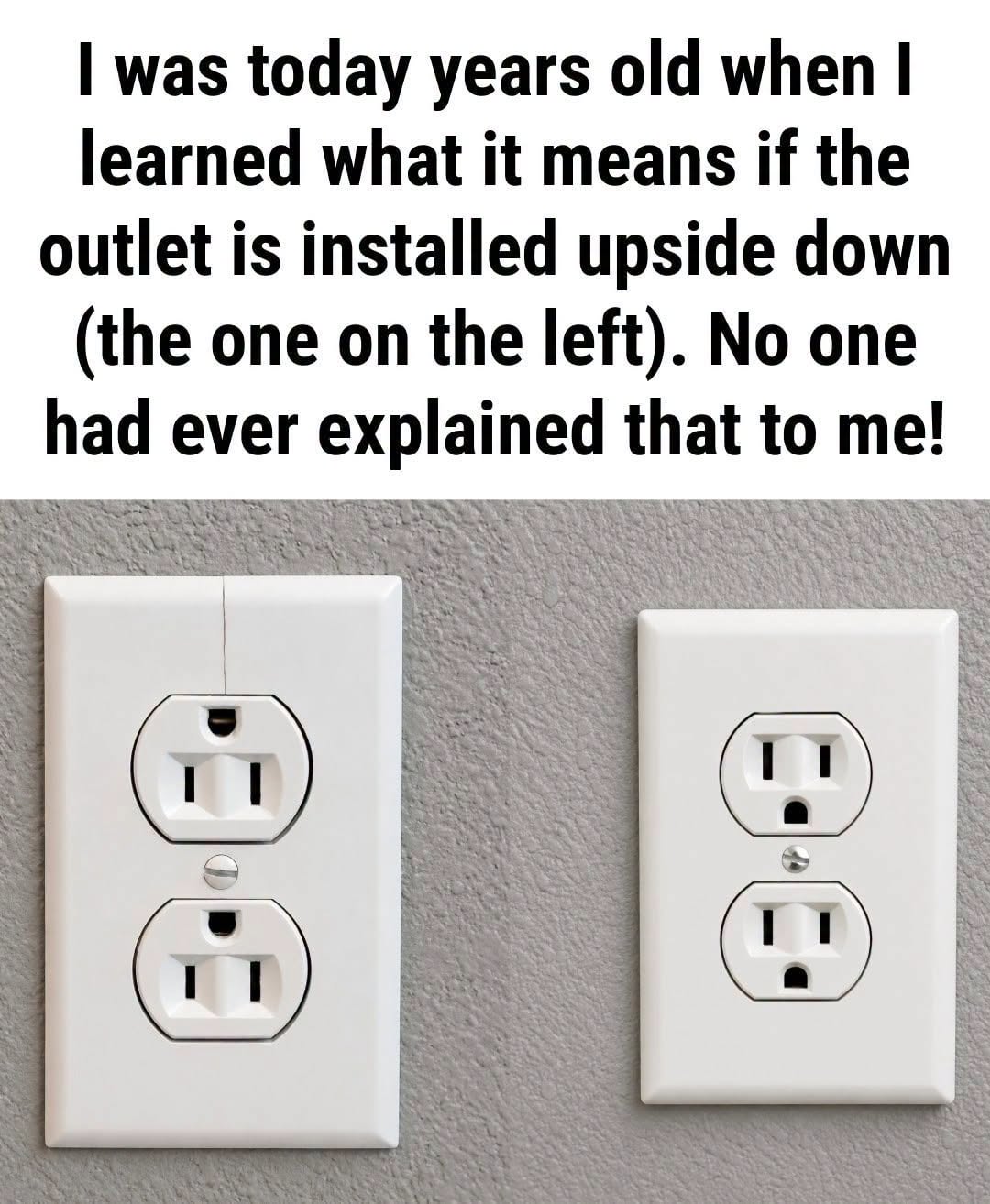
One electrical outlet is upside down.
Instead of the two vertical slots sitting above the round ground hole, the outlet appears flipped, with the ground at the top.
At first, it looks like someone made a mistake.
Maybe the electrician installed it incorrectly.
Maybe a previous homeowner replaced the outlet and accidentally turned it the wrong way.
Or perhaps it simply slipped through inspection unnoticed.
Most people never think much about it.
Others become convinced something must be wrong with the wiring.
The truth is far more interesting.
In many cases, that upside-down outlet was installed that way on purpose.
And once you understand why, you’ll probably start noticing them everywhere.
For decades, electricians have used subtle visual clues to communicate information without needing labels or stickers.
One of those clues involves the orientation of electrical receptacles.
In countless homes built before recessed lighting and ceiling fixtures became common in every room, builders often relied on floor lamps as the primary source of light.
Instead of wiring a ceiling light, they wired part of a wall outlet to a nearby light switch.
The idea was simple.
You would plug a lamp into the outlet.
When you entered the room, you could flip the wall switch, and the lamp would turn on instantly.
No walking across a dark room.
No fumbling for a lamp switch.
The wall switch controlled the light just like an overhead fixture would.
To make these special outlets easier to recognize, some electricians developed a practical habit.
They simply installed the outlet upside down.
Rather than placing the ground hole at the bottom, they positioned it at the top.
That small difference acted as a visual reminder that this outlet functioned differently from the others in the room.
Without testing anything, someone familiar with the practice could immediately suspect that the receptacle might be connected to a switch.
But there is another detail many homeowners never realize.
Often, only half of that outlet is actually switch-controlled.
Look closely at a standard duplex outlet.
There are two places to plug something in.
In many switched receptacles, one of those plugs turns on and off with the wall switch.
The other remains permanently energized.
That allows you to plug a lamp into the switched half while leaving the other half available for devices that need constant power.
Clocks.
Phone chargers.
Wi-Fi routers.
Televisions.
All of them continue working regardless of whether the room light is on or off.
It’s an elegant solution that many people use every day without realizing how it works.
Yet the upside-down outlet has created endless confusion over the years.
People move into older homes and assume the outlet was installed incorrectly.
Some even hire electricians to “fix” it, only to discover there was never anything wrong in the first place.
Others spend years wondering why a particular outlet sometimes seems dead.
They plug in a vacuum cleaner or phone charger.
Nothing happens.
Assuming the outlet has failed, they stop using it altogether.
Later, someone accidentally flips a nearby wall switch.
Suddenly the outlet comes to life.
What looked like a broken receptacle was simply waiting for the correct switch.
Interestingly, there is no nationwide electrical code requiring outlets to be installed one particular way.
The National Electrical Code does not mandate that switched outlets must face upside down.
Nor does it require the ground hole to be on the top or the bottom.
As long as the outlet is installed safely and functions correctly, either orientation is acceptable.
That surprises many homeowners.
People often assume every upside-down outlet has a specific meaning.
In reality, different electricians follow different preferences.
Some always install outlets with the ground on the bottom because that’s how they were trained.
Others prefer the ground on top for safety reasons.
Their reasoning is straightforward.
Imagine a metal object, like a picture frame or butter knife, accidentally sliding down a wall and partially contacting a plug that isn’t fully inserted.
If the ground pin is on top, the object is more likely to touch the grounded pin first rather than the energized metal prongs below it.
That may slightly reduce the chance of creating a dangerous short circuit.
While the overall safety difference is debated, some hospitals, commercial buildings, and industrial facilities intentionally install outlets with the ground facing upward for this reason.
Then there are homeowners who simply prefer the appearance.
Some like the “face” created when the ground is on the bottom.
Others think the outlet looks more balanced upside down.
Taste alone sometimes determines orientation.
That’s why you should never assume an upside-down outlet has only one purpose.
It could indicate a switched receptacle.
It could reflect a safety preference.
It could simply be how the electrician installed every outlet in the building.
The only reliable way to know is to test it.
Fortunately, that requires almost no effort.
Plug a lamp into the outlet.
Then flip each nearby wall switch one at a time.
If the lamp turns on and off with one of them, you’ve found a switched outlet.
If nothing changes, the orientation probably has nothing to do with switching at all.
This simple test can solve one of the most common mysteries homeowners encounter after moving into a new house.
It also helps explain why certain outlets seem inconsistent.
Many people unknowingly unplug lamps from switched outlets and replace them with televisions, computers, or chargers.
Later they accidentally switch the outlet off and assume something has malfunctioned.
Knowing which outlets are switch-controlled allows you to use your home’s electrical system exactly as it was originally designed.
Modern homes often rely more heavily on ceiling lighting, making switched outlets less common than they once were.
Still, millions of older homes across North America continue using them every day.
In fact, some homeowners intentionally request switched outlets during new construction because they appreciate the flexibility.
Not everyone wants recessed lights or overhead fixtures in every room.
A floor lamp connected to a wall switch can create a warmer atmosphere while remaining just as convenient.
So the next time you notice an upside-down outlet, don’t rush to assume someone made a mistake.
That small detail may actually reveal a thoughtful design choice dating back decades.
It might point to a switched receptacle.
It might reflect an electrician’s safety philosophy.
Or it might simply be a harmless preference that has puzzled homeowners for generations.
Sometimes the smallest features inside a home have the most interesting stories behind them.
And once you know the secret, you’ll never look at an upside-down outlet the same way again.