At first glance, this looks like the kind of peaceful scene you could stare at for hours.
A quiet morning.
A cozy café.
A steaming cup of coffee.
Everything about the illustration feels calm, inviting, and perfectly ordinary. Nothing appears out of place. In fact, if someone told you the two pictures were exact copies of each other, you would probably believe them without hesitation.
But that confidence is exactly what makes this visual challenge so surprisingly difficult.
Somewhere between the two nearly identical café scenes, one tiny detail has been changed.
Only one.
No dramatic alterations.
No missing characters.
No obvious tricks.
Just a single, carefully hidden difference that has left thousands of people staring far longer than they ever expected.
Many confidently announce that they have found it within seconds, only to realize moments later that they were looking at something completely unrelated. Others become convinced there must be more than one change because the real answer feels almost impossible to spot.
That is what makes puzzles like this so addictive.
They are less about eyesight and more about attention.
Your brain naturally wants to process the entire picture as one complete story instead of carefully inspecting every tiny detail. It fills in information automatically, assuming that familiar objects remain unchanged from one image to the next.
Most of the time, that shortcut works perfectly.
Today, however, it works against you.
Take another look at the scene.
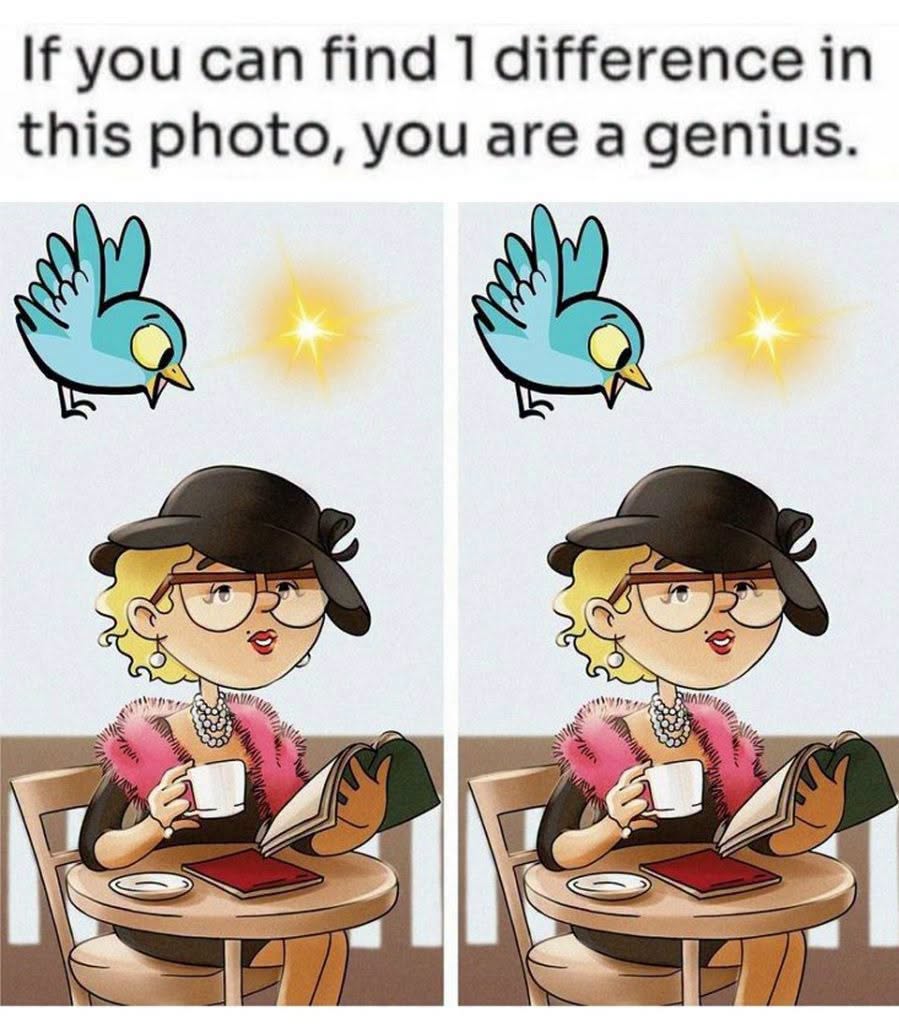
An elegant woman sits comfortably at an outdoor café, enjoying a peaceful break from the day. She appears completely relaxed, lost in the pages of an interesting book while holding a warm drink in her other hand.
Everything about her suggests comfort and confidence.
She wears a stylish black hat that casts a soft shadow across her face. Beneath it, loose blonde curls frame her features, giving the illustration a timeless, sophisticated feel.
A pair of fashionable sunglasses rests perfectly across her face.
A bright pink scarf wraps gently around her neck.
A pearl necklace adds another elegant touch.
Even the smallest accessories seem carefully placed to create a picture of effortless style.
Nothing appears unusual.
Above her, a cheerful blue bird flies through the bright morning sky.
The sun shines warmly nearby, filling the illustration with cheerful energy.
On the table sits a matching saucer beneath her cup, alongside a small red notebook that hints she may have been writing before becoming absorbed in her book.
Behind her, a wooden chair and decorative fence complete the peaceful outdoor atmosphere.
Everything feels balanced.
Everything feels familiar.
Everything feels exactly the same.
And yet it isn’t.
Hidden somewhere within these ordinary details lies the single change that separates one picture from the other.
The challenge seems simple enough.
Find one difference.
But your eyes quickly discover that simplicity can be surprisingly deceptive.
Many people immediately begin searching for large changes.
Perhaps the bird has moved.
Perhaps the coffee cup is missing.
Maybe the scarf has changed color.
Others inspect the background, convinced the answer must involve the fence, the chair, or even the position of the sun.
Still others become convinced the woman’s expression has changed.
Did her smile move slightly?
Is one earring different?
Did one strand of hair disappear?
The longer you search, the more possibilities appear.
Ironically, that makes finding the actual answer even harder.
Your attention begins jumping randomly across the page instead of following any organized pattern.
That is exactly how the brain behaves when faced with visual uncertainty.
Rather than carefully comparing one section at a time, it starts guessing.
Researchers who study visual perception often explain that the human brain is designed for efficiency rather than perfection.
Instead of analyzing every single object individually, it groups familiar patterns together and assumes consistency.
If two scenes appear almost identical, the brain treats them as identical until something dramatically interrupts that assumption.
A tiny alteration often slips completely beneath conscious awareness.
That is why so many people miss the obvious.
They are not looking carefully.
They are looking confidently.
Confidence is useful in everyday life.
It helps us make quick decisions.
It allows us to recognize familiar faces instantly.
It prevents us from wasting energy analyzing information that usually remains unchanged.
But puzzles like this exploit that very strength.
They reward patience instead of speed.
People who eventually solve these challenges usually describe changing their strategy halfway through.
Instead of randomly scanning the entire picture, they slow down.
They compare one object at a time.
They begin at the top.
Then move downward.
Then left to right.
Suddenly details that seemed invisible begin revealing themselves.
Perhaps it starts with the bird.
Its wings.
Its beak.
Its tiny feet.
Everything deserves careful attention.
Next comes the bright morning sun.
Then the woman’s hat.
Her curls.
Her glasses.
Her earrings.
Every fold in the scarf.
Every pearl around her neck.
The coffee cup.
The saucer.
The open book.
The notebook.
The chair.
The fence.
Every line becomes important.
The fascinating part is that the illustration itself never changes.
Only your way of looking changes.
That shift is what transforms frustration into discovery.
People often assume observation simply means seeing.
In reality, observation means slowing down long enough to notice what rushed attention ignores.
That lesson extends far beyond puzzles.
Modern life encourages constant speed.
We scroll quickly.
Read headlines instead of articles.
Notice conclusions before evidence.
Our brains become trained to recognize patterns without truly examining them.
Visual challenges like this interrupt that habit.
For a few minutes, they force us to pause.
To focus.
To compare.
To think carefully instead of instantly.
The reward is not merely finding the hidden difference.
It is experiencing the moment when your brain finally lets go of its assumptions and begins seeing what has been there all along.
Whether you solve the puzzle in twenty seconds or spend several minutes searching every corner of the image, the experience remains the same.
The picture quietly reminds us that details often hide in plain sight.
Not because they are invisible.
But because our minds are usually too busy telling us we’ve already seen everything.
So look once more.
Ignore your first impression.
Forget your earlier guesses.
Slow your eyes.
Compare every object carefully.
The hidden detail is waiting exactly where it has always been.
The only thing that needs to change now… is the way you look.