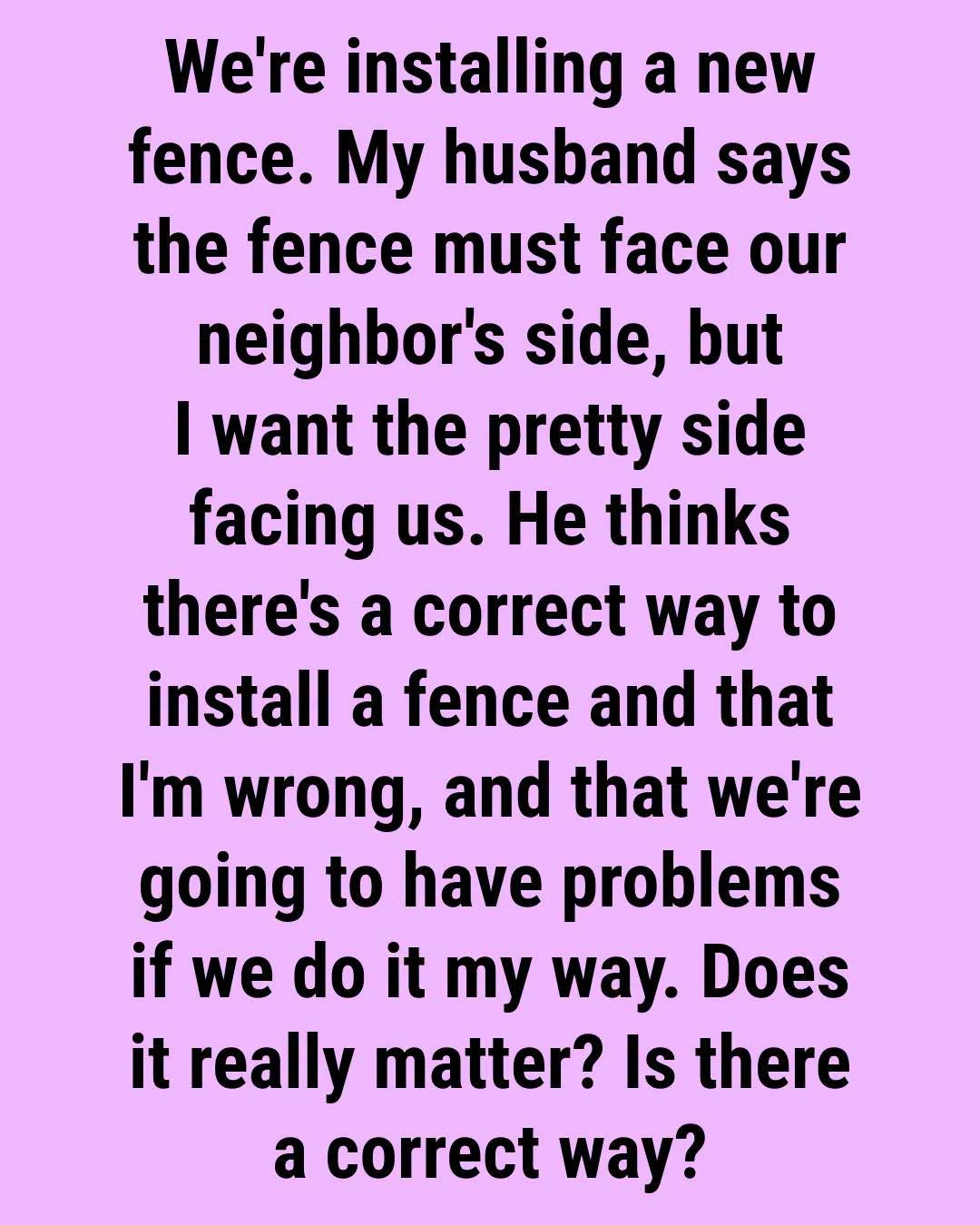
It seems like such a simple question.
When you build a fence between your property and your neighbor’s, which side should face them?
Most people answer without hesitation.
“The finished side goes toward the neighbor.”
For decades, that has been repeated so often that many homeowners accept it as absolute fact.
It sounds official.
It sounds like a law.
It even sounds like common courtesy.
But once you begin looking into the actual rules, something surprising happens.
The answer becomes far more complicated than most people ever imagined.
In reality, the belief that every fence must have its finished side facing the neighboring property is not a universal legal requirement.
In many places, it isn’t a law at all.
Instead, it is a long-standing tradition that has gradually taken on the appearance of an official rule.
That distinction matters more than you might think.
Homeowners often spend thousands of dollars installing new fences.
Before construction even begins, questions start piling up.
Who owns the fence?
Who pays for it?
Where exactly should it be placed?
Which direction should it face?
Can a neighbor object?
Many people assume there must be one nationwide rule that answers all of those questions.
There isn’t.
Fence regulations are usually determined at the local level.
Cities.
Counties.
Municipal governments.
Homeowners associations.
Each may have its own requirements, and those rules can vary dramatically from one community to another.
In some neighborhoods, local building codes say very little about fence orientation.
Instead, they focus on practical issues like maximum height, setback distances, visibility near intersections, and construction materials.
Other communities include very specific appearance standards.
Some require the finished side of the fence to face public streets.
Others require it to face sidewalks.
A few homeowners associations even regulate fence color, style, and maintenance.
Yet surprisingly, many say nothing at all about which side should face a neighboring yard.
That means homeowners often have more flexibility than they realize.
The famous “good side to the neighbor” guideline largely exists because of etiquette rather than legislation.
Traditionally, the finished side displays the smooth rails, attractive boards, or decorative panels.
The opposite side often exposes horizontal support rails and structural posts.
Many people believe presenting the cleaner-looking side to neighboring properties demonstrates respect and consideration.
Over time, this practice became so common that many assumed it was legally required everywhere.
But customs and laws are not always the same thing.
That doesn’t mean orientation is unimportant.
Quite the opposite.
Fence placement can have long-lasting consequences for relationships between neighbors.
A poorly communicated fence project has the potential to create years of tension over an issue that might have been resolved with a single conversation beforehand.
One of the biggest factors homeowners overlook is ownership.
Where exactly is the fence being built?
If it sits entirely inside one owner’s property line, ownership is generally straightforward.
That homeowner typically controls maintenance, repairs, and future modifications, subject to local regulations.
If the fence sits directly on the shared property boundary, however, the situation becomes much more complicated.
In many jurisdictions, boundary fences may be considered jointly owned.
That often means both neighbors have rights and responsibilities regarding maintenance, repairs, and replacement costs.
Because property laws differ significantly, confirming exact boundary lines before construction becomes extremely important.
Surveying the property may seem like an unnecessary expense at first.
Yet it can prevent costly disputes later.
A fence accidentally installed several inches onto someone else’s property can create legal complications that last for decades.
Property surveys remove much of that uncertainty.
Equally valuable is communication.
Many neighborhood disputes begin not because someone broke a law, but because nobody discussed plans beforehand.
Imagine arriving home one afternoon to discover heavy construction equipment digging post holes along your property line.
Even if everything is technically legal, the surprise alone may create unnecessary frustration.
Now imagine the alternative.
A brief conversation several weeks earlier.
Sharing the proposed design.
Discussing placement.
Clarifying ownership.
Answering questions before construction begins.
That small investment in communication often prevents major conflicts later.
Some homeowners even choose to create written agreements.
Although not always legally required, documenting responsibilities for maintenance, future repairs, and shared costs provides clarity if circumstances change years later.
Neighbors move.
Properties sell.
Memories fade.
Written agreements remain.
Another common misunderstanding involves privacy.
Many people assume placing the unfinished side toward themselves provides better security because climbing exposed rails from inside their own yard seems less important than preventing outside access.
Others reverse the logic entirely.
Again, local rules sometimes address these concerns, but many do not.
Design preferences often become personal choices rather than legal obligations.
Modern fence designs have also changed considerably.
Many newer privacy fences look nearly identical from both sides.
Shadowbox fencing alternates boards so both neighbors enjoy a finished appearance while allowing airflow.
Vinyl fencing frequently appears identical from every angle.
Decorative composite materials eliminate much of the traditional distinction between finished and unfinished sides altogether.
These newer options reduce many of the disagreements that older wood fences sometimes created.
Still, regardless of materials, one principle consistently remains valuable.
Respect.
Owning property provides significant rights.
It also creates opportunities for cooperation.
A beautiful fence does little good if it permanently damages relationships with the people living just a few feet away.
Strong neighborhoods depend less on perfectly aligned fence boards than on mutual understanding.
The direction the fence faces is often far less important than how the decision was made.
Before beginning any fencing project, homeowners benefit from taking several simple steps.
Review local building codes.
Check homeowners association rules if applicable.
Confirm property boundaries.
Discuss plans with neighboring property owners.
Understand ownership responsibilities.
Then choose a design that satisfies both legal requirements and practical needs.
Many disputes that eventually require lawyers begin with assumptions that could have been corrected through a simple conversation.
Perhaps that explains why the old saying persists.
“Good fences make good neighbors.”
The phrase has often been interpreted as encouragement to separate ourselves from those living nearby.
Its deeper meaning may be something entirely different.
Clear boundaries reduce misunderstandings.
Thoughtful planning prevents conflict.
Communication preserves relationships.
In the end, the real secret isn’t deciding which side of the fence faces the neighbor.
It’s remembering that the people on both sides of that fence will probably continue living next to one another long after construction is finished.
And that relationship is worth protecting just as carefully as the property itself.