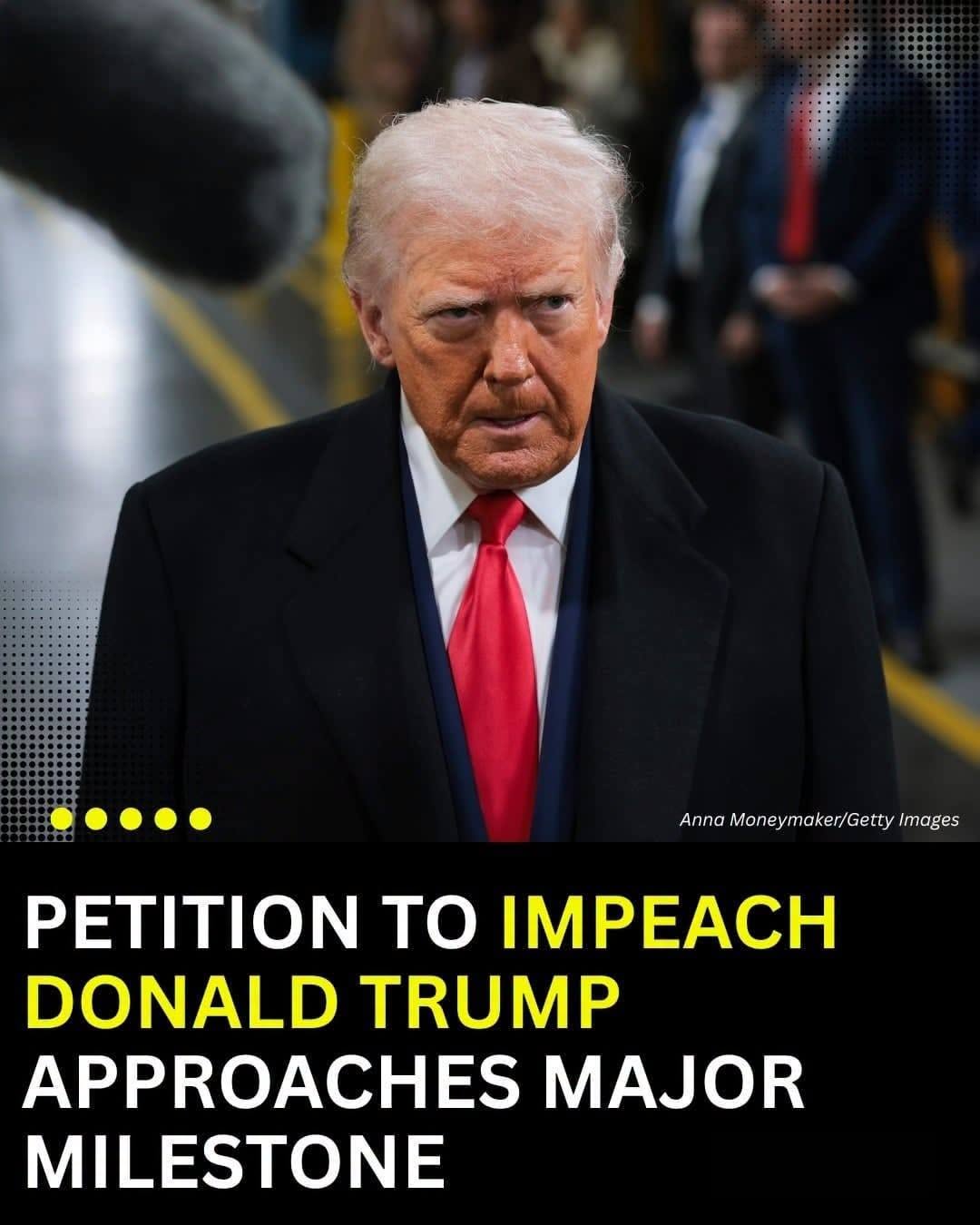
A petition calling for the impeachment of President Donald Trump has once again ignited a national conversation that extends far beyond signatures, legal arguments, or political procedures.
What began as an online campaign has quickly become another chapter in the long and deeply emotional debate surrounding one of the most divisive figures in modern American politics.
For supporters of the petition, every signature represents more than a name on a digital form.
It represents frustration.
It represents accountability.
It represents a belief that the controversies, investigations, and political conflicts surrounding Trump’s years in public life cannot simply be left behind.
For critics, however, the petition symbolizes something entirely different.
They see it as evidence that the country remains trapped in an endless cycle of political retaliation, unable to accept election outcomes, move forward, or focus on current challenges.
As the number of signatures continues to grow, the debate surrounding the petition has become less about legal consequences and more about the emotional divisions that continue to shape American politics.
The petition itself has attracted attention because it touches on questions that have remained unresolved for millions of Americans.
Can political controversies ever truly end?
When does accountability become retribution?
And how does a country move forward when its citizens remain deeply divided over the same public figure?
Donald Trump has occupied a unique place in American politics for nearly a decade.
Few presidents have inspired such intense loyalty among supporters while simultaneously generating equally strong opposition among critics.
Even after elections conclude, investigations end, or legal battles move through the courts, Trump continues to dominate headlines, political discussions, and public debate.
For those signing the petition, this continued influence is exactly why they believe action remains necessary.
Many argue that the controversies associated with Trump’s presidency should not simply fade into history. They point to investigations, public disputes, legal challenges, and political conflicts that have defined much of the national conversation in recent years.
To them, signing the petition becomes a symbolic act.
It is a statement.
It is participation.
It is a way to place their opinions on the public record.
Each signature carries personal meaning.
Some sign out of disappointment.
Others out of anger.
Some out of concern for the future of American institutions.
Others simply because they believe accountability remains unfinished.
In this sense, the petition functions less as a legal mechanism and more as a form of political expression.
Supporters often describe it as a reminder that unresolved issues still matter to many Americans.
Yet opponents see the situation very differently.
They argue that the petition has little practical impact.
The Constitution establishes clear processes regarding impeachment, elections, and presidential authority. Critics point out that petitions themselves cannot alter those processes or reverse political outcomes that have already occurred.
For them, the campaign represents something larger than disagreement.
It represents exhaustion.
Many Americans have spent years watching political conflict dominate every aspect of public life.
They see the continued efforts to revisit old battles as evidence that the country struggles to move forward.
Some argue that constant political warfare damages public trust.
Others believe it increases division and prevents meaningful discussion about present challenges.
The backlash against the petition has therefore become nearly as strong as the support behind it.
Social media platforms quickly filled with arguments from both sides.
Supporters praised the campaign.
Critics condemned it.
Political commentators offered competing interpretations.
Some described the petition as an act of democratic participation.
Others called it symbolic activism with no realistic outcome.
The intensity of these reactions reveals something important.
Donald Trump remains far more than a political figure.
He has become a symbol onto which Americans project hopes, fears, frustrations, and beliefs about the country itself.
For some people, he represents disruption, strength, and resistance against political establishments.
For others, he represents instability, division, and concerns about democratic norms.
Because of this, discussions about Trump rarely remain limited to individual policies or events.
They become conversations about identity.
Values.
Institutions.
The future.
The petition has therefore become another arena where these larger conflicts are playing out.
Political analysts have noted that symbolic actions often carry enormous emotional significance.
Petitions may not create laws.
They may not directly change government decisions.
But they can reveal public sentiment.
They can mobilize supporters.
They can generate conversations that extend far beyond their original purpose.
In this case, the petition has exposed how deeply divided public opinion remains.
Years after some of the most contentious political moments in recent history, Americans continue to disagree not only about Donald Trump himself but about what his political legacy means.
Some believe accountability remains unfinished.
Others believe the country must move beyond constant political battles.
Both sides argue that they are protecting democracy.
Both believe the future is at stake.
Meanwhile, lawmakers and political leaders continue navigating a landscape where every statement, investigation, and controversy quickly becomes part of a larger national debate.
The petition itself may never produce direct legal consequences.
Many observers acknowledge this reality.
Yet its existence still carries meaning.
It demonstrates that significant portions of the population remain emotionally invested in questions surrounding Trump’s political career.
It also demonstrates how difficult it has become for the nation to reach consensus on even the most fundamental political issues.
Public trust has become increasingly fragile.
Institutions face scrutiny from multiple directions.
Political opponents often view each other not simply as rivals but as threats.
Within this environment, even symbolic actions can generate enormous attention.
The petition reflects this reality.
It is not simply about impeachment.
It is about memory.
It is about accountability.
It is about whether certain chapters of American political history have truly ended.
For supporters, signing becomes an act of civic participation.
For opponents, opposing the petition becomes equally important.
Each side views the other through vastly different lenses.
And that may be the most significant aspect of the entire story.
The petition itself may eventually stop growing.
Media attention may move elsewhere.
Political debates may shift to new issues.
But the deeper questions remain.
How does a nation heal after years of political conflict?
When does accountability end?
When does moving forward begin?
Donald Trump continues to occupy an unusually powerful position within the American political imagination.
Supporters continue to defend him.
Critics continue to oppose him.
And both sides continue to shape the national conversation.
The petition may not alter the Constitution.
It may not change past elections.
It may not rewrite history.
But its existence reveals something impossible to ignore.
The political battles surrounding Donald Trump are far from over.
And for millions of Americans, the struggle over accountability, memory, and the future of the country remains as intense as ever.