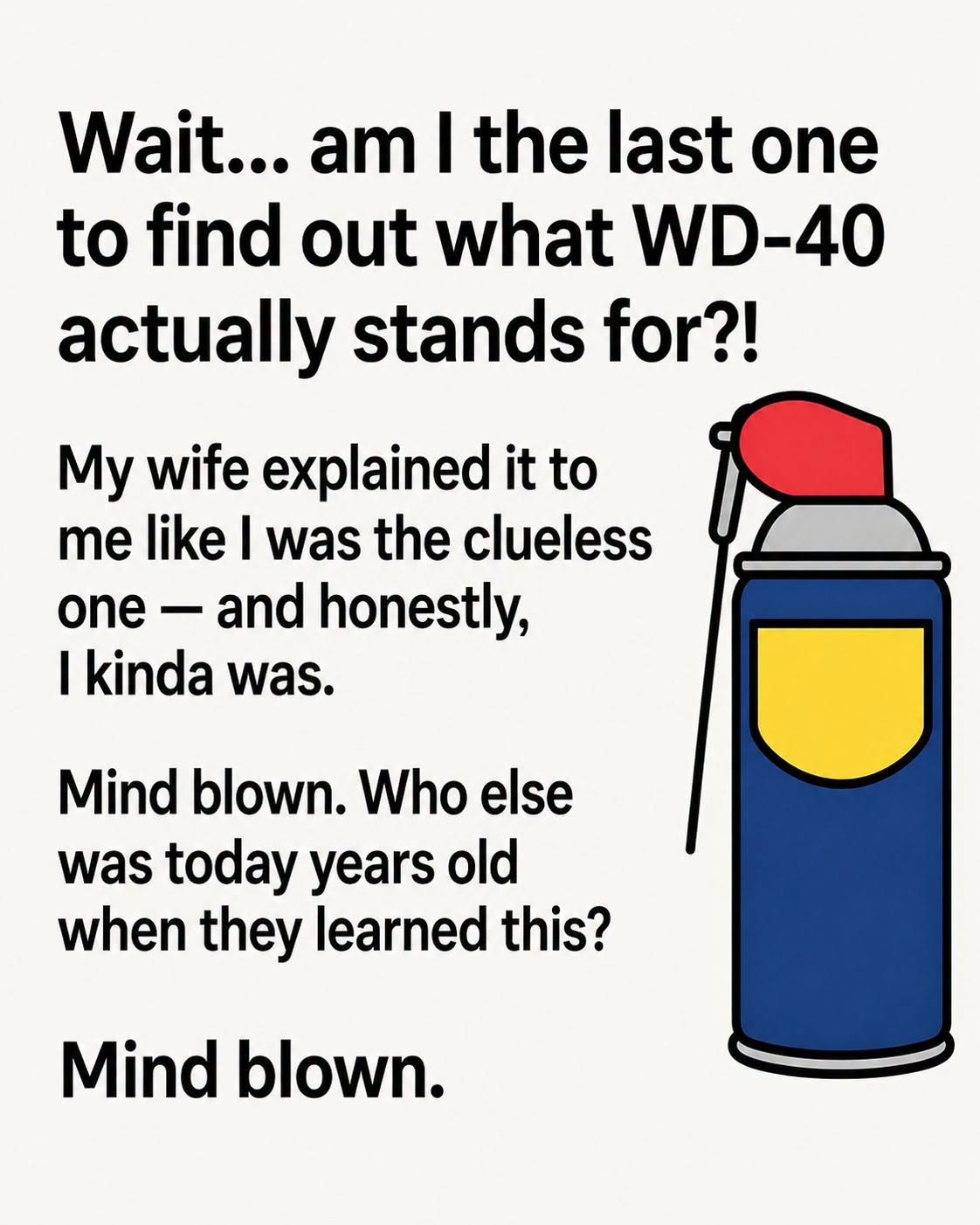
For decades, the familiar blue and yellow can has sat quietly on garage shelves, kitchen counters, workbenches, and toolboxes around the world. People reach for it when a door hinge squeaks, when a rusty bolt refuses to move, or when a stubborn lock suddenly stops working. It has become one of those products that seems to solve problems almost by magic.
Yet despite its enormous popularity, millions of people have never stopped to ask one simple question.
What does WD-40 actually mean?
Most assume it is simply a brand name, perhaps a random combination of letters and numbers created by a marketing team. Others imagine it refers to a chemical formula or some secret ingredient hidden inside the famous spray can.
The truth is far more surprising.
The story behind WD-40 begins not in garages or hardware stores, but during one of the most tense periods in modern history.
It was the early 1950s.
The Cold War was intensifying, military technology was advancing rapidly, and engineers faced a growing challenge that had nothing to do with weapons themselves.
The problem was water.
Moisture and corrosion were quietly attacking metal components used in missiles and aerospace equipment. Rust could weaken parts, damage machinery, and create serious risks for expensive military hardware. Engineers needed a solution that could protect metal surfaces and force moisture away before corrosion began.
In 1953, a small company called the Rocket Chemical Company began working on this problem.
Among the people involved was Norm Larsen, an engineer determined to create a formula capable of displacing water and protecting sensitive metal equipment.
The mission sounded simple.
The reality was not.
The first attempt failed.
The second attempt failed.
The third failed.
And then the failures continued.
Formula after formula was tested.
Some did not remove moisture effectively.
Others provided inadequate protection.
Some simply failed to perform under the demanding conditions required for aerospace applications.
The team kept working.
Formula 10.
Formula 15.
Formula 25.
Formula 39.
None delivered exactly what they needed.
Finally, after thirty-nine unsuccessful attempts, the fortieth formula succeeded.
It worked.
The liquid pushed moisture away from metal surfaces, protected against corrosion, and created the barrier engineers had been searching for.
The name practically created itself.
WD stood for Water Displacement.
40 represented the fortieth formula.
WD-40.
What sounds today like a mysterious product name is actually a simple reminder of persistence.
Thirty-nine failures.
One success.
That story helps explain why the product performs so well in everyday life.
Its original purpose was never to lubricate squeaky doors or loosen rusted garden tools. It was designed to protect critical aerospace equipment from moisture and corrosion under demanding conditions.
The same properties that protected missile components decades ago now help people solve countless household problems.
Rusty bolts.
Stuck locks.
Frozen hinges.
Corroded battery terminals.
Stubborn tools.
Creaking doors.
Old machinery.
The product became so versatile that many households began using it for dozens of different tasks.
People discovered that it could loosen seized parts, remove sticky residue, protect tools, and drive moisture away from metal surfaces.
Word spread quickly.
Employees of the Rocket Chemical Company reportedly began taking cans home for personal use. Friends and neighbors noticed how well it worked. Demand grew far beyond its original military purpose.
Eventually, the company realized that they had created something much larger than an industrial product.
WD-40 entered the consumer market.
The response was remarkable.
Mechanics embraced it.
Homeowners relied on it.
Farmers used it.
Factory workers kept it nearby.
Car enthusiasts carried it in their garages.
Over time, the simple spray can became one of the most recognizable products in the world.
What makes the story especially fascinating is how accidental its fame was.
The creators were not trying to develop a household product.
They were solving a very specific engineering problem.
Their goal was not convenience.
It was protection.
And yet the solution proved useful in places nobody had imagined.
Part of the product’s appeal comes from its reliability.
People often keep a can for years.
Some families have one sitting in the garage that seems almost permanent.
It becomes part of household life.
When something squeaks, sticks, rusts, or refuses to move, someone inevitably says, “Try the WD-40.”
The name itself has become almost universal.
Yet few people realize that every time they say it, they are repeating the story of forty attempts.
Forty experiments.
Forty chances.
Thirty-nine disappointments.
One breakthrough.
That history also serves as a powerful reminder about innovation.
Success often appears simple when viewed from the end.
People see the finished product.
They see the famous can.
They see the solution.
What they do not see are the failures that came before it.
Formula 1 did not work.
Formula 12 did not work.
Formula 24 did not work.
Formula 39 did not work.
Any one of those failures could have ended the project.
Instead, the team continued.
That persistence is perhaps the real secret behind WD-40.
Not the ingredients.
Not the formula.
Not the spray can.
Persistence.
Today, millions of cans are sold every year around the world. The product remains largely unchanged from the successful formula developed decades ago.
Few products can claim that kind of longevity.
Fewer still can trace their origins directly to the aerospace industry and Cold War engineering challenges.
The next time someone reaches for that familiar blue and yellow can, they are holding far more than a household product.
They are holding the result of dozens of failures.
They are holding an invention created to protect missile components.
They are holding a small piece of engineering history.
Most importantly, they are holding proof that failure is often part of success.
Because the name WD-40 does not celebrate the first attempt.
It does not celebrate perfection.
It celebrates the fortieth try.
And perhaps that is why its story continues to resonate so many decades later.
Behind every squeaky hinge it silences and every rusty bolt it loosens lies a simple lesson.
Sometimes the breakthrough only comes after thirty-nine reasons to quit.