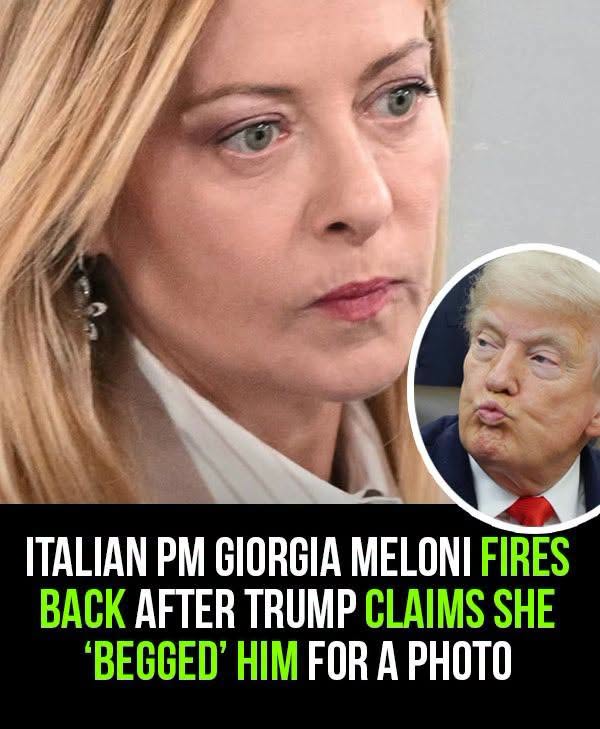
What began as a seemingly trivial dispute over a photograph at a G7 summit has rapidly evolved into a sharper diplomatic exchange, exposing underlying strains in the relationship between Italy and the United States.
At the center of the controversy is Italian Prime Minister Giorgia Meloni, who forcefully rejected claims made by Donald Trump suggesting that she had “begged” for a photo during the high-profile gathering of world leaders. The accusation, widely circulated and quickly amplified through political commentary and media coverage, triggered an unusually blunt response from Rome and set off a chain reaction that extended far beyond personal reputations.
Meloni’s reply was immediate and uncompromising. In a statement that resonated strongly across Italian political circles, she dismissed the allegation outright, insisting that neither she nor Italy “begs” under any circumstances. Her language was interpreted not only as a defense of her own conduct but as a broader assertion of national dignity and sovereignty. Supporters of the prime minister framed her response as a necessary pushback against what they viewed as an unnecessary and disrespectful characterization of a sitting head of government.
Behind the rhetoric, however, lies a more complex diplomatic reality.
The G7 summit itself was already taking place against a backdrop of international tension, with discussions focused on global security, economic instability, and ongoing geopolitical conflicts. While leaders publicly emphasized unity and cooperation, private dynamics between key figures appeared more strained. According to observers of the event, interactions between certain delegations were notably formal, with less of the familiar warmth that typically characterizes such gatherings.
It was within this already sensitive environment that the disputed photograph moment became a focal point.
What should have been a routine and symbolic image of international cooperation instead became the subject of competing narratives. One version, promoted by Trump and his allies, suggested that Meloni had been unusually eager or insistent in seeking a photo opportunity. Another, firmly rejected by Italian officials, described the interaction as entirely standard protocol for leaders participating in a multilateral summit where group and bilateral photographs are expected and scheduled.
The clash over interpretation quickly escalated beyond social media commentary.
Italy’s foreign ministry responded with unusual urgency, signaling that the issue had crossed a diplomatic threshold. The cancellation of a planned visit by Italy’s foreign minister to the United States was widely interpreted as a deliberate political message. Officials in Rome described the remarks attributed to Trump as offensive not only to Meloni personally but to Italy as a whole, emphasizing that respect between allied nations must extend to their elected leaders.
This reaction marked a significant shift in tone.
While disagreements between allied governments are not uncommon, public expressions of offense at this level often indicate deeper friction beneath the surface. Analysts noted that the situation reflected growing sensitivity within European capitals regarding how they are portrayed in American political discourse, particularly when statements are seen as diminishing or dismissive of their leaders.
For Meloni, the controversy comes at a moment when she has been actively positioning herself as a strong, independent voice within European politics. Her leadership style has often emphasized national pride, institutional authority, and a careful balancing act between maintaining close ties with Washington while asserting Italy’s own strategic interests.
The suggestion that she had “begged” for anything struck at the core of that political image.
Her firm rebuttal was therefore not just personal but symbolic, reinforcing her broader political identity as a leader unwilling to be framed as subordinate in international relations. Italian commentators noted that her wording was deliberately sharp, designed to leave little room for ambiguity or reinterpretation.
In Washington, reactions were more divided.
Supporters of Trump defended his comments as typical of his informal and confrontational communication style, arguing that his remarks should be understood in the context of political rhetoric rather than formal diplomatic assessment. Critics, however, warned that such statements risk undermining relationships with key allies and complicating already delicate international negotiations.
The incident has also reignited broader questions about the role of personal dynamics in global diplomacy.
Modern summits like the G7 are carefully structured events, with tightly managed schedules, choreographed photo opportunities, and scripted statements intended to project unity. Yet even within this controlled environment, moments of spontaneity—or competing interpretations of the same moment—can quickly take on outsized significance once filtered through political narratives and media amplification.
What might have once been dismissed as a minor misunderstanding is now part of a larger conversation about respect, perception, and the fragility of diplomatic language in an age of instant global communication.
The cancellation of the Italian foreign minister’s US trip further intensified the situation. While official explanations emphasized scheduling and diplomatic reassessment, the timing left little doubt that the decision was connected to the controversy. It signaled that Rome was willing to translate rhetorical disagreement into tangible diplomatic distance, at least temporarily.
Despite the tension, both governments have strong incentives to prevent a long-term rupture. The United States and Italy remain NATO allies, deeply connected through economic ties, defense cooperation, and shared strategic interests. Analysts expect that behind public statements, diplomatic channels will continue working to stabilize the relationship and prevent further escalation.
Still, the episode has left a mark.
It has highlighted how quickly modern diplomacy can be shaped by perception, how easily informal remarks can escalate into formal disputes, and how leaders must now navigate not only international negotiations but also the rapid amplification of narratives in the public sphere.
For Meloni, the episode reinforces her determination to project strength on the global stage. For Trump, it reflects his continued influence in shaping political discourse even outside formal office, particularly when his comments reverberate through international media.
What remains clear is that the disagreement over a single photograph has grown into something far larger: a test of tone, respect, and mutual perception between two governments that, while allied, are now navigating an increasingly complicated relationship in the spotlight of global attention.