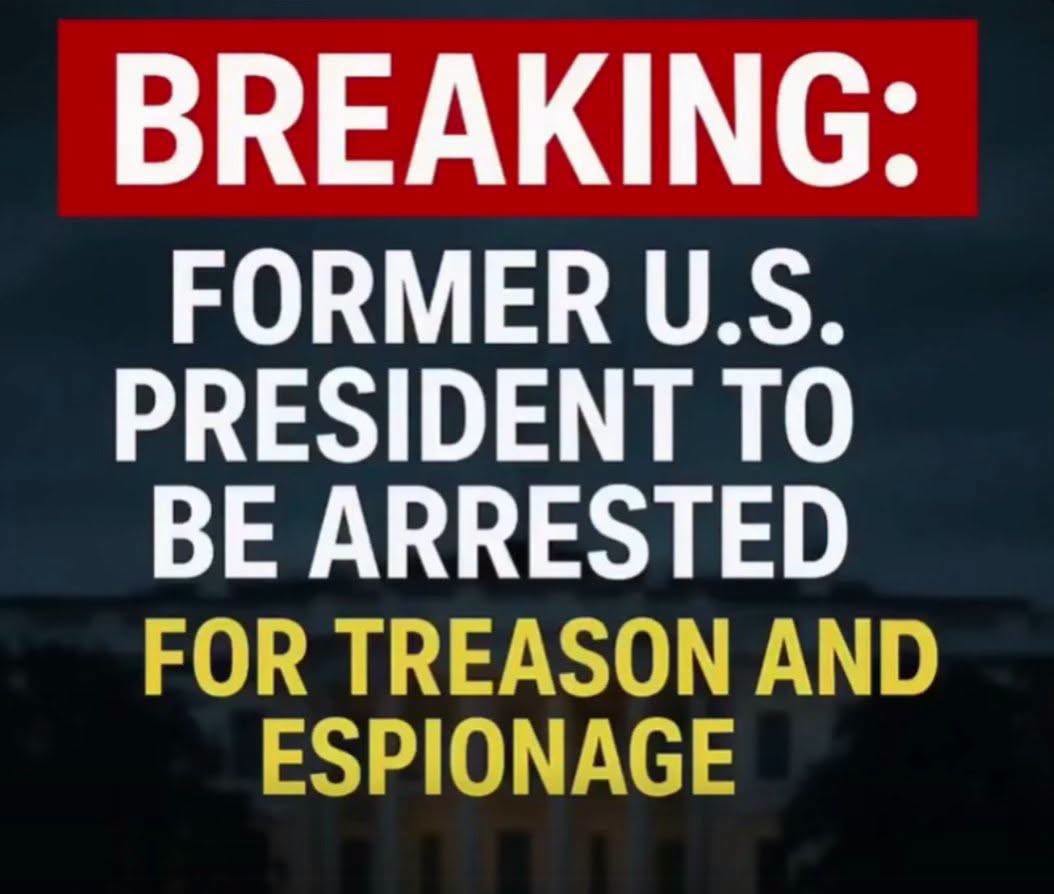
Few things spread faster in modern America than a political rumor powerful enough to shock both supporters and critics at the same time. In recent days, dramatic claims began circulating online suggesting that former President Barack Obama could soon face criminal charges involving treason, espionage, and conspiracy allegations.
The reports quickly ignited social media, sparked heated debates, and left many Americans wondering whether the country was on the verge of one of the most extraordinary legal moments in its history.
The claims appeared suddenly and spread with remarkable speed.
Posts across social media described secret investigations, unnamed government insiders, and alleged preparations involving federal agencies. According to these reports, officials were supposedly coordinating behind closed doors, preparing for actions that would be unprecedented in American history.
The allegations were enormous.
If true, they would represent one of the most significant criminal cases ever involving a former president. Headlines suggested that federal authorities were preparing charges tied to intelligence matters, alleged foreign contacts, and accusations involving political activities during and after Obama’s presidency.
Within hours, the story had spread far beyond political circles.
Supporters of the claims argued that powerful figures had finally become vulnerable to legal scrutiny. Critics dismissed the reports as politically motivated speculation. Others simply waited for official confirmation, recognizing that extraordinary accusations require equally extraordinary evidence.
What made the situation especially volatile was the absence of verifiable information.
No formal charges were publicly announced.
No official court filings appeared.
No public statements confirmed that any indictment existed.
Despite this lack of evidence, the story continued gaining momentum because it touched on several issues that already divide the country: trust in government institutions, political loyalty, accountability, and the growing influence of social media.
The modern information environment rewards speed more than certainty.
A dramatic headline can reach millions of people before journalists, attorneys, or government agencies have an opportunity to verify the facts. Once a story begins circulating, corrections often travel far more slowly than the original claims.
This dynamic has become increasingly common in American politics.
Rumors involving investigations, indictments, secret evidence, and anonymous sources frequently generate enormous attention. Supporters often view them as long-awaited revelations. Opponents see them as disinformation campaigns. In many cases, the truth emerges only after days or weeks of confusion.
Barack Obama remains one of the most recognizable and controversial political figures in modern American history.
Even years after leaving office, he continues to attract both admiration and criticism. Supporters view his presidency as a period of stability and progress, while critics continue to challenge many of his policies and decisions.
Because of his influence, stories involving Obama often generate enormous public interest.
Any allegation connected to a former president immediately carries significant political consequences. The mere suggestion of criminal charges against a former commander in chief can dominate news cycles, influence public opinion, and deepen existing political divisions.
Legal experts frequently emphasize that accusations alone do not constitute evidence.
Criminal charges involving national security matters require substantial investigations, documented evidence, and extensive legal procedures. Cases involving former high-ranking officials would face particularly intense scrutiny because of their constitutional and political significance.
Historically, the United States has rarely confronted situations involving criminal investigations of former presidents.
Such cases raise difficult questions about accountability, political influence, and public trust. They also require investigators and prosecutors to meet exceptionally high legal standards.
The rumors surrounding Obama demonstrate how quickly speculation can evolve into apparent certainty online.
Anonymous sources are often presented as definitive proof.
Unverified documents are shared repeatedly.
Claims become headlines before they become facts.
For many Americans, the constant flow of conflicting information has created deep uncertainty about whom to trust.
Some people rely on traditional news organizations.
Others follow independent commentators.
Many receive information primarily through social media platforms, where emotional reactions frequently spread faster than careful analysis.
The result is a political environment where dramatic stories can gain enormous traction even without official confirmation.
Supporters of the allegations argue that powerful individuals should never be immune from investigation. They believe accountability must apply equally regardless of political status or former office.
Critics respond that serious accusations require serious evidence and that spreading unverified claims risks damaging public trust and inflaming political tensions.
Both perspectives reflect broader anxieties about the American political system.
Many citizens worry that institutions no longer operate fairly.
Others fear that misinformation is undermining confidence in democracy itself.
These concerns create fertile ground for rumors that promise hidden truths or dramatic revelations.
As discussions intensified, observers pointed to the importance of official information.
Federal investigations typically involve court documents, public statements, legal filings, or announcements from authorized officials. Without these elements, speculation often remains exactly that: speculation.
The absence of public confirmation does not automatically prove or disprove a claim.
However, responsible evaluation requires evidence rather than assumption.
This principle becomes especially important when accusations involve crimes as serious as treason or espionage.
Such charges carry extraordinary legal and historical significance.
They cannot be established through social media posts, anonymous claims, or political commentary alone.
Regardless of political beliefs, many Americans agree on one principle: facts matter.
The legal system depends on evidence.
Democracy depends on informed citizens.
Public trust depends on transparency and accountability.
Stories involving former presidents inevitably attract enormous attention because they touch on issues far larger than any single individual. They raise questions about power, justice, loyalty, and the future of American politics itself.
For now, the dramatic claims surrounding Barack Obama remain part of an intense public conversation rather than an established legal reality.
The situation serves as a reminder of how rapidly information can spread and how difficult it can become to separate verified facts from speculation.
In an age where rumors travel instantly and headlines compete for attention, patience may be more valuable than ever.
The truth, whatever it may ultimately be, depends not on anonymous claims or viral posts, but on evidence, official proceedings, and the legal process itself.
Until that evidence exists, the story remains less about an impending arrest and more about the powerful role that rumors, politics, and public perception continue to play in modern America.