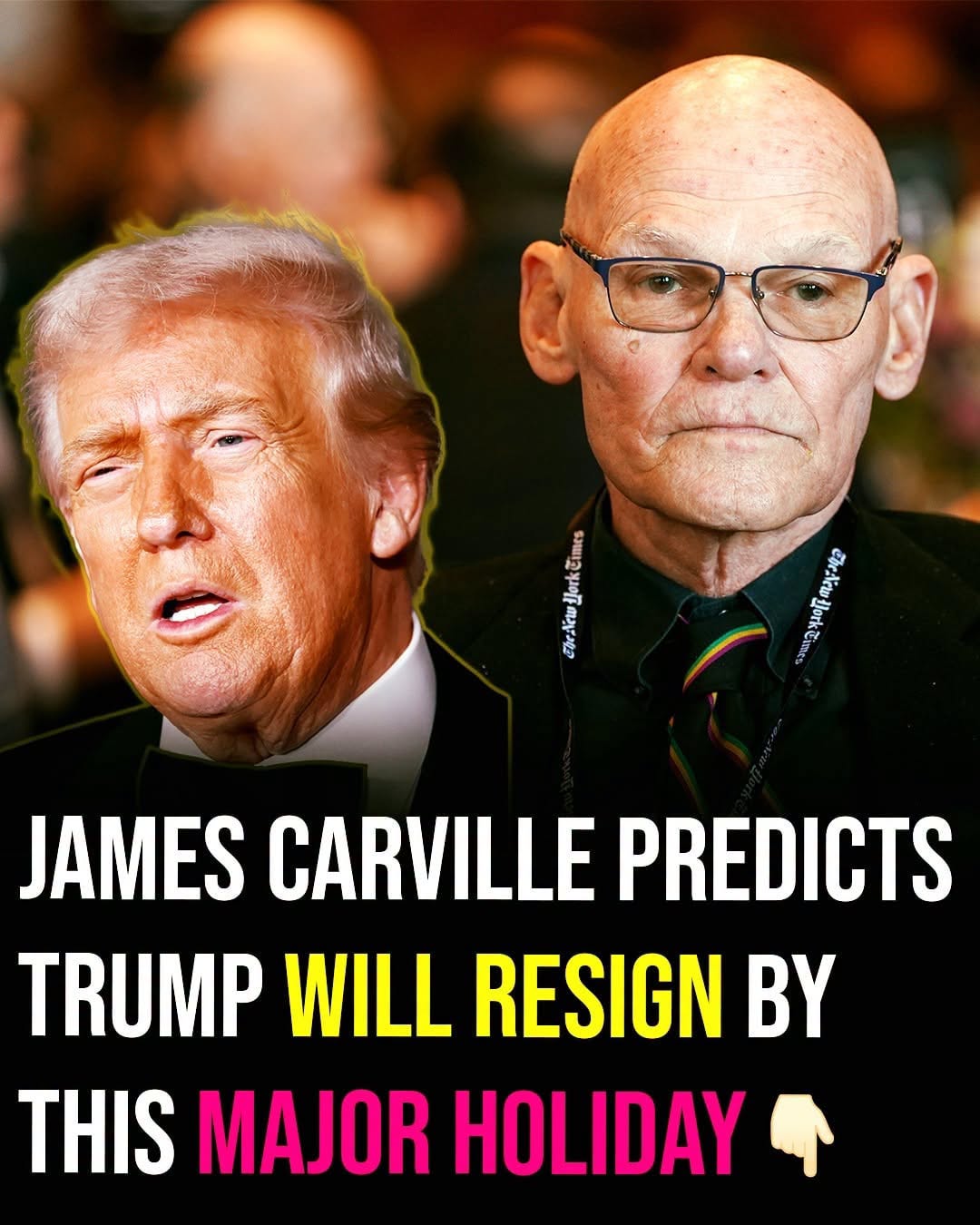
James Carville has never been known for cautious language, but his latest prediction pushed even his critics to sit up and listen. Speaking in his unmistakable, razor-edged style on a recent podcast appearance, the veteran Democratic strategist sketched out a future in which Donald Trump’s political survival doesn’t end in a dramatic confrontation or electoral defeat but in a voluntary exit timed, as Carville suggested, around a major holiday in 2027.
It was less a formal forecast than a narrative warning, but it immediately ignited debate across political circles. Carville described a presidency heading toward what he called an “inevitable exhaustion point,” where legal pressure, political fatigue, and public backlash converge in a way that becomes too difficult to manage even for a figure as combative as Trump.
In his telling, the next phase of American politics is not simply about winning or losing elections. It is about endurance.
Carville argued that Donald Trump’s political environment is becoming increasingly unstable beneath the surface, even if public appearances suggest otherwise. Investigations, congressional inquiries, and ongoing legal battles, he claimed, are slowly building a cumulative pressure that cannot be easily dismissed or spun away. While Trump remains a dominant force in the political landscape, Carville suggested that dominance does not necessarily translate into stability.
According to his analysis, the turning point would not arrive suddenly but would unfold gradually through a series of escalating events that begin to overwhelm even a highly disciplined political operation. He pointed to the post-election environment and the expected surge of subpoenas, legal maneuvers, and legislative confrontations that typically follow periods of divided government. In this scenario, Trump would not face a single decisive blow, but rather a sustained period of attrition.
Carville’s most controversial claim centered on timing. He suggested that by the time the political cycle reaches its next major national milestone Easter 2027 Trump could find himself in a position where continuing in office or in active political leadership becomes more burdensome than beneficial. In Carville’s framing, resignation would not be the result of a single scandal or moment of collapse, but rather the culmination of accumulated strain.
He painted a picture of a presidency increasingly isolated from reality, surrounded by aides attempting to manage information flow and shield the administration from constant negative developments. In this scenario, Trump becomes less an active decision-maker and more a figure encircled by competing narratives, legal constraints, and political firefights that limit his ability to govern freely.
Carville suggested that this environment could eventually produce a psychological and strategic shift one in which stepping away becomes a rational calculation rather than a forced outcome. It was this idea, more than the specific timing, that generated the strongest reaction.
Supporters of Donald Trump quickly rejected the prediction as political theater. They argued that Carville’s track record of bold forecasts has often leaned toward exaggeration and that Trump’s political resilience has repeatedly defied expectations. From impeachment proceedings to electoral challenges and ongoing legal scrutiny, Trump has consistently remained central to American political life, often emerging from controversy with his base intact or even strengthened.
From this perspective, Carville’s prediction is seen not as analysis, but as partisan storytelling designed to provoke media attention.
The White House response to similar commentary in the past has typically been swift and dismissive, and this case was no different. Allies of Trump have repeatedly characterized such claims as detached from political reality, pointing to continued support within key voter blocs and an enduring ability to dominate headlines regardless of controversy. In their view, speculation about resignation misunderstands both Trump’s political instincts and his long-standing refusal to retreat from conflict.
Still, Carville’s comments struck a nerve because they tap into a broader uncertainty about the future of American politics. Even among analysts who disagree with his timeline or conclusions, there is acknowledgment that the next election cycle will be intensely volatile. Legal proceedings, congressional dynamics, and shifting public opinion are all expected to play significant roles in shaping the political landscape.
Carville’s broader argument is less about a single individual and more about political sustainability in an era defined by constant exposure and conflict. In his view, modern presidencies operate under pressures that are far more intense and relentless than in previous decades. The combination of media saturation, legal scrutiny, and partisan division creates an environment where fatigue becomes a political force in itself.
Within that framework, his prediction about Trump is presented as an example rather than an exception. A high-profile figure operating at the center of continuous controversy, Carville suggests, will eventually face a moment where the costs of staying outweigh the benefits of continuing.
Yet even as he lays out this scenario, there is no certainty attached to it. The prediction remains speculative, shaped as much by interpretation and political philosophy as by concrete evidence. Trump’s political career has already defied numerous forecasts of decline, collapse, or withdrawal, making any definitive timeline inherently uncertain.
What Carville has done, however, is reframe the discussion. Instead of focusing solely on elections, polling, or legal outcomes, he has introduced the idea of political fatigue as a decisive factor. Whether or not his “holiday deadline” ever materializes, the concept itself reflects a growing awareness among analysts that modern political survival depends not just on winning battles, but on enduring them.
In the end, Carville’s prediction stands less as a precise roadmap and more as a provocation a way of asking how long any political figure can remain at the center of constant conflict before the weight of it begins to reshape their decisions.
Whether Easter 2027 becomes a symbolic milestone or just another date on the calendar, the debate it sparked is likely to continue long after the prediction itself fades from headlines.