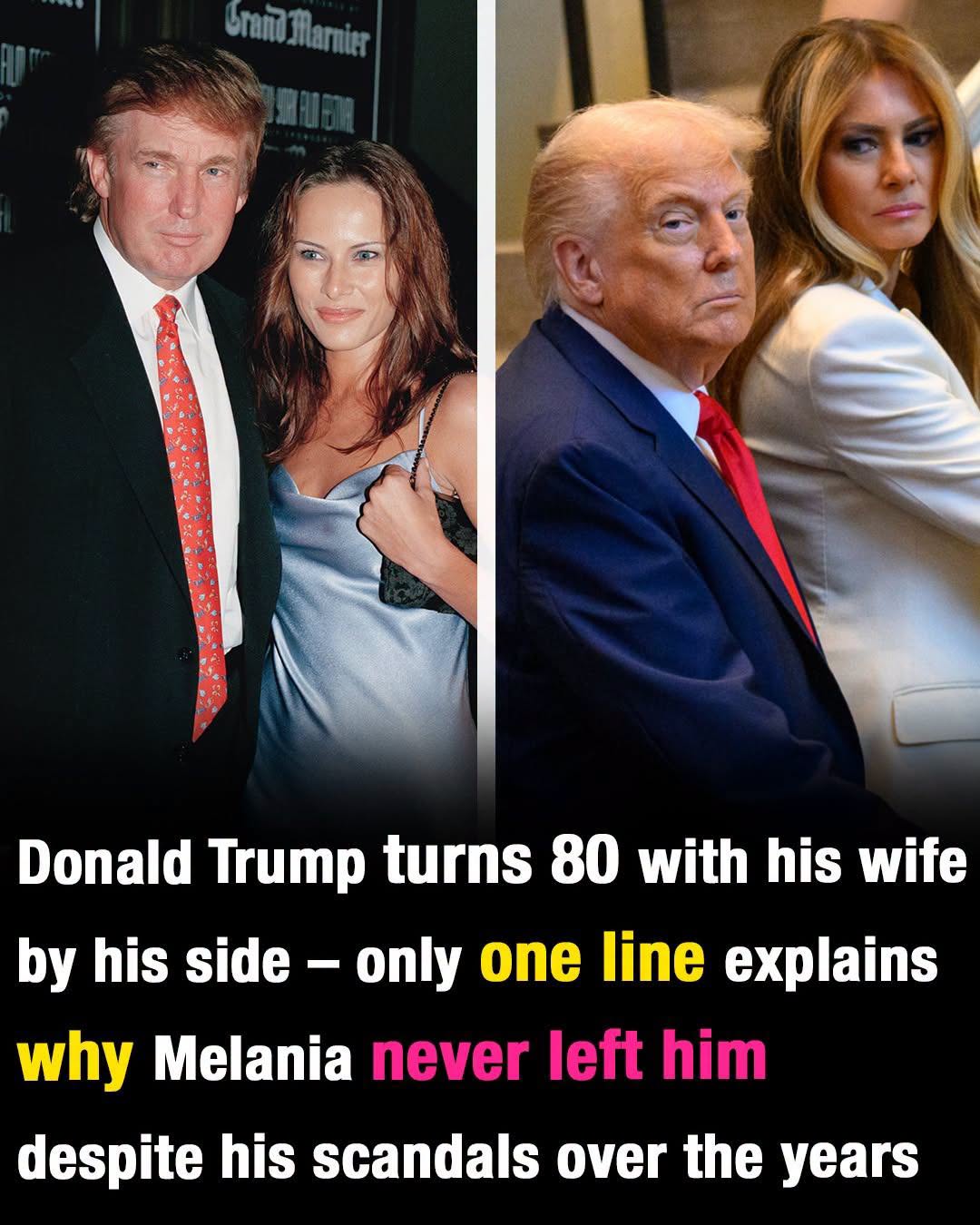
For years, the marriage of Donald and Melania Trump has been dissected through the lens of politics, power, and public performance.
To outsiders, it often appears like a partnership held together by formal appearances rather than emotional closeness: the staged smiles, the rare hand-holding, the carefully measured public interactions that leave more questions than answers. In that vacuum, speculation has flourished, turning silence into narrative and distance into assumed conflict.
Reports of tension have followed them for much of their time in the public eye. Melania’s limited presence on the campaign trail, her preference for privacy, and her refusal to fully step into the role of traditional political spouse have repeatedly been interpreted as signs of discontent. Each absence or restrained appearance has been amplified into theories about separation, resentment, or an impending split.
Yet according to former White House aide Stephanie Grisham, those assumptions miss a far more deliberate reality.
Grisham’s account paints a portrait of Melania Trump not as a passive figure caught in circumstances beyond her control, but as someone fully aware of the life she entered and what she continues to choose. In this interpretation, her marriage is not defined by emotional unpredictability or impulsive decisions, but by calculation, boundaries, and a strong sense of personal autonomy.
From the beginning, those close to the couple have suggested that Melania understood the nature of Donald Trump’s public and private persona. His political ambitions, media dominance, and controversial reputation were not surprises discovered later in the marriage, but conditions known well in advance. According to this view, she did not walk into the relationship unaware of the spotlight or the scrutiny that would follow.
Instead, she entered it with her eyes open.
What Grisham and others imply is that Melania’s position has always been defined by choice rather than obligation. She is not portrayed as someone swept along by circumstance, but as someone who evaluates her environment carefully and decides what she is willing to accept. In that framework, staying in the marriage is not the absence of escape it is the presence of intention.
Observers have long noted that Melania Trump maintains a highly controlled personal world. She is selective about appearances, measured in public statements, and protective of her private life to an unusual degree, even by political standards. Unlike many spouses of high-profile leaders, she has consistently avoided adopting a fully public-facing role, preferring instead to define her identity on her own terms.
That independence, according to insiders, is central to understanding her choices.
Grisham’s remarks suggest that Melania weighs the realities of her life with a pragmatic lens. The benefits of her position security, stability, influence by proximity, and a carefully maintained lifestyle exist alongside the challenges of constant public scrutiny and political turbulence. Rather than being overwhelmed by that contrast, she is described as someone who has made a long-term assessment of it.
In that assessment, leaving is not necessarily the most rational option.
This interpretation reframes the narrative that she is “stuck” or “silent out of fear.” Instead, it presents her silence as a form of control. By speaking selectively and maintaining emotional distance from political conflict, she preserves a boundary between her public association and her private self. In doing so, she avoids being fully absorbed into the volatility that surrounds her husband’s public life.
Her critics often interpret this silence differently, reading it as disengagement or disapproval. Her supporters, however, see it as discipline and restraint in an environment defined by constant noise. Both interpretations contribute to the broader mystique surrounding her, where even absence becomes a statement that others are eager to interpret.
Over time, this ambiguity has become a defining feature of her public identity.
Unlike many political spouses who actively shape public messaging or campaign narratives, Melania has consistently resisted being positioned as an extension of her husband’s political brand. Even during periods of intense national attention, she has maintained a posture of separation present when necessary, distant when possible, and rarely fully transparent about her inner perspective.
This has fueled ongoing fascination, particularly during moments when she appears alongside Donald Trump in high-visibility settings. Small gestures, facial expressions, or body language are often scrutinized for meaning, as if they contain hidden commentary on their relationship. In this environment, every appearance becomes a puzzle, and every silence becomes a potential message.
According to Grisham’s account, however, there is less mystery at the core than the public assumes.
Rather than a relationship defined by instability, it is portrayed as one governed by mutual awareness of roles, expectations, and personal limits. Donald Trump occupies the center of political and media attention; Melania operates on the perimeter, observing, managing her exposure, and maintaining a separate sense of identity within the structure of that attention.
Within that structure, her decision to remain is not presented as passive endurance, but as active acceptance.
She understands what the relationship demands, what it offers, and what it costs. And according to those who have worked closely with her, she has consistently chosen to stay within that framework because it aligns with her own priorities and boundaries.
This perspective challenges the common assumption that visibility equals transparency. Just because Melania is seen in public alongside her husband does not mean her motivations or decisions are fully accessible to outside interpretation. Instead, her carefully limited communication suggests a preference for control over narrative, even when that control results in misunderstanding.
In many ways, that misunderstanding has become part of her public image.
The idea that she “will never leave,” as some accounts frame it, does not necessarily imply emotional attachment in the conventional sense. Rather, it reflects a broader calculation about stability, identity, and agency within a uniquely high-profile marriage. It is a conclusion drawn not from dramatic statements or public declarations, but from consistency over time.
Through years of speculation, crises, campaigns, and controversies, she has remained in place neither fully stepping into political partnership nor fully withdrawing from it. That balance, intentional or not, has created a perception of distance that invites constant interpretation.
Yet according to those closest to her professionally, that distance is precisely the point.
It allows her to exist within the orbit of power without being consumed by it.
In that sense, her silence is not emptiness, but structure. And her continued presence in the marriage is not confusion, but continuity.
Whether viewed as strategy, pragmatism, or personal conviction, it is a position she has maintained with remarkable consistency over time. And for observers trying to understand the nature of her relationship with Donald Trump, that consistency may be the clearest answer available.