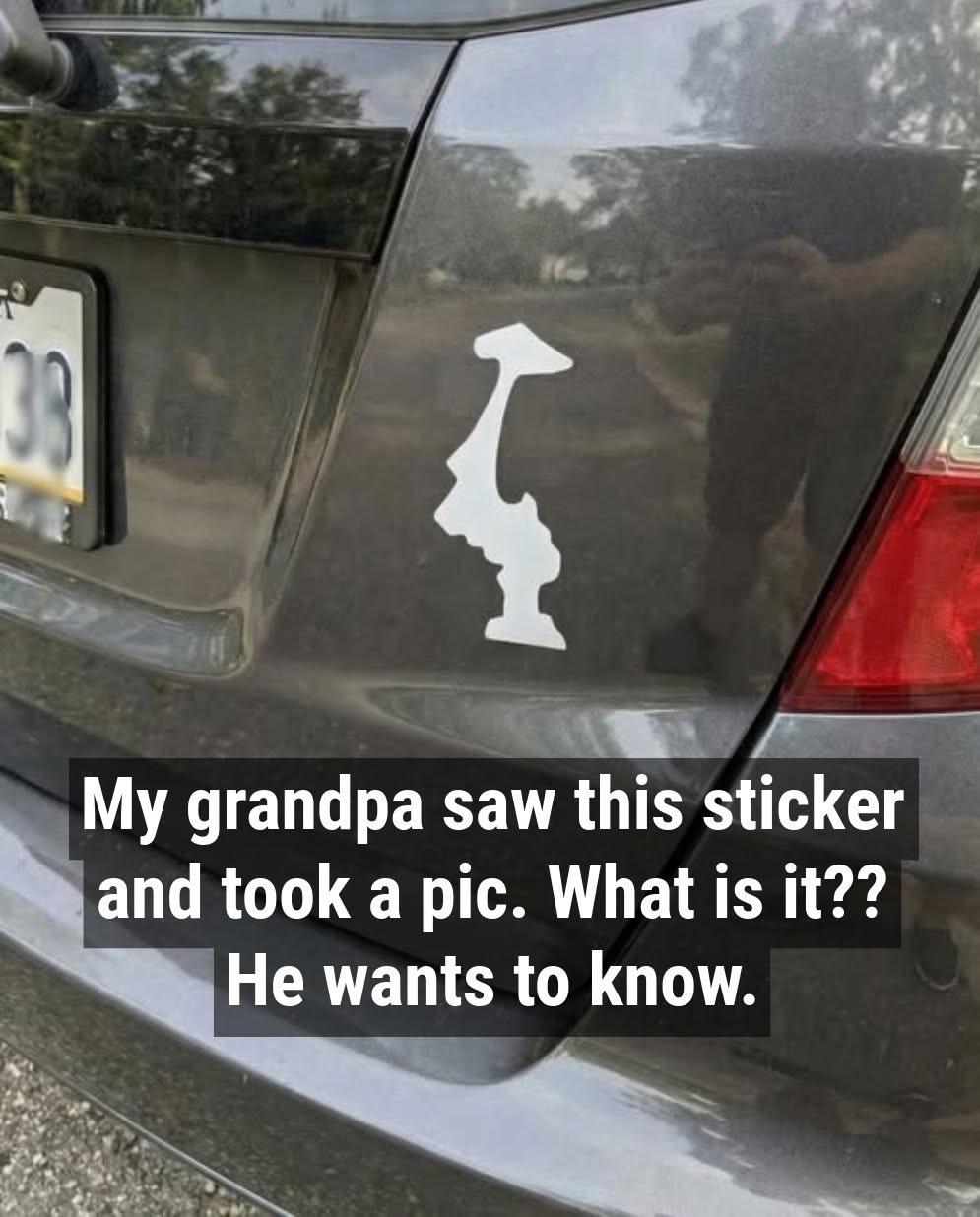
At first glance, it looks like a mistake.
A familiar outline of Washington state, flipped upside down on the back window of a dusty SUV or a weather-worn van, catches the eye for a moment and makes you do a double take. It feels slightly wrong, almost accidental like a decal applied in haste or a design printed the wrong way around.
But for many drivers, the inversion is entirely intentional.
That upside-down silhouette has become a quiet symbol with a meaning far deeper than its simple shape suggests. It is not about geography alone. It is about memory, distance, identity, and the strange emotional pull of home that does not fade just because someone has moved away.
For some, it is a joke. For others, it is a statement. For many, it is both at the same time.
The sticker has evolved into a kind of moving postcard one that travels across highways, borders, and continents, carried by people who may no longer live in the Pacific Northwest but still feel rooted in it.
The idea is simple, but the emotion behind it is layered.
Turning the Washington outline upside down is often interpreted as a playful twist on state pride, a way of gently subverting the usual seriousness of regional identity. Instead of displaying allegiance in a standard, polished way, drivers invert it, giving it a slightly rebellious edge.
But beneath the humor lies something more personal.
For many who display it, the sticker represents displacement not necessarily in a negative sense, but in the sense of having moved on while still carrying a piece of where they came from. Life pulls people away for work, education, relationships, or adventure. Over time, addresses change, accents soften, routines shift. Yet identity often lags behind geography.
The upside-down Washington becomes a subtle acknowledgment of that disconnect.
“I’m not there anymore,” it seems to say, “but I’m still from there.”
You will often find these decals on vehicles that already tell stories of movement and exploration. Trail-dusted Subarus parked at climbing crags in Utah. Camper vans with faded paint idling near coastal roads in New Zealand. Jeeps coated in mountain dust in British Columbia, their roofs loaded with gear and their windows carrying small pieces of home.
These are not showroom cars. They are lived-in machines, shaped by miles of travel and seasons of change.
And on many of them, the inverted Washington outline sits quietly in the corner of a rear window, unassuming but meaningful.
The appeal of the sticker also lies in its subtlety. It does not demand attention the way slogans or bold graphics do. Instead, it reveals itself slowly. Most people do not notice it immediately. When they do, it often prompts curiosity rather than explanation.
Why is it upside down?
The answer varies depending on who is asked.
Some drivers say it represents being “turned around” by life leaving home young, building a life elsewhere, and realizing that direction is not always linear. Others use it as a lighthearted nod to the idea of inversion itself, embracing the imperfect, the offbeat, the slightly unconventional.
In that sense, it fits perfectly with the culture of the Pacific Northwest, a region often associated with outdoor life, independent thinking, and a certain understated aesthetic.
The sticker itself is usually sourced from small artists or independent creators based in the region. Many are made from durable, weatherproof vinyl designed to withstand rain, snow, road salt, and long highway stretches. They are built for movement, just like the people who buy them.
Over time, exposure to sun and weather often fades the edges. The crisp outline softens. The colors dull slightly. And yet, this wear only adds to its character.
A brand-new sticker says something simple.
A faded one says something lived.
There is also a growing sense that these decals function as quiet social signals among strangers. Someone spotting the upside-down Washington in a parking lot or at a trailhead might recognize it instantly as a shared reference point. It becomes a small bridge between people who might otherwise never speak to each other.
A silent acknowledgment of origin.
A brief sense of familiarity in unfamiliar places.
Not everyone who uses the sticker is consciously engaging in symbolism. For some, it is simply aesthetic. It looks interesting. It breaks symmetry. It adds personality to a vehicle that already reflects a life spent outdoors, on the road, or in transition.
But even when chosen casually, symbols tend to accumulate meaning over time.
A sticker that begins as decoration can slowly become identity.
The Pacific Northwest itself plays a strong role in why the symbol resonates so widely. The region is deeply tied to nature forests, mountains, coastlines, and long stretches of road that lead far beyond city limits. Many who grow up there develop a strong connection to landscape as much as to place.
When they leave, that connection does not disappear. It often becomes more pronounced.
Distance has a way of sharpening memory.
A rainy street in Seattle, a ferry crossing, a mountain skyline these details take on a different weight once they are no longer part of daily life.
The upside-down Washington outline becomes a compact way of carrying that memory forward.
It travels without needing space. It does not require luggage or explanation. It simply exists in motion, attached to a vehicle that is already crossing distances.
Over time, it has spread far beyond its original regional context. It now appears in places that have no immediate connection to Washington state itself. That expansion has only deepened its meaning, transforming it from a regional symbol into something more universal: a marker of belonging that persists even when geography changes.
Because at its core, the sticker is not really about a state.
It is about the experience of leaving and remembering at the same time.
About how identity follows people even when they think they have outgrown it.
And about how something as small as a flipped outline on a car window can quietly hold an entire sense of home, moving with them across roads that stretch far beyond the place where it all began.