What began as a celebration of sport, patriotism, and competition quickly transformed into one of the most discussed moments online.
The event had all the ingredients of a made-for-television spectacle. Bright lights illuminated the grounds, crowds cheered from every direction, and cameras captured nearly every second as fighters, celebrities, and political figures gathered for UFC Freedom 250. The atmosphere was electric, designed to celebrate athletic achievement and national pride.
But amid the excitement, a brief exchange would soon dominate headlines and social media discussions.
At the center of the controversy was an unexpected moment involving President Donald Trump and a UFC fighter whose post-fight remarks instantly ignited debate across the internet.
Like many major sporting events, the evening was filled with emotion.
Victories bring adrenaline.
Crowds amplify passion.
Athletes often speak from the heart in the moments immediately after competition.
Sometimes those moments inspire.
Other times, they create controversy that extends far beyond the arena.
That appears to be what happened during the now-viral exchange.
Following his victory, fighter Josh Hokit addressed the crowd and acknowledged President Trump, who was in attendance. The comments initially seemed like standard praise often exchanged between athletes and political figures at public events.
Then the tone shifted.
According to numerous accounts circulating online, Hokit made a controversial remark directed toward former First Lady Michelle Obama, repeating a long-debunked claim that has circulated on certain corners of the internet for years.
The statement immediately drew strong reactions.
Some audience members cheered.
Others appeared visibly uncomfortable.
Online, reactions quickly divided along political lines.
Critics condemned the comment as disrespectful and rooted in misinformation. Supporters argued that public figures often face criticism and satire in highly polarized environments.
Regardless of political perspective, the remark quickly became one of the most discussed moments of the event.
But what happened next generated even more attention.
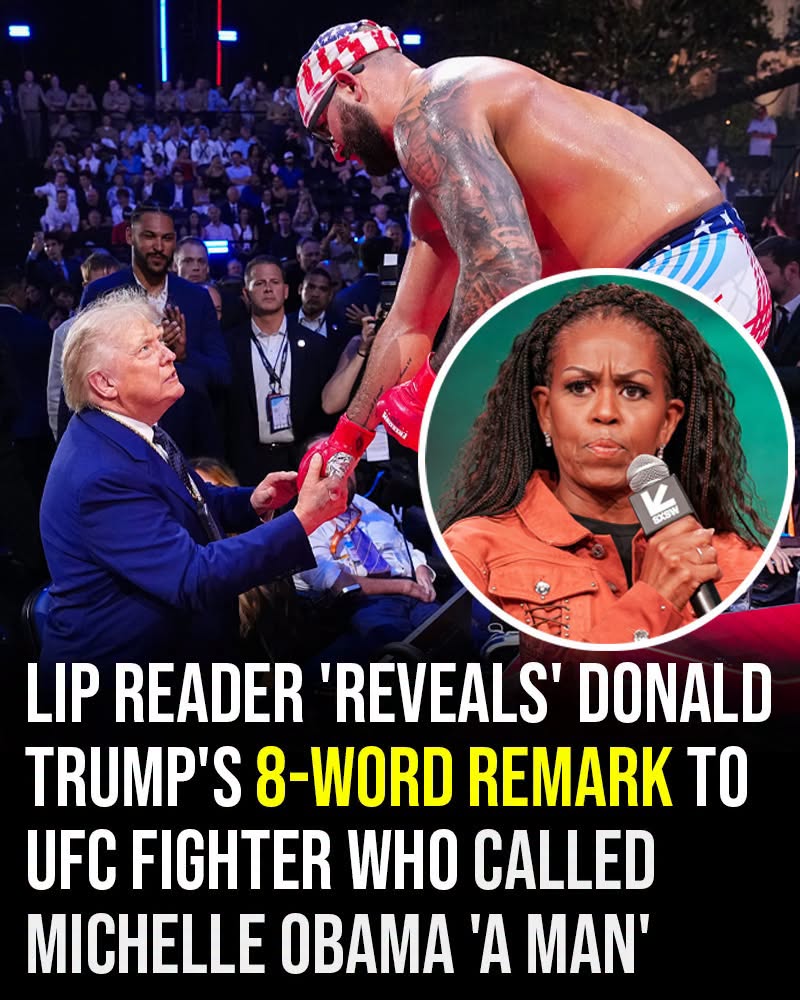
Television cameras captured Trump leaning toward the fighter during the post-fight interaction. Because no official audio of the exchange was available, online speculation exploded almost instantly.
People began asking the same question:
What exactly was said?
Into that vacuum stepped professional lip reader Jeremy Freeman, who later offered his interpretation of the brief exchange. According to his analysis, Trump allegedly responded with the words:
“Too kind, thank you. You are the champion.”
It is important to note that lip reading is not an exact science. Experts frequently caution that interpreting speech solely from visual cues can be difficult and may not always be accurate.
Nevertheless, the claimed interpretation spread rapidly online.
For some observers, the alleged response appeared to sidestep the controversial remark entirely, focusing instead on congratulating the athlete for his victory.
Others argued that failing to directly address inflammatory comments can sometimes be interpreted as tacit acceptance.
The debate intensified almost immediately.
Supporters of Trump noted that public figures often receive compliments from athletes and supporters in highly public settings, and that brief interactions captured on camera rarely provide complete context.
Critics countered that moments involving national leaders carry symbolic weight, particularly when controversial statements are made in their presence.
The incident once again highlighted how quickly modern political moments can evolve into larger cultural conversations.
Within hours, clips circulated across social media platforms.
Comment sections exploded.
Hashtags trended.
Millions watched and rewatched the footage, searching for clues hidden within a few seconds of video.
In today’s digital age, a brief exchange lasting only moments can become the subject of days of analysis.
The controversy also reignited broader discussions about public discourse and the role of prominent figures in shaping conversations.
Public events involving politics and sports have long occupied a unique place in American culture.
For decades, athletes have used their platforms to express opinions on social issues, while politicians have often appeared at sporting events to connect with supporters and celebrate national traditions.
These intersections, however, can become complicated.
Sports are often viewed as spaces that unite people across differences.
Yet they can also become stages where broader cultural conflicts play out in real time.
That tension was evident in the reaction to the UFC event.
Some people viewed the controversy as another example of political polarization spilling into entertainment.
Others argued that public figures, regardless of affiliation, should be held accountable for the messages amplified around them.
Meanwhile, UFC president Dana White reportedly addressed the controversy by emphasizing respect and rejecting false claims directed toward families.
His comments were widely interpreted as an attempt to lower tensions and separate athletic competition from personal attacks.
For many observers, the moment underscored how difficult that separation has become.
In the modern media environment, politics, celebrity culture, and sports increasingly overlap.
A single comment made during a celebration can become a national discussion within minutes.
A few seconds of video can generate days of headlines.
And every gesture, reaction, or silence may be interpreted differently depending on the audience watching.
Lost amid the debate was the original purpose of the evening: competition.
Athletes had trained for months.
Fans gathered to celebrate sport.
Victories were earned inside the cage.
Yet the conversation quickly shifted elsewhere.
That shift reflects a broader reality of public life in the twenty-first century.
Increasingly, major events are remembered not only for what happened, but for how those moments were interpreted online afterward.
For supporters, critics, and casual observers alike, the exchange served as another reminder that public figures operate under constant scrutiny.
Every word matters.
Every reaction is analyzed.
Every moment can become part of a much larger narrative.
As the footage continues circulating across social media, opinions remain sharply divided.
Some see a harmless exchange between a president and an athlete.
Others view it as a moment carrying deeper cultural implications.
What remains undeniable is that a few seconds of conversation on a brightly lit stage managed to spark a nationwide debate—once again demonstrating the extraordinary power of images, perception, and public interpretation in the digital age.