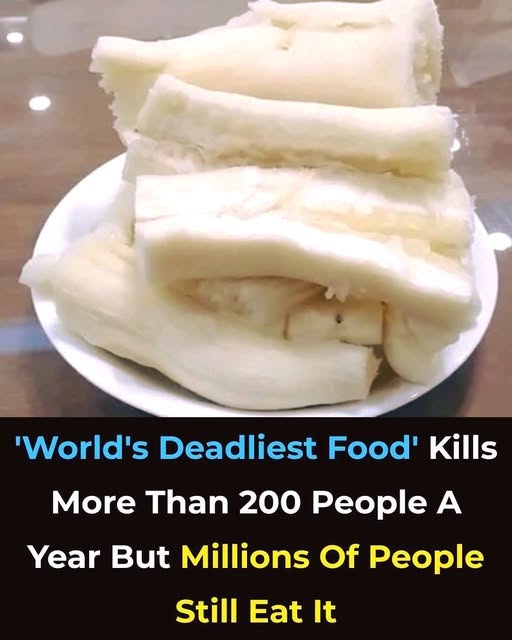
Every day, hundreds of millions of people around the world sit down to meals that include one humble root vegetable. It appears in breads, porridges, flour, chips, stews, and countless traditional dishes passed down through generations. In many parts of Africa, Asia, and Latin America, it is more than just food it is a lifeline.
That crop is cassava.
Known by different names such as manioc or yuca, cassava is one of the most important staple foods on Earth. For millions of families, it provides a reliable source of calories in regions where drought, poor soil, and harsh climates make farming difficult. Its ability to survive under conditions that destroy other crops has made it essential to global food security.
Yet behind its importance lies a little-known fact that surprises many people: cassava contains naturally occurring compounds that can become toxic if the plant is not prepared properly.
This unusual characteristic has led some to describe cassava as one of the world’s most dangerous foods—not because it is inherently harmful, but because safe consumption depends on knowledge, preparation, and tradition.
The story of cassava begins thousands of years ago in South America, where Indigenous communities first cultivated and domesticated the plant. Over time, explorers, traders, and colonial expansion carried cassava across oceans to Africa and Asia, where it adapted remarkably well to tropical environments.
Its popularity grew rapidly for good reason.
Cassava thrives in poor soils where other crops struggle. It tolerates heat and drought better than many staples and can remain in the ground for extended periods until needed. In areas facing food shortages or unpredictable weather, this resilience makes cassava invaluable.
Today, countries around the world depend on it as a critical food source.
But cassava possesses a unique biological defense system.
Like many plants in nature, cassava evolved mechanisms to protect itself from insects and animals. One of these defenses involves naturally occurring compounds called cyanogenic glycosides. Under normal conditions, these substances remain safely contained within the plant’s tissues.
However, when cassava is cut, peeled, crushed, or chewed, chemical reactions can occur that release hydrogen cyanide.
Cyanide is a powerful toxin that interferes with the body’s ability to use oxygen at the cellular level. In large enough amounts, it can become dangerous or even fatal.
This fact may sound alarming, but there is an important distinction: properly prepared cassava is safe to eat and has nourished populations for centuries.
The danger arises only when preparation methods are inadequate or skipped entirely.
Over generations, communities that rely heavily on cassava developed sophisticated techniques to remove or reduce harmful compounds. These methods represent centuries of practical knowledge passed from one generation to the next.
Preparation often begins with peeling the root thoroughly, since toxic compounds are concentrated in certain parts of the plant. Depending on local traditions and the type of cassava used, the root may then be soaked in water, fermented, dried, grated, or cooked extensively.
These steps dramatically reduce cyanide levels and make the food safe for consumption.
What appears simple on the surface often reflects generations of accumulated wisdom.
In many regions, preparing cassava is not merely cooking it is cultural knowledge that protects communities and sustains families.
Problems typically arise during periods of hardship.
In times of famine, conflict, displacement, or severe poverty, people may lack sufficient time, water, fuel, or resources to process cassava correctly. Under these difficult circumstances, individuals may consume improperly prepared roots out of necessity.
This is when health risks increase.
International health organizations have documented cases of cyanide poisoning associated with insufficiently processed cassava. While such incidents remain relatively rare compared to the enormous number of people who eat cassava safely every day, they highlight the importance of proper preparation.
One of the most serious conditions linked to chronic exposure to cassava toxins is a neurological disease known as konzo.
Konzo primarily affects communities experiencing severe food insecurity and limited dietary diversity. The disease causes sudden and irreversible paralysis of the legs and has been observed mainly in parts of sub-Saharan Africa.
Researchers have found that nutrition plays a critical role in this process.
Protein helps the body detoxify small amounts of cyanide. When diets are deficient in essential nutrients, the body’s ability to process these compounds decreases, increasing vulnerability to harmful effects.
This illustrates an important reality: food safety often depends not only on the food itself but also on broader social and economic conditions.
Despite these challenges, cassava remains one of humanity’s most valuable crops.
Without it, millions of people would face far greater risks of hunger and malnutrition. Its ability to grow where other crops fail provides stability in regions vulnerable to drought and climate variability.
In many communities, cassava is not viewed as dangerous at all.
Instead, it is regarded as dependable, resilient, and lifesaving.
Its versatility also contributes to its importance. Cassava can be transformed into flour, breads, noodles, porridges, snacks, and traditional dishes unique to different cultures. In some countries, tapioca pearls made from cassava starch have become globally popular ingredients in desserts and beverages.
This remarkable adaptability has allowed cassava to become deeply woven into cultural identities and culinary traditions around the world.
Modern science continues to improve cassava safety and productivity.
Researchers have developed varieties containing lower levels of cyanogenic compounds while maintaining resilience against drought and disease. Agricultural programs and public health campaigns also work to educate communities about safe preparation methods.
These efforts seek to preserve cassava’s role in food security while minimizing potential health risks.
The story of cassava reveals something larger about humanity’s relationship with food.
Many foods we consume safely today once required careful observation, experimentation, and cultural knowledge to prepare properly. Human societies have long learned how to transform raw natural resources into nourishing meals through innovation and shared experience.
Cassava stands as a powerful example of this process.
What could be harmful in one form becomes life-sustaining in another through knowledge and tradition.
Its story is not really about danger.
It is about adaptation.
It is about resilience.
And it is about the extraordinary ways human communities learn to work with nature rather than against it.
For millions of people across the globe, cassava remains more than a crop. It is security during difficult times, nourishment during uncertainty, and a reminder that survival often depends not only on what we eat, but on the wisdom passed down through generations.
When prepared correctly, cassava is not one of the world’s most dangerous foods.
It is one of its most important.