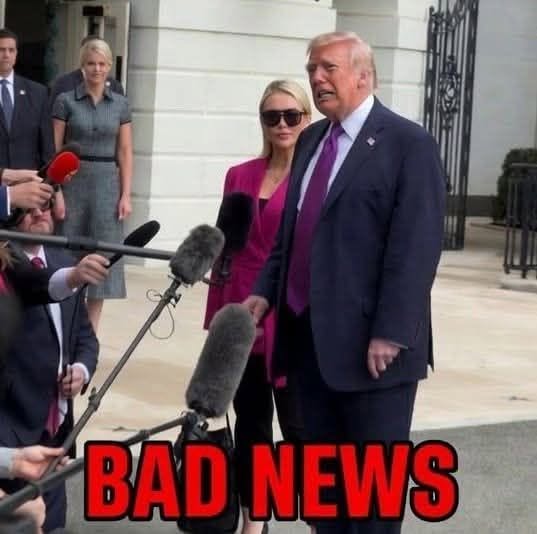
A small and seemingly routine adjustment to Donald Trump’s public schedule was enough to ignite a wave of speculation across social media, highlighting once again how quickly uncertainty can spiral into misinformation in the digital age.
What began as a minor change in timing or appearance at a planned engagement quickly evolved into a global talking point, not because of verified events, but because of the information vacuum that followed.
In today’s hyperconnected environment, even brief gaps in official communication can become fertile ground for speculation. Within minutes of the schedule change being noticed, online platforms began circulating unverified posts suggesting that Trump had experienced a sudden medical emergency. Some of these posts were framed as urgent “breaking news,” while others claimed to come from anonymous insiders or unnamed sources close to the situation.
The effect was immediate. Algorithms on major platforms amplified the most emotionally charged content, pushing sensational claims higher in feeds than cautious or factual commentary. As a result, millions of users were exposed to alarming narratives before any official clarification was released.
For many observers, the speed of the spread was as striking as the content itself. What might once have taken hours or days to circulate through traditional media channels now unfolded in real time, with rumors evolving and intensifying as they were shared, reposted, and reinterpreted by users across different networks.
Some posts went further, suggesting that Trump had been taken to Walter Reed National Military Medical Center, a claim that rapidly gained traction despite the absence of evidence. The specificity of such claims often gave them a false sense of credibility, leading many users to assume that they were based on insider knowledge or early reporting.
At the same time, supporters and critics of Trump reacted in markedly different ways, reflecting the broader polarization that often surrounds political figures in the United States. Some users expressed concern and waited for confirmation, while others dismissed the claims as politically motivated misinformation. Still others engaged with the rumors as they spread, unintentionally contributing to their visibility.
This mixture of reaction, speculation, and repetition created a feedback loop in which uncertainty itself became the story.
It was not until official representatives addressed the situation that clarity began to emerge. According to statements released after the rumors had already circulated widely, Trump had not been admitted to Walter Reed, had experienced no medical emergency, and was not undergoing any urgent health-related issue. He was described as being at home and continuing with his usual activities.
By the time this clarification was made public, however, the initial narrative had already traveled far beyond its origin. Screenshots, reposted claims, and fragmented interpretations of earlier posts continued to circulate even after the correction was issued, demonstrating how difficult it can be to fully reverse misinformation once it gains momentum online.
This pattern has become increasingly familiar in the modern media landscape. A small trigger such as a change in schedule, a brief absence, or a delayed appearance can rapidly escalate into widespread speculation when combined with high public interest and low immediate verification.
Experts in media behavior often point out that uncertainty is one of the strongest drivers of online engagement. When information is incomplete, people tend to fill in the gaps with assumptions, especially if the subject involves a well-known public figure. The more prominent the individual, the more intense the speculation tends to become.
In this case, Trump’s high-profile status amplified the effect. As a former president and ongoing political figure, any perceived change in his health or availability naturally attracts attention. That attention, when paired with incomplete information, creates an environment where rumors can flourish before facts are confirmed.
The episode also highlights the role of social media algorithms in accelerating the spread of unverified claims. Platforms designed to maximize engagement often prioritize content that provokes strong emotional reactions, including fear, shock, or urgency. As a result, misleading posts can sometimes travel faster and farther than factual updates, particularly in the early stages of a developing story.
Once misinformation spreads widely, correction becomes significantly more difficult. Even when official statements are issued, they often reach fewer people than the original viral claims. In addition, corrections may lack the emotional intensity that drove the initial spread, making them less likely to be shared or amplified.
This imbalance between rumor and correction has become a defining challenge of modern communication. It affects not only political reporting but also public health, finance, and crisis response, where timely and accurate information is essential.
In response to incidents like this, communication experts often emphasize a simple but powerful principle: verification before amplification. Checking sources, waiting for confirmation, and avoiding the sharing of unverified claims are increasingly seen as essential practices for navigating today’s information environment.
The recent wave of speculation surrounding Trump’s schedule serves as a reminder of how quickly perception can shift in the absence of facts. A brief moment of uncertainty can be transformed into a global narrative within minutes, regardless of its accuracy.
Ultimately, the situation underscores a broader reality of the digital era. Information now moves at unprecedented speed, but truth often moves more slowly. In that gap between speed and verification, rumors can thrive, narratives can distort, and public understanding can become fragmented.
While official clarification eventually resolved the specific claims in this case, the broader lesson remains unchanged. In an environment where attention spreads faster than accuracy, the responsibility to pause, verify, and think critically has never been more important.
And as this episode shows, even the smallest informational void can become the starting point for a story that the world rushes to believe before it is ever confirmed.