What began as a routine reporting effort quickly exploded into a larger national conversation about journalism, politics, and public trust.
A controversy involving NBC News and outreach to individuals connected to the Jeffrey Epstein case has reignited longstanding debates over how major media organizations conduct investigations and whether the public still believes in their motives.
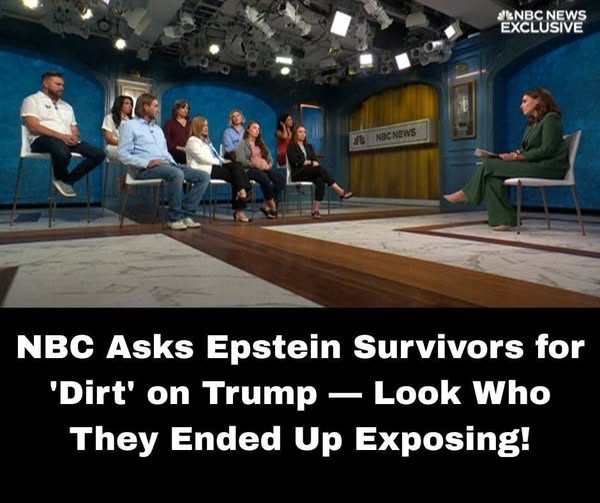
At the center of the uproar are allegations that reporters contacted Epstein survivors and associates seeking information related to former President Donald Trump. Critics immediately accused the network of pursuing a politically motivated story, while defenders argued that investigative journalism often requires asking difficult questions, even when those questions involve powerful public figures.
The incident quickly spread across social media, where reactions were swift and deeply divided. To some observers, the outreach represented an example of the media aggressively searching for damaging information about a political figure. To others, it reflected standard reporting practices that have long been used to uncover important stories involving influential individuals.
The controversy highlights a growing challenge facing modern journalism: in an era of intense political polarization, even ordinary reporting methods can become the subject of fierce public debate.
For decades, investigative journalism has relied on contacting sources, witnesses, experts, and people connected to major events. Reporters routinely reach out to individuals who may possess relevant information, even if those conversations never lead to publication. In many cases, these efforts happen entirely behind the scenes and remain invisible to the public.
Supporters of traditional reporting practices argue that this process is essential to journalism itself.
Without asking difficult questions, they say, reporters would struggle to uncover misconduct, verify claims, or challenge those in positions of power. History is filled with examples of major investigations that began with a simple phone call or an uncomfortable conversation.
From political scandals to corporate wrongdoing, many landmark stories emerged because journalists pursued leads that initially seemed uncertain or controversial.
Critics, however, argue that context matters.
When outreach involves individuals connected to emotionally charged cases such as Jeffrey Epstein’s crimes, some believe journalists carry an even greater responsibility to avoid creating the appearance of political agendas. Epstein’s case remains one of the most disturbing and widely scrutinized scandals in recent memory, involving allegations of abuse, exploitation, and networks of powerful associates.
Because of that history, any effort to revisit connections between public figures and the Epstein case is likely to attract intense attention.
For many Americans, trust in media institutions has declined significantly over the past several years. Surveys repeatedly show growing skepticism toward news organizations across the political spectrum. Conservatives often accuse mainstream outlets of bias against right-leaning figures, while liberals sometimes criticize the media for failing to hold powerful individuals sufficiently accountable.
This erosion of trust has created an environment in which nearly every journalistic decision is viewed through a political lens.
A request for comment may be interpreted as activism.
An investigation may be viewed as advocacy.
Silence may be seen as protection.
The result is a media landscape where intent is often questioned before facts are even examined.
In this particular controversy, NBC reportedly defended its actions by describing them as part of ordinary reporting efforts. News organizations frequently contact numerous individuals while pursuing broader stories, often gathering information that never ultimately appears in published work.
From the perspective of many journalists, such outreach is not unusual.
But in today’s climate, routine practices do not always appear routine to the public.
The rise of social media has fundamentally changed the relationship between journalists and audiences. In earlier eras, much of the reporting process occurred out of public view. Today, screenshots, emails, messages, and private exchanges can rapidly become viral topics of discussion.
As a result, the public now witnesses parts of journalism that were once largely invisible.
This increased transparency has advantages, allowing greater scrutiny of reporting methods and accountability for news organizations. At the same time, it can also lead to misunderstandings when partial information circulates without full context.
The debate surrounding NBC’s outreach illustrates how difficult it has become to separate reporting methods from political narratives.
For some critics, the issue is not simply whether reporters contacted sources. Instead, they question why certain stories receive attention while others appear to receive less scrutiny. This perception of selective coverage has fueled accusations of bias across the media landscape.
Journalists, meanwhile, often argue that newsworthiness not politics guides editorial decisions.
Yet proving neutrality in a deeply polarized environment has become increasingly difficult.
Trust, once lost, is difficult to rebuild.
The controversy also raises broader questions about the role of investigative journalism in democratic societies. A free press is often described as an essential check on power, tasked with asking difficult questions and pursuing uncomfortable truths. At the same time, journalists must navigate ethical boundaries, maintain credibility, and avoid creating perceptions of unfairness.
Balancing these responsibilities has never been easy.
Today, it may be harder than ever.
Political divisions have transformed how people consume information. Many individuals now rely on news sources that align with their existing beliefs, reinforcing different interpretations of the same events. As a result, identical actions by reporters may be viewed as courageous investigation by one audience and partisan activism by another.
The same story can produce entirely different realities depending on who is watching.
This phenomenon extends far beyond a single network or controversy. It reflects broader changes in media consumption, technology, and public trust that have reshaped journalism worldwide.
News organizations now operate under unprecedented scrutiny.
Every headline is analyzed.
Every source is questioned.
Every editorial choice becomes a potential battleground.
In such an environment, even routine reporting practices can trigger national debates about fairness, ethics, and political influence.
The controversy surrounding NBC’s outreach to individuals connected to the Epstein case serves as a reminder of how fragile trust has become—not only in media institutions but in public discourse itself.
For journalists, the challenge is to continue pursuing facts while maintaining transparency and credibility.
For audiences, the challenge is equally difficult: distinguishing between legitimate reporting, opinion, and political narratives in an increasingly fragmented information landscape.
The larger question may not be whether reporters asked difficult questions.
After all, journalism has always involved asking difficult questions.
The deeper issue is whether the public still believes those questions are being asked for the right reasons.
As debates over media bias, accountability, and trust continue, one reality remains clear: journalism today operates under a microscope unlike any in history. Every action is examined, every motive is debated, and every controversy adds another chapter to an ongoing conversation about who informs the public and who the public chooses to believe.