Optical illusions have captivated people for generations, challenging the way we see the world and revealing just how complex human perception can be.
A single image can spark endless debate, with one person instantly spotting something completely different from what another sees. These visual puzzles continue to spread across social media because they tap into a universal fascination: the mystery of how our brains interpret reality.
One of the most popular types of illusions asks a simple question: What do you see first? Whether it’s a hidden face, a concealed object, or an animal blended into a landscape, the answer often surprises people. Some viewers immediately notice one figure, while others are convinced an entirely different image stands out. This difference in perception is what makes these illusions so intriguing.
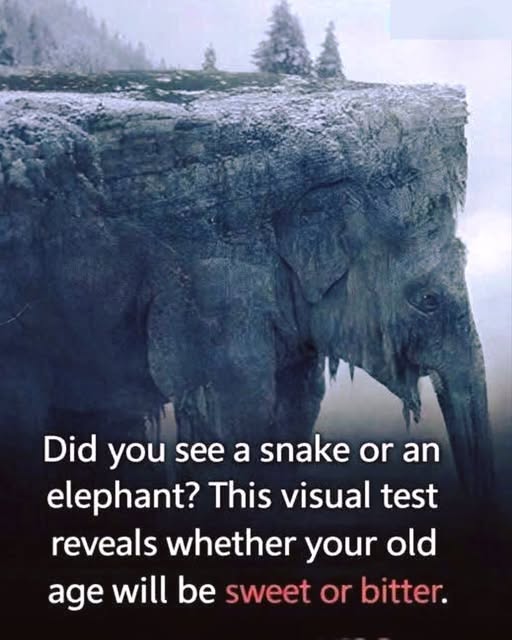
A particularly fascinating example features a scene that appears simple at first glance but contains multiple possible interpretations. Some people instantly notice the shape of a snake winding through the image. Others swear they see an elephant formed by shadows, contours, and natural patterns. Both observations seem equally convincing, creating a visual puzzle that encourages viewers to take a second, third, and even fourth look.
The immediate temptation is to believe that what you see first reveals something profound about your personality. Online posts often suggest that spotting one animal indicates creativity, while seeing another points to logic, intuition, leadership, or emotional sensitivity. These descriptions are entertaining and often feel surprisingly accurate, which is one reason they spread so quickly across the internet.
But the real story behind these illusions is even more fascinating.
The human brain does not function like a camera that simply records what appears in front of it. Instead, it constantly interprets, filters, and organizes incoming information. Every second, your eyes send enormous amounts of visual data to your brain. Processing every detail individually would be overwhelming, so the brain relies on shortcuts and pattern recognition to make sense of the world efficiently.
When you encounter an ambiguous image, your brain immediately searches for familiar shapes. It compares what you see with thousands of stored memories and visual experiences. This process happens almost instantly and usually without conscious awareness.
That is why two people can look at the exact same image and see completely different things.
For someone who notices the snake first, the brain may have quickly identified a curved shape or pattern that resembles something familiar. The recognition happens so rapidly that the viewer often feels as though the image was obvious from the beginning. Once the brain settles on that interpretation, it tends to hold onto it, making alternative images harder to recognize.
The same process occurs for viewers who first see the elephant. Their brains may be focusing on larger outlines and broader visual structures instead of smaller details. The overall silhouette becomes the dominant interpretation, causing the elephant to emerge before anything else.
Neither perception is right or wrong. They simply reflect different ways the brain processes visual information in a specific moment.
Psychologists have spent decades studying optical illusions because they offer valuable insight into human cognition. These visual puzzles demonstrate that perception is not a direct reflection of reality. Instead, it is a construction created by the brain using available information, previous experiences, and contextual clues.
One of the key concepts involved is known as pattern recognition. Humans evolved to identify meaningful shapes quickly because doing so offered survival advantages. Recognizing a predator in the distance or spotting movement in a crowded environment could mean the difference between safety and danger.
Although modern life is very different, our brains still rely on the same fundamental mechanisms. We are constantly searching for patterns, even when the information presented to us is incomplete or ambiguous.
Another important factor is attention. At any given moment, countless details compete for our focus. Because the brain cannot process everything equally, it prioritizes certain elements while ignoring others. What catches your attention first often determines how you interpret an image.
Even subtle factors can influence perception. Lighting conditions, screen size, viewing angle, fatigue, stress levels, and recent experiences may all affect what someone notices first. A person who sees a snake today might notice the elephant immediately if they view the same image tomorrow.
This flexibility highlights one of the most remarkable aspects of human cognition: perception is dynamic rather than fixed.
Many viral illusion posts claim that your first impression reveals hidden personality traits. While these interpretations can be fun, scientists generally agree that optical illusions are not reliable tools for measuring personality, intelligence, or future behavior. There is no evidence that seeing one animal over another can accurately determine who you are as a person.
However, that does not make these illusions meaningless.
What they do reveal is how uniquely each individual processes information. They encourage self-reflection and spark conversations about perspective, observation, and cognition. When friends compare answers and discover they saw different things, they are experiencing a small demonstration of how perception varies from person to person.
This realization can be surprisingly powerful.
In everyday life, we often assume that other people see situations exactly as we do. Optical illusions remind us that perception is shaped by individual experiences and mental processes. Two people can look at the same image and walk away with entirely different conclusions. The same principle often applies to conversations, memories, and real-world events.
That is one reason these visual puzzles continue to fascinate millions of people. They reveal that reality is not always as straightforward as it seems.
Researchers also use illusions to explore broader questions about how the brain functions. By studying moments when perception becomes confused or ambiguous, scientists gain valuable insights into attention, memory, decision-making, and visual processing. These discoveries help improve our understanding of everything from learning and problem-solving to neurological disorders.
Beyond science, optical illusions remain a source of entertainment because they create moments of surprise. There is something deeply satisfying about suddenly seeing a hidden image that was invisible only seconds before. The experience feels almost magical, even though it is rooted in ordinary brain function.
Whether you spotted a snake first, noticed an elephant immediately, or needed several attempts before seeing both, the experience says less about your personality and more about the incredible capabilities of the human mind.
Every day, your brain performs astonishing feats of interpretation without you even realizing it. It transforms colors, shapes, shadows, and patterns into a meaningful picture of the world around you. Optical illusions pull back the curtain on that process, offering a rare glimpse into how perception truly works.
So the next time an image challenges what you think you see, take a moment to appreciate the mystery behind it. The most interesting discovery may not be the hidden animal itself, but the remarkable brain that found it.